Internal Medicine Department, University of Kentucky, MN 602, H Building, 1000 S Limestone, Lexington, KY, 40506, USA.
Pulmonary Critical Care Department, University of Maryland, Baltimore & National Institute of Health Sciences, Baltimore, MD, USA.
Respir Res. 2023 Feb 21;24(1):59. doi: 10.1186/s12931-023-02369-7.
To investigate whether COVID-19 patients with pulmonary embolism had higher mortality and assess the utility of D-dimer in predicting acute pulmonary embolism.
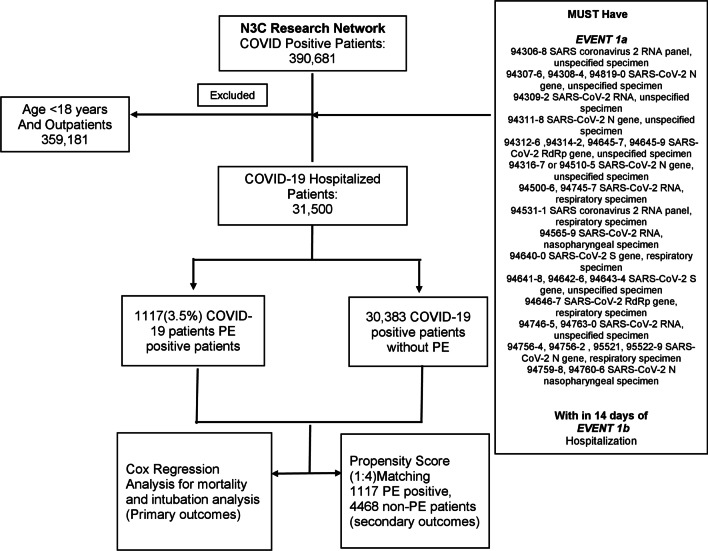
Using the National Collaborative COVID-19 retrospective cohort, a cohort of hospitalized COVID-19 patients was studied to compare 90-day mortality and intubation outcomes in patients with and without pulmonary embolism in a multivariable cox regression analysis. The secondary measured outcomes in 1:4 propensity score-matched analysis included length of stay, chest pain incidence, heart rate, history of pulmonary embolism or DVT, and admission laboratory parameters.
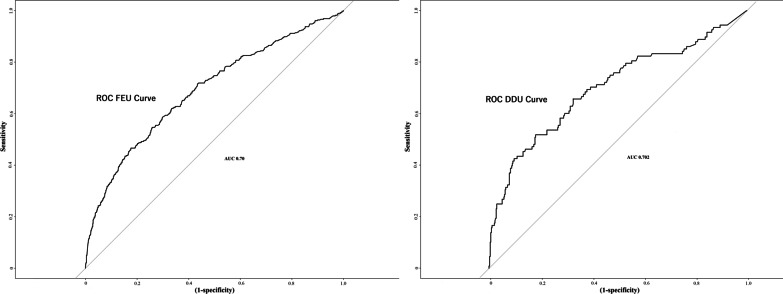
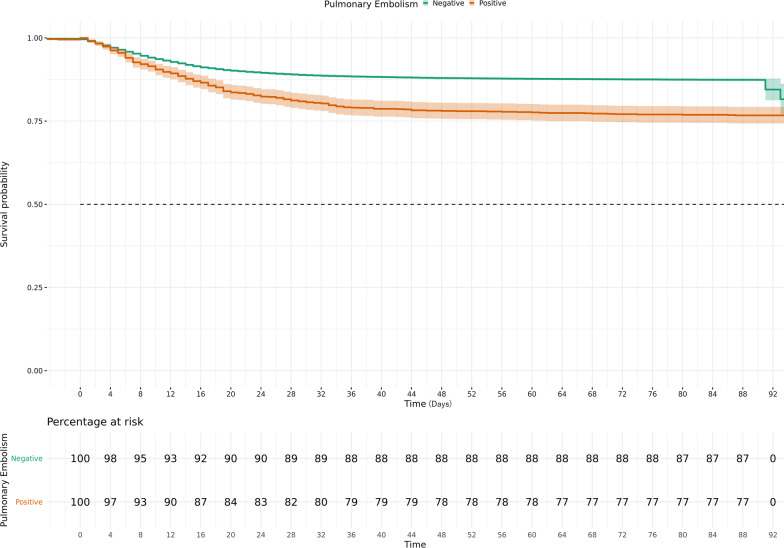
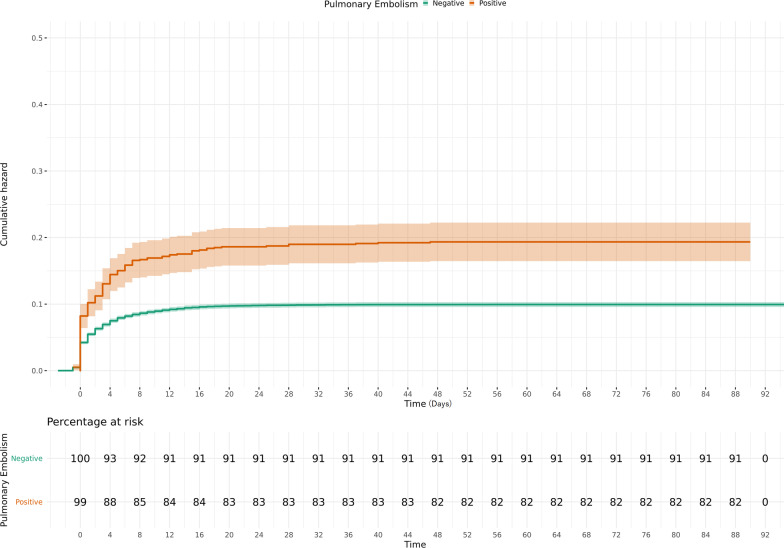
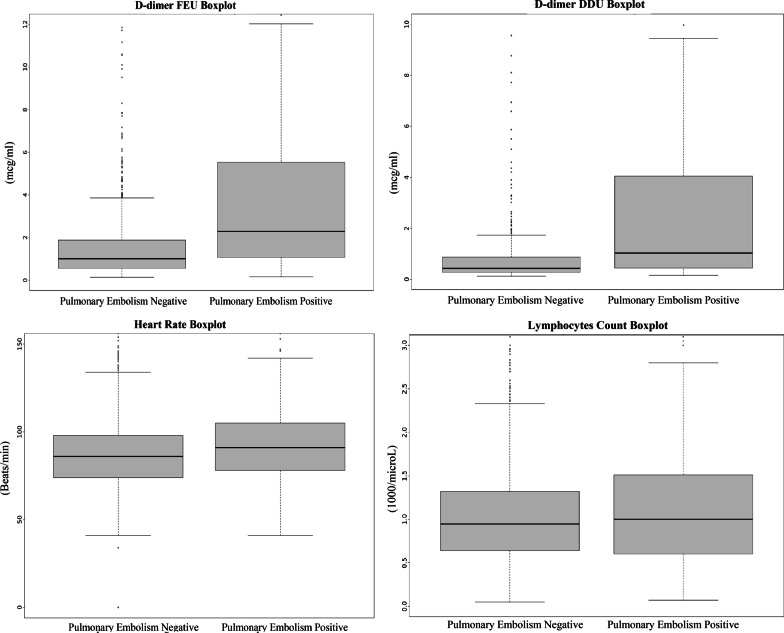
Among 31,500 hospitalized COVID-19 patients, 1117 (3.5%) patients were diagnosed with acute pulmonary embolism. Patients with acute pulmonary embolism were noted to have higher mortality (23.6% vs.12.8%; adjusted Hazard Ratio (aHR) = 1.36, 95% CI [1.20-1.55]), and intubation rates (17.6% vs. 9.3%, aHR = 1.38[1.18-1.61]). Pulmonary embolism patients had higher admission D-dimer FEU (Odds Ratio(OR) = 1.13; 95%CI [1.1-1.15]). As the D-dimer value increased, the specificity, positive predictive value, and accuracy of the test increased; however, sensitivity decreased (AUC 0.70). At cut-off D-dimer FEU 1.8 mcg/ml, the test had clinical utility (accuracy 70%) in predicting pulmonary embolism. Patients with acute pulmonary embolism had a higher incidence of chest pain and history of pulmonary embolism or deep vein thrombosis.
Acute pulmonary embolism is associated with worse mortality and morbidity outcomes in COVID-19. We present D-dimer as a predictive risk tool in the form of a clinical calculator for the diagnosis of acute pulmonary embolism in COVID-19.
研究 COVID-19 合并肺栓塞患者的死亡率是否更高,并评估 D-二聚体在预测急性肺栓塞中的作用。
利用全国合作 COVID-19 回顾性队列,对住院 COVID-19 患者队列进行研究,通过多变量 Cox 回归分析比较肺栓塞患者与非肺栓塞患者的 90 天死亡率和插管结局。在 1:4 倾向评分匹配分析中,次要测量结果包括住院时间、胸痛发生率、心率、肺栓塞或深静脉血栓形成病史以及入院实验室参数。
在 31500 例住院 COVID-19 患者中,1117 例(3.5%)患者被诊断为急性肺栓塞。肺栓塞患者的死亡率(23.6% vs. 12.8%;调整后的危险比[aHR]:1.36,95%可信区间[1.20-1.55])和插管率(17.6% vs. 9.3%,aHR:1.38[1.18-1.61])更高。肺栓塞患者入院时 D-二聚体 FEU 更高(优势比[OR]:1.13;95%可信区间[1.1-1.15])。随着 D-二聚体值的升高,该试验的特异性、阳性预测值和准确性均升高,而敏感性降低(AUC 0.70)。在截断值 D-二聚体 FEU 1.8 mcg/ml 时,该试验对预测肺栓塞具有临床实用性(准确率为 70%)。急性肺栓塞患者胸痛发生率和肺栓塞或深静脉血栓形成病史较高。
COVID-19 患者急性肺栓塞与死亡率和发病率增加相关。我们提出 D-二聚体作为一种预测风险工具,以 COVID-19 中急性肺栓塞的临床计算器形式呈现。