Zhang Miaoying, Sun Chengjun, Liu Renchao, Dong Chenbin, Cheng Ruoqian, Zheng Zhangqian, Wu Bingbing, Luo Feihong, Pei Zhou, Lu Wei
Department of Endocrinology and Inherited Metabolic Diseases, Children's Hospital of Fudan University, Shanghai, China.
The Molecular Genetic Diagnosis Center, Pediatrics Research Institute, Children's Hospital of Fudan University, Shanghai, China.
Transl Pediatr. 2020 Oct;9(5):653-661. doi: 10.21037/tp-20-243.
Beckwith-Wiedemann syndrome (BWS) is primarily caused by epigenetic errors. This study aimed to analyze the relationship between the epigenetic errors and phenotypes of BWS and to evaluate the efficacy of diagnosing BWS using patients' clinical characteristics.
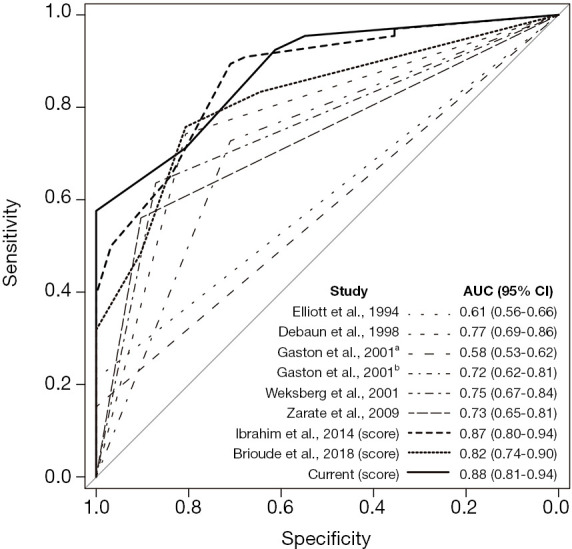
Patients clinically diagnosed with BWS were subjected to methylation-specific multiplex ligation-dependent probe amplification (MS-MLPA) for (epi)genotyping. The patients' clinical characteristics were analyzed and compared using regression models. The diagnostic efficacy of previous criteria and scoring systems was compared using area under the receiving operating curve (ROC).
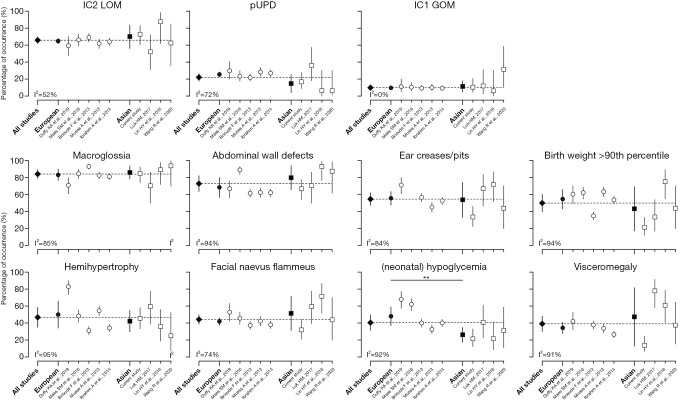
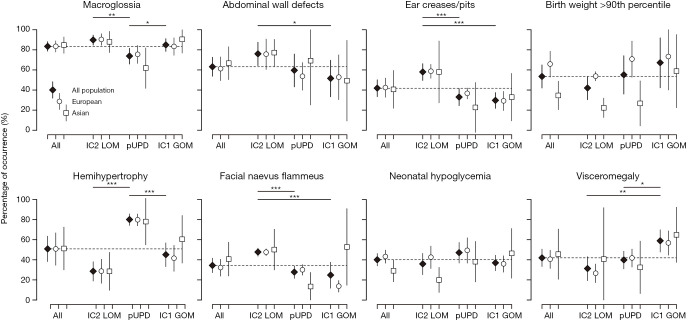
The most common clinical features observed in BWS patients were macroglossia (83.2%), abdominal wall defects (71.3%), and ear creases/pits (55.3%). Patients with the loss of methylation at imprinting control 2 (IC2-LOM) and gaining of methylation at imprinting control 1 (IC1-GOM) subtypes had significantly higher frequencies of ear creases/pits and facial nevus flammeus, and visceromegaly, respectively. Paternal uniparental isodisomy (pUPD) was characterized by significantly less macroglossia but more hemihypertrophy. The area under the curve (AUC) was comparably good in both recently developed scoring systems (0.87 for Ibrahim and 0.82 for Brioude.) and in the scoring system developed using the current cohort (0.88).
This study, which is the largest cohort study of BWS cases in China published to date, confirmed the diagnostic efficacy of a recently developed symptom-based BWS scoring system in a Chinese population. Significant differences exist between the phenotypes of BWS epigenetic subtypes; however, the pattern is similar between Asian and European populations.
贝克威思-维德曼综合征(BWS)主要由表观遗传错误引起。本研究旨在分析表观遗传错误与BWS表型之间的关系,并评估利用患者临床特征诊断BWS的有效性。
对临床诊断为BWS的患者进行甲基化特异性多重连接依赖探针扩增(MS-MLPA)以进行(表观)基因分型。使用回归模型分析和比较患者的临床特征。使用接受操作曲线(ROC)下面积比较先前标准和评分系统的诊断效能。
BWS患者中最常见的临床特征是巨舌(83.2%)、腹壁缺损(71.3%)和耳部褶皱/凹陷(55.3%)。印记控制区2甲基化缺失(IC2-LOM)和印记控制区1甲基化增加(IC1-GOM)亚型的患者耳部褶皱/凹陷、面部葡萄酒色斑和内脏肿大的发生率分别显著更高。父源单亲二体(pUPD)的特征是巨舌明显较少但半身肥大较多。最近开发的两种评分系统(易卜拉欣评分系统的曲线下面积为0.87,布里乌德评分系统的曲线下面积为0.82)以及使用当前队列开发的评分系统(曲线下面积为0.88)的诊断效能相当。
本研究是迄今为止中国发表的关于BWS病例的最大队列研究,证实了最近开发的基于症状的BWS评分系统在中国人群中的诊断效能。BWS表观遗传亚型的表型之间存在显著差异;然而,亚洲和欧洲人群之间的模式相似。