Jiang Yan, Zhao Yanfeng, Wang Qingliang, Chen Hao, Zhou Xiao
Department of Thoracic Surgery, Shanghai Pulmonary Hospital, Tongji University School of Medicine, Shanghai, China.
Ann Transl Med. 2020 Oct;8(20):1303. doi: 10.21037/atm-20-6653.
Chronic obstructive pulmonary disease (COPD) is a major cause of morbidity and mortality globally. Fine particulate matter (PM2.5) has been indicated to be a major detrimental risk factor for COPD by numerous epidemiological studies. Histone deacetylase 2 (HDAC2), a critical regulator of chromatin remodeling, plays a pivotal role in the development of COPD. However, the underlying mechanisms regarding the relationship between PM2.5 and HDAC2 in the pathogenesis of COPD have yet to be elucidated. In the present study, we aim to investigate the role and the underlying mechanism of HDAC2 in the development of PM2.5-induced COPD.
The effects of PM2.5 exposure on M2 macrophage polarization and the expression levels of HDAC2 were examined . The influence of HDAC2 deficiency on M2 macrophage polarization and the pathogenesis of COPD was investigated in a PM2.5-induced mouse model.
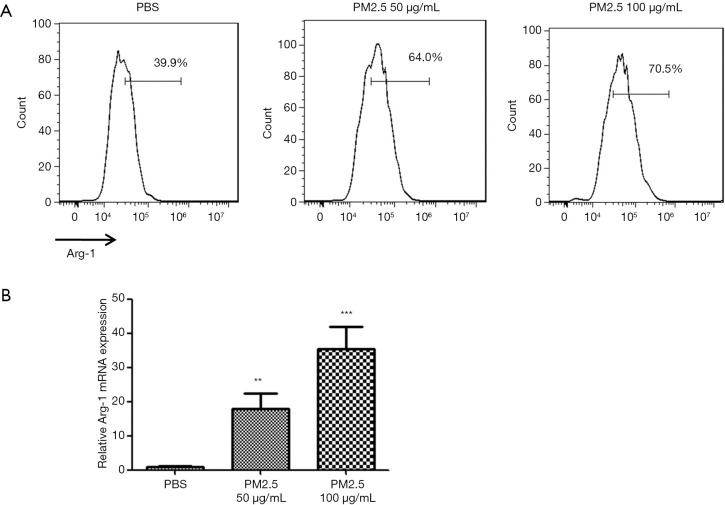
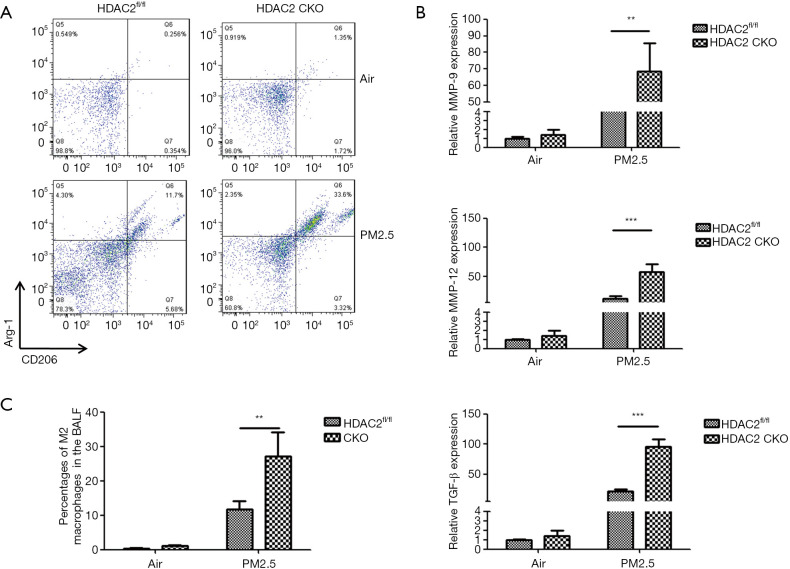
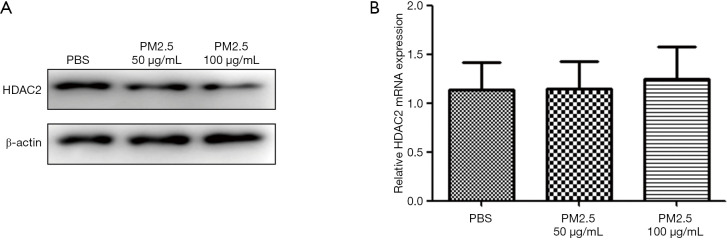
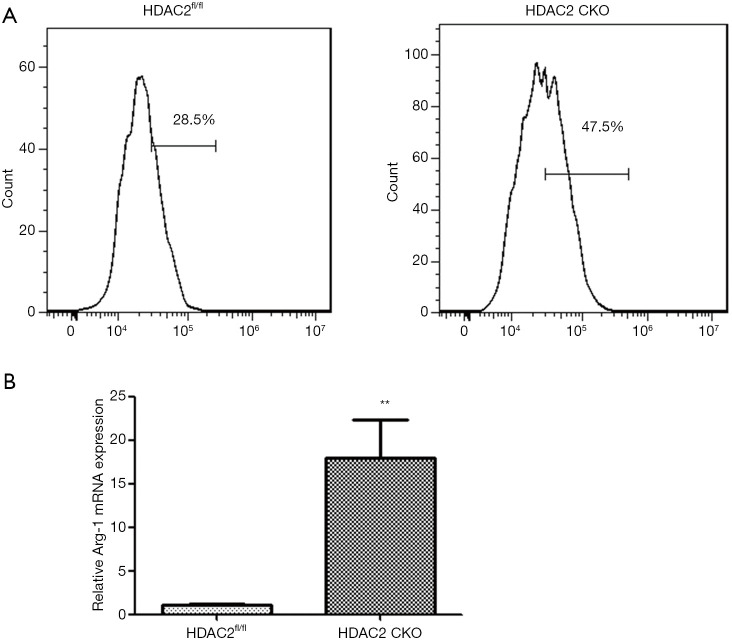
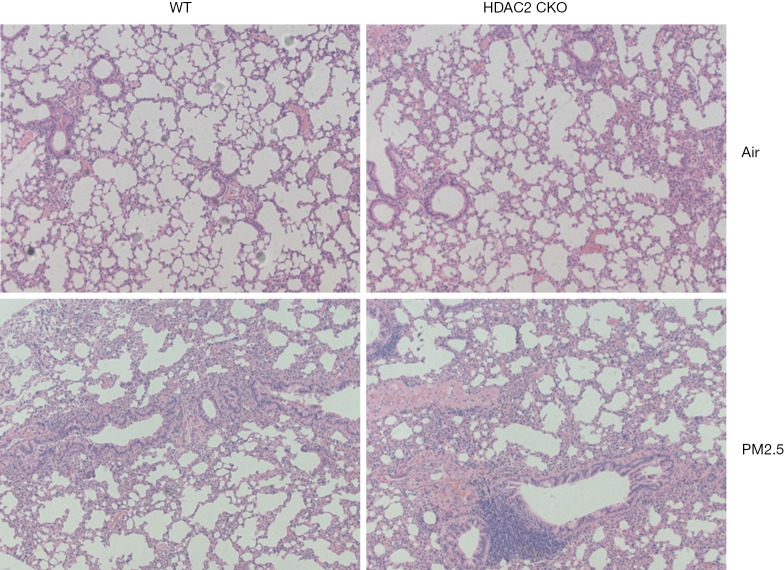
PM2.5 exposure down-regulated the protein level of HDAC2 and enhanced M2 macrophage polarization . In the COPD murine model, myeloid-specific deficiency of HDAC2 augmented PM2.5-induced M2 polarization of alveolar macrophages (AMs) and up-regulation of tumor necrosis factor (TGF)-β, matrix metallopeptidase (MMP)-9, and MMP-12 in lung tissue, which resulted in more prominent lung function deterioration, airspace enlargement, alveolar wall destruction, and airway remodeling, indicating a key role of HDAC2 in the pathogenesis of PM2.5-induced COPD.
PM2.5 facilitated M2 polarization by inhibiting HDAC2, leading to the development of COPD. Targeting of HDAC2 would provide a novel approach to prevent the development of PM2.5 exposure-induced COPD.
慢性阻塞性肺疾病(COPD)是全球发病和死亡的主要原因。众多流行病学研究表明,细颗粒物(PM2.5)是COPD的主要有害危险因素。组蛋白去乙酰化酶2(HDAC2)是染色质重塑的关键调节因子,在COPD的发展中起关键作用。然而,PM2.5与HDAC2在COPD发病机制中的潜在关系尚未阐明。在本研究中,我们旨在探讨HDAC2在PM2.5诱导的COPD发展中的作用及潜在机制。
检测PM2.5暴露对M2巨噬细胞极化和HDAC2表达水平的影响。在PM2.5诱导的小鼠模型中研究HDAC2缺乏对M2巨噬细胞极化和COPD发病机制的影响。
PM2.5暴露下调HDAC2蛋白水平并增强M2巨噬细胞极化。在COPD小鼠模型中,HDAC2的髓系特异性缺乏增强了PM2.5诱导的肺泡巨噬细胞(AM)的M2极化,并上调了肺组织中肿瘤坏死因子(TGF)-β、基质金属肽酶(MMP)-9和MMP-12的表达,导致更明显的肺功能恶化、气腔扩大、肺泡壁破坏和气道重塑,表明HDAC2在PM2.5诱导的COPD发病机制中起关键作用。
PM2.5通过抑制HDAC2促进M2极化,导致COPD的发展。靶向HDAC2将为预防PM2.5暴露诱导的COPD发展提供一种新方法。