Beard Timothy L, Michalsky Cathy, Candiotti Keith A, Rider Paul, Wase Linda, Habib Ashraf S, Demitrack Mark A, Fossler Michael J, Viscusi Eugene R
Department of Surgery and Clinical Research, Summit Medical Group, Bend Memorial Clinic, Bend, OR, USA.
Trevena, Inc., Chesterbrook, PA, USA.
Pain Ther. 2021 Jun;10(1):401-413. doi: 10.1007/s40122-020-00216-x. Epub 2020 Nov 18.
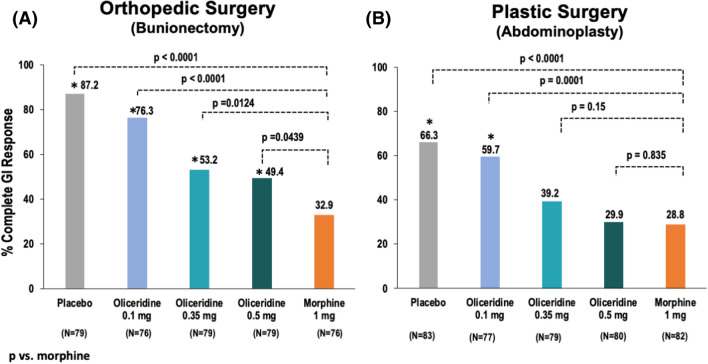
Use of parenteral opioids is a major risk factor for postoperative nausea and vomiting. Conventional opioids bind to µ-opioid receptors (MOR), stimulate both the G-protein signaling (achieving analgesia); and the β-arrestin pathway (associated with opioid-related adverse effects). Oliceridine, a next-generation IV opioid, is a G-protein selective MOR agonist, with limited recruitment of β-arrestin. In two randomized, placebo- and morphine-controlled phase 3 studies of patients with moderate-to-severe acute pain following bunionectomy or abdominoplasty, oliceridine at demand doses of 0.1, 0.35, and 0.5 mg provided rapid and sustained analgesia vs. placebo with favorable gastrointestinal (GI) tolerability. In this exploratory analysis, we utilized a clinical endpoint assessing gastrointestinal tolerability, "complete GI response" defined as the proportion of patients with no vomiting and no use of rescue antiemetic to characterize the GI tolerability profile of oliceridine vs. morphine.
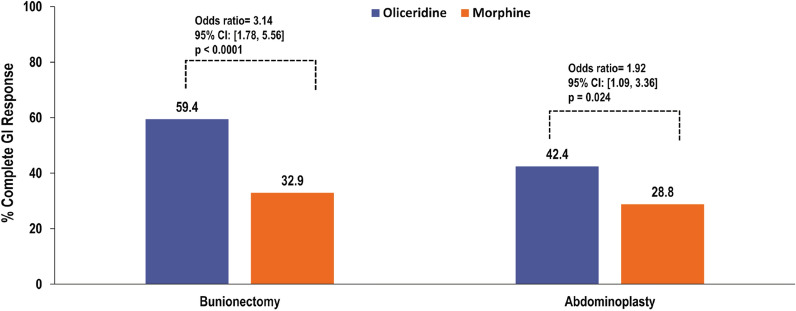
A logistic regression model was utilized to compare oliceridine (pooled regimens) vs. morphine, after controlling for analgesia (using the sum of pain intensity difference [SPID]-48/24 [bunionectomy/abdominoplasty] with pre-rescue scores carried forward for 6 h). This analysis excluded patients receiving placebo and was performed for each study separately and for pooled data from both studies.
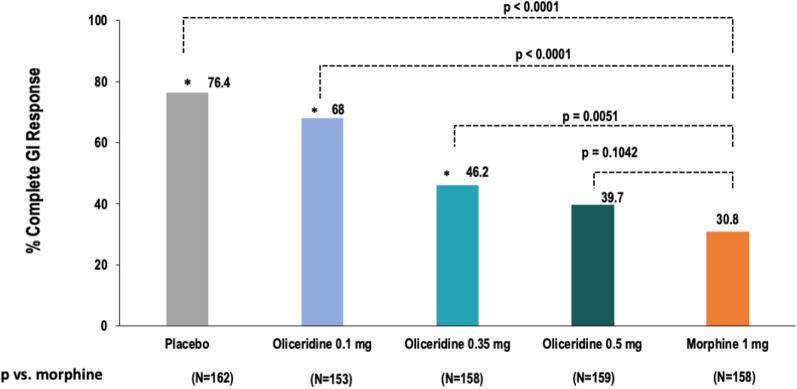
In the unadjusted analysis, a significantly greater proportion of patients in the placebo (76.4%), oliceridine 0.1 mg (68.0%), and 0.35 mg (46.2%) demand dose achieved complete GI response vs. morphine 1 mg (30.8%), p ≤ 0.005. In the adjusted analysis, after controlling for analgesia, the odds ratio of experiencing a complete GI response with oliceridine (pooled regimens) vs. morphine was 3.14 (95% CI: 1.78, 5.56; p < 0.0001) in bunionectomy study and 1.92 (95% CI: 1.09, 3.36; p = 0.024) in abdominoplasty study.
When controlled for the analgesic effects (constant SPID-48/24), the odds ratio for complete GI response was higher with oliceridine than morphine, suggesting better GI tolerability with oliceridine.
胃肠外使用阿片类药物是术后恶心呕吐的主要危险因素。传统阿片类药物与μ-阿片受体(MOR)结合,刺激G蛋白信号传导(实现镇痛)以及β-抑制蛋白途径(与阿片类药物相关的不良反应有关)。奥利替丁是一种新一代静脉用阿片类药物,是一种G蛋白选择性MOR激动剂,对β-抑制蛋白的募集有限。在两项针对拇囊炎切除术或腹部整形术后中重度急性疼痛患者的随机、安慰剂和吗啡对照的3期研究中,按需剂量为0.1、0.35和0.5mg的奥利替丁与安慰剂相比,能提供快速且持续的镇痛效果,胃肠道(GI)耐受性良好。在这项探索性分析中,我们采用了一个评估胃肠道耐受性的临床终点指标,即“完全胃肠道反应”,定义为未呕吐且未使用急救止吐药的患者比例,以描述奥利替丁与吗啡的胃肠道耐受性特征。
在控制镇痛效果后(使用疼痛强度差值总和[SPID]-48/24[拇囊炎切除术/腹部整形术],并将预急救评分提前6小时),采用逻辑回归模型比较奥利替丁(合并方案)与吗啡。该分析排除了接受安慰剂的患者,分别对每项研究以及两项研究的合并数据进行分析。
在未调整分析中,安慰剂组(76.4%)、0.1mg奥利替丁组(68.0%)和0.35mg奥利替丁组按需剂量的患者实现完全胃肠道反应的比例显著高于1mg吗啡组(30.8%),p≤0.005。在调整分析中,在控制镇痛效果后,拇囊炎切除术研究中,奥利替丁(合并方案)与吗啡相比出现完全胃肠道反应的优势比为3.14(第95百分位数可信区间:1.78,5.56;p<0.0001),腹部整形术研究中为1.92(第95百分位数可信区间:1.09,3.36;p=0.024)。
在控制镇痛效果(恒定的SPID-48/24)时,奥利替丁出现完全胃肠道反应的优势比高于吗啡,表明奥利替丁具有更好的胃肠道耐受性。