Song Zhao, Song Zhan, Ye Yuping
Shenzhen Institutes of Advanced Technology, Chinese Academy of Sciences, Shenzhen 518055, China.
University of Chinese Academy of Sciences, Beijing 100049, China.
Sensors (Basel). 2020 Nov 17;20(22):6564. doi: 10.3390/s20226564.
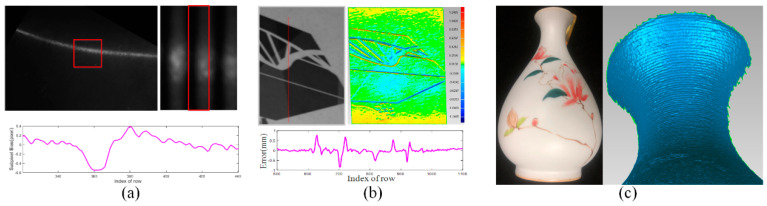
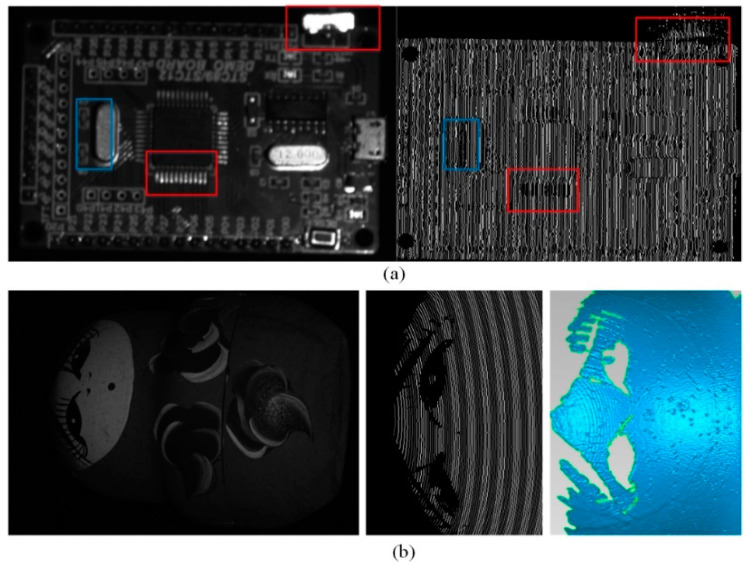
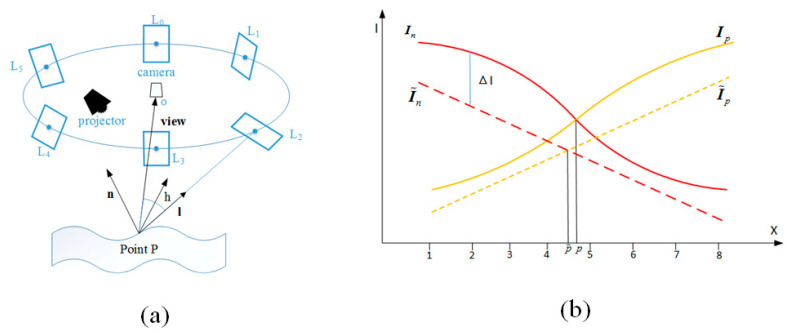
The acquisition of the geometry of general scenes is related to the interplay of surface geometry, material properties and illumination characteristics. Surface texture and non-Lambertian reflectance properties degrade the reconstruction results by structured light technique. Existing structured light techniques focus on different coding strategy and light sources to improve reconstruction accuracy. The hybrid system consisting of a structured light technique and photometric stereo combines the depth value with normal information to refine the reconstruction results. In this paper, we propose a novel hybrid system consisting of stripe-based structured light and photometric stereo. The effect of surface texture and non-Lambertian reflection on stripe detection is first concluded. Contrary to existing fusion strategy, we propose an improved method for stripe detection to reduce the above factor's effects on accuracy. The reconstruction problem for general scene comes down to using reflectance properties to improve the accuracy of stripe detection. Several objects, including checkerboard, metal-flat plane and free-form objects with complex reflectance properties, were reconstructed to validate our proposed method, which illustrates the effectiveness on improving the reconstruction accuracy of complex objects. The three-step phase-shifting algorithm was implemented and the reconstruction results were given and also compared with ours. In addition, our proposed framework provides a new feasible scheme for solving the ongoing problem of the reconstruction of complex objects with variant reflectance. The problem can be solved by subtracting the non-Lambertian components from the original grey values of stripe to improve the accuracy of stripe detection. In the future, based on stripe structured light technique, more general reflection models can be used to model different types of reflection properties of complex objects.
一般场景几何形状的获取与表面几何形状、材料属性和光照特性的相互作用有关。表面纹理和非朗伯反射特性会降低结构光技术的重建结果。现有的结构光技术专注于不同的编码策略和光源,以提高重建精度。由结构光技术和光度立体视觉组成的混合系统将深度值与法线信息相结合,以优化重建结果。在本文中,我们提出了一种由基于条纹的结构光和光度立体视觉组成的新型混合系统。首先总结了表面纹理和非朗伯反射对条纹检测的影响。与现有的融合策略相反,我们提出了一种改进的条纹检测方法,以减少上述因素对精度的影响。一般场景的重建问题归结为利用反射特性来提高条纹检测的精度。通过对包括棋盘格、金属平面和具有复杂反射特性的自由形状物体在内的多个物体进行重建,验证了我们提出的方法,该方法说明了在提高复杂物体重建精度方面的有效性。实现了三步相移算法,并给出了重建结果,并与我们的结果进行了比较。此外,我们提出的框架为解决具有可变反射率的复杂物体重建这一当前问题提供了一种新的可行方案。该问题可以通过从条纹的原始灰度值中减去非朗伯分量来提高条纹检测的精度来解决。未来,基于条纹结构光技术,可以使用更通用的反射模型来对复杂物体的不同类型反射特性进行建模。