Interdisciplinary Crohn Colitis Centre, Rhein-Main, Frankfurt/Main, Germany.
Justus-Liebig University, Giessen, Germany.
Adv Ther. 2021 Jan;38(1):660-677. doi: 10.1007/s12325-020-01553-1. Epub 2020 Nov 20.
Iron deficiency anemia (IDA) is a common complication of inflammatory bowel disease (IBD) and can result in reduced quality of life and increased healthcare costs. IDA is treated with iron supplementation, either with oral iron therapy (OI) or intravenous iron formulations, including ferric carboxymaltose (FCM), iron isomaltoside 1000 (IIM), and iron sucrose (IS). This analysis compared the cost-effectiveness of FCM versus IIM, IS, and OI in terms of additional cost per additional responder in Switzerland.
A health economic model was developed to assess the additional cost per additional responder, defined as normalization or an increase of at least 2 g/dL in hemoglobin levels, for FCM versus IIM, IS, and OI. To date, no single head-to-head trial comparing all therapies is available, and therefore relative efficacy data were taken from a published network meta-analysis. Costs of treatment were calculated in 2020 Swiss francs (CHF) using a microcosting approach, and included the costs of iron, healthcare professional time, and consumables. Costs are also presented in euros (EUR) based on an exchange rate of CHF 1 = EUR 0.94.
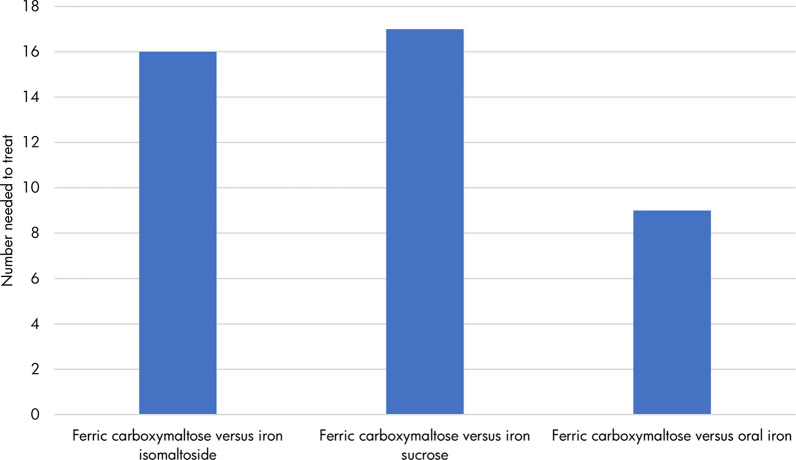
Response rates with FCM, IIM, IS, and OI were 81%, 74%, 75%, and 69%, respectively, with FCM projected to be the most effective treatment. FCM was associated with cost savings of CHF 24 (EUR 23) versus IIM and of CHF 147 (EUR 138) versus IS, and increased costs by CHF 345 (EUR 324) versus OI. Therefore FCM was considered dominant versus both IIM and IS, improving clinical outcomes with cost savings. FCM was associated with an incremental cost-effectiveness ratio of CHF 2970 (EUR 2792) per additional responder versus OI.
FCM was projected to be the most cost-effective intravenous iron therapy in Switzerland, increasing the number of responders and leading to cost savings for healthcare payers.
缺铁性贫血(IDA)是炎症性肠病(IBD)的常见并发症,可导致生活质量下降和医疗保健费用增加。IDA 的治疗方法是补充铁剂,包括口服铁治疗(OI)和静脉铁制剂,如羧基麦芽糖铁(FCM)、异麦芽糖铁 1000(IIM)和蔗糖铁(IS)。本分析比较了 FCM 与 IIM、IS 和 OI 在瑞士的额外成本效益,以每增加一个应答者的额外成本来衡量。
开发了一种健康经济学模型,以评估 FCM 与 IIM、IS 和 OI 相比,每增加一个应答者的额外成本,定义为血红蛋白水平正常化或至少增加 2g/dL。迄今为止,尚无比较所有治疗方法的头对头试验,因此相对疗效数据来自已发表的网络荟萃分析。使用微观成本法计算了 2020 年瑞士法郎(CHF)的治疗成本,并包括铁、医疗保健专业人员时间和消耗品的成本。还根据 CHF 1=EUR 0.94 的汇率以欧元(EUR)表示成本。
FCM、IIM、IS 和 OI 的应答率分别为 81%、74%、75%和 69%,FCM 被预测为最有效的治疗方法。FCM 与 IIM 相比节省了 CHF 24(EUR 23),与 IS 相比节省了 CHF 147(EUR 138),与 OI 相比增加了 CHF 345(EUR 324)的成本。因此,FCM 被认为与 IIM 和 IS 相比均具有优势,通过节省成本提高了临床疗效。FCM 与 OI 相比,增量成本效益比为 CHF 2970(EUR 2792)/每个额外应答者。
FCM 被预测为瑞士最具成本效益的静脉铁治疗方法,增加了应答者数量,并为医疗保健支付者节省了成本。