• 文献检索
  • 文档翻译
  • 深度研究
  • 学术资讯
  • Suppr Zotero 插件Zotero 插件
  • 邀请有礼
  • 套餐&价格
  • 历史记录
应用&插件
Suppr Zotero 插件Zotero 插件浏览器插件Mac 客户端Windows 客户端微信小程序
定价
高级版会员购买积分包购买API积分包
服务
文献检索文档翻译深度研究API 文档MCP 服务
关于我们
关于 Suppr公司介绍联系我们用户协议隐私条款
关注我们

Suppr 超能文献

核心技术专利:CN118964589B侵权必究
粤ICP备2023148730 号-1Suppr @ 2026

文献检索

告别复杂PubMed语法,用中文像聊天一样搜索,搜遍4000万医学文献。AI智能推荐,让科研检索更轻松。

立即免费搜索

文件翻译

保留排版,准确专业,支持PDF/Word/PPT等文件格式,支持 12+语言互译。

免费翻译文档

深度研究

AI帮你快速写综述,25分钟生成高质量综述,智能提取关键信息,辅助科研写作。

立即免费体验

认知行为疗法对颞下颌关节紊乱症患者运动恐惧及口腔健康相关生活质量的有效性:一项随机对照试验的研究方案

Effectiveness of cognitive behavioral therapy on kinesiophobia and oral health-related quality of life in patients with temporomandibular disorders, study protocol for a randomized controlled trial.

作者信息

Zhang Qi, Zhang Juan, Ran Wenjing, Yu Shuipeng, Jin Yingshu

机构信息

School of Nursing, Tianjin University of Traditional Chinese Medicine.

The TMJ Clinic, Stomatological Hospital of Tianjin Medical University.

出版信息

Medicine (Baltimore). 2020 Nov 20;99(47):e23295. doi: 10.1097/MD.0000000000023295.

DOI:10.1097/MD.0000000000023295
PMID:33217860
原文链接:https://pmc.ncbi.nlm.nih.gov/articles/PMC7676583/
Abstract

BACKGROUND

Temporomandibular disorders (TMD) is a common physical and psychological disease in dental department. Pain and mandibular limitation are the main reasons for patients to seek oral treatment. However, the presence of kinesiophobia, patients often catastrophize pain, so as to avoid mandibular movement, which seriously affects their quality of life. Cognitive behavioral therapy (CBT) has significant improvements in reducing kinesiophobia and quality of life in musculoskeletal disease, but has not been proved in TMD patients. The study aims to apply CBT on kinesiophobia and oral health related quality of life (OHRQOL) in TMD patients.

METHODS

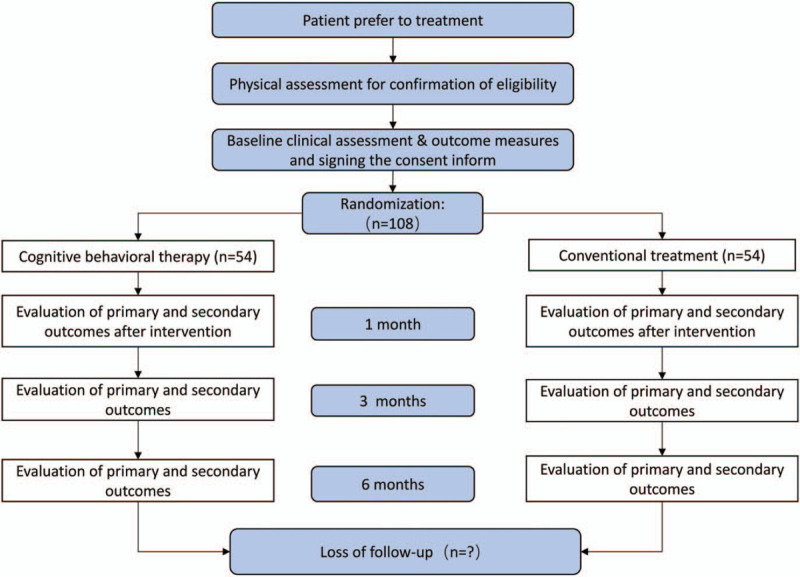
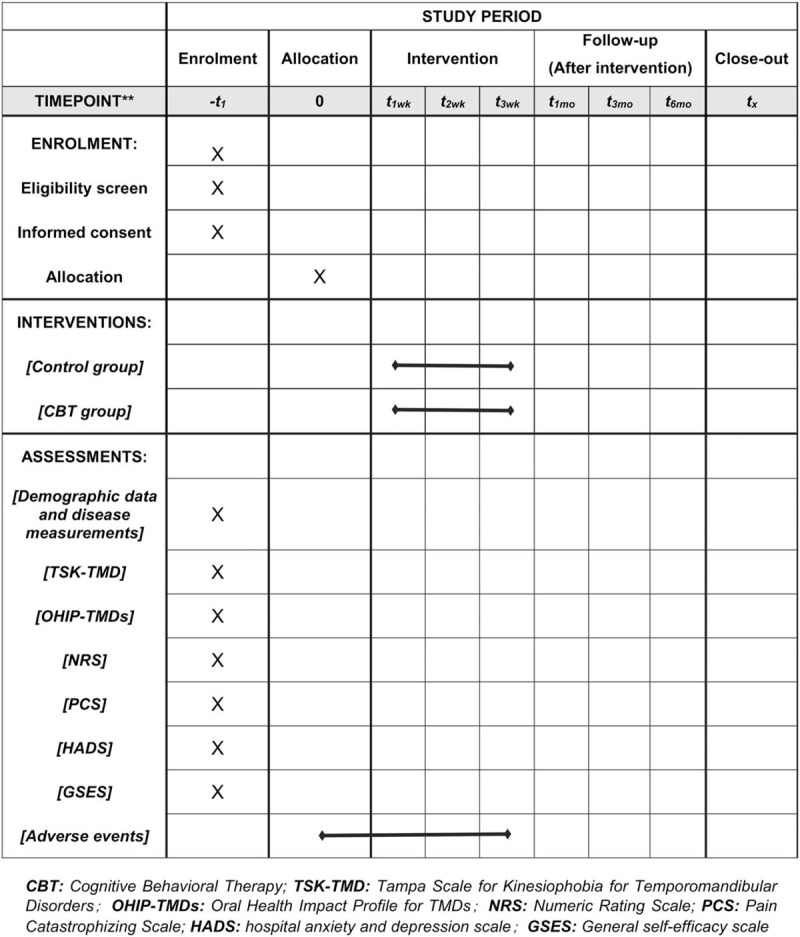
A total of 108 individuals between 18 and 65 years of age, who will be referred to the temporomandibular joint clinic of Stomatology Hospital of Tianjin Medical University in china will be randomized into 2 treatment arms. The control group will receive a conventional treatment, whereas the experiment group will receive CBT on the basis of the control group. The primary outcomes will be the kinesiophobia and OHRQOL, and will be measured by the Tampa scale for kinesiophobia for patients with Temporomandibular Disorders (TSK-TMD) and the Oral Health Impact Scale for patients with temporomandibular disorders (OHIP-TMDs), the secondary outcomes will be pain intensity measured by Numerical Rating Scale (NRS), pain catastrophizing measured by Pain Catastrophizing Scale (PCS), anxiety and depression measured by Hospital Anxiety and Depression Scale (HADS), and self-efficacy measured by General Self-Efficacy Scale (GSES).

DISCUSSION

This study protocol reported a randomized controlled trial which aimed at assessing the effectiveness of the CBT versus conventional treatment with TMD.

TRIAL REGISTRATION

Registered in the Chinese Clinical Trial Registration Center with the number ChiCTR2000038573. Registered 24 September 2020.

摘要

背景

颞下颌关节紊乱病(TMD)是口腔科常见的身心疾病。疼痛和下颌运动受限是患者寻求口腔治疗的主要原因。然而,由于存在运动恐惧,患者常将疼痛灾难化,从而避免下颌运动,严重影响其生活质量。认知行为疗法(CBT)在改善肌肉骨骼疾病患者的运动恐惧和生活质量方面有显著效果,但在TMD患者中尚未得到证实。本研究旨在将CBT应用于TMD患者的运动恐惧及口腔健康相关生活质量(OHRQOL)。

方法

共有108名年龄在18至65岁之间、将被转诊至中国天津医科大学口腔医院颞下颌关节门诊的患者被随机分为2个治疗组。对照组接受常规治疗,而实验组在对照组的基础上接受CBT。主要结局指标为运动恐惧和OHRQOL,分别采用颞下颌关节紊乱病患者运动恐惧坦帕量表(TSK-TMD)和颞下颌关节紊乱病患者口腔健康影响量表(OHIP-TMDs)进行测量;次要结局指标包括采用数字评定量表(NRS)测量的疼痛强度、采用疼痛灾难化量表(PCS)测量的疼痛灾难化、采用医院焦虑抑郁量表(HADS)测量的焦虑和抑郁,以及采用一般自我效能感量表(GSES)测量的自我效能感。

讨论

本研究方案报告了一项随机对照试验,旨在评估CBT对比TMD常规治疗的有效性。

试验注册

在中国临床试验注册中心注册,注册号为ChiCTR2000038573。于2020年9月24日注册。
https://cdn.ncbi.nlm.nih.gov/pmc/blobs/5a8e/7676583/20cd5328cb9e/medi-99-e23295-g002.jpg
https://cdn.ncbi.nlm.nih.gov/pmc/blobs/5a8e/7676583/00d7d750acc9/medi-99-e23295-g001.jpg
https://cdn.ncbi.nlm.nih.gov/pmc/blobs/5a8e/7676583/20cd5328cb9e/medi-99-e23295-g002.jpg
https://cdn.ncbi.nlm.nih.gov/pmc/blobs/5a8e/7676583/00d7d750acc9/medi-99-e23295-g001.jpg
https://cdn.ncbi.nlm.nih.gov/pmc/blobs/5a8e/7676583/20cd5328cb9e/medi-99-e23295-g002.jpg

相似文献

1
Effectiveness of cognitive behavioral therapy on kinesiophobia and oral health-related quality of life in patients with temporomandibular disorders, study protocol for a randomized controlled trial.认知行为疗法对颞下颌关节紊乱症患者运动恐惧及口腔健康相关生活质量的有效性:一项随机对照试验的研究方案
Medicine (Baltimore). 2020 Nov 20;99(47):e23295. doi: 10.1097/MD.0000000000023295.
2
Does a Program Based on Cognitive Behavioral Therapy Affect Kinesiophobia in Patients Following Total Knee Arthroplasty? A Randomized, Controlled Trial With a 6-Month Follow-Up.基于认知行为疗法的方案是否会影响全膝关节置换术后患者的运动恐惧?一项 6 个月随访的随机对照试验。
J Arthroplasty. 2018 Mar;33(3):704-710. doi: 10.1016/j.arth.2017.10.035. Epub 2017 Oct 28.
3
Effectiveness of a multicomponent treatment versus conventional treatment in patients with fibromyalgia: Study protocol.多组分治疗与传统治疗对纤维肌痛患者的疗效比较:研究方案。
Medicine (Baltimore). 2020 Jan;99(4):e18833. doi: 10.1097/MD.0000000000018833.
4
Characteristics of painful temporomandibular disorders and their influence on jaw functional limitation and oral health-related quality of life.颞下颌关节紊乱疼痛的特征及其对下颌功能受限和口腔健康相关生活质量的影响。
J Oral Rehabil. 2024 Sep;51(9):1748-1758. doi: 10.1111/joor.13768. Epub 2024 Jun 6.
5
Cross-cultural adaptation, reliability and construct validity of the Tampa scale for kinesiophobia for temporomandibular disorders (TSK/TMD-Br) into Brazilian Portuguese.跨文化调适、特鲁姆普关节痛恐惧量表(TSK/TMD-Br)用于评估颞下颌关节紊乱病的可靠性和结构效度的巴西葡萄牙语版本。
J Oral Rehabil. 2017 Jul;44(7):500-510. doi: 10.1111/joor.12515. Epub 2017 May 15.
6
Efficacy of Maitland joint mobilization technique on pain intensity, mouth opening, functional limitation, kinesiophobia, sleep quality and quality of life in temporomandibular joint dysfunction following bilateral cervicofacial burns.双侧头颈部烧伤后面神经麻痹性牙关紧闭患者行麦特兰德关节松动技术治疗的疗效:对疼痛强度、张口度、功能受限、运动恐惧、睡眠质量和生活质量的影响。
Burns. 2020 Dec;46(8):1880-1888. doi: 10.1016/j.burns.2020.05.017. Epub 2020 May 30.
7
The Tampa Scale for Kinesiophobia for Temporomandibular Disorders (TSK-TMD).颞下颌关节紊乱病的 Tampa 量表-运动恐惧(TSK-TMD)。
Pain. 2010 Sep;150(3):492-500. doi: 10.1016/j.pain.2010.06.002. Epub 2010 Jul 3.
8
Fear of Movement and Catastrophizing in Participants with Temporomandibular Disorders.颞下颌关节紊乱患者的运动恐惧和灾难化。
J Oral Facial Pain Headache. 2022;36(1):59-66. doi: 10.11607/ofph.3060.
9
Photobiomodulation therapy on the palliative care of temporomandibular disorder and orofacial/cervical skull pain: study protocol for a randomized controlled clinical trial.光生物调节疗法对颞下颌关节紊乱和口腔/颈部颅骨疼痛的姑息治疗:一项随机对照临床试验的研究方案。
Trials. 2019 Apr 6;20(1):200. doi: 10.1186/s13063-019-3294-7.
10
Efficacy of two brief cognitive-behavioral rehabilitation programs for chronic neck pain: results of a randomized controlled pilot study.两种简短认知行为康复方案治疗慢性颈痛的疗效:一项随机对照初步研究结果。
Eur J Phys Rehabil Med. 2018 Dec;54(6):890-899. doi: 10.23736/S1973-9087.18.05206-1. Epub 2018 Jul 6.

引用本文的文献

1
Efficacy of Cognitive Behavioral Therapy for Kinesiophobia: A Systematic Review and Meta-Analysis of Randomized Controlled Trials.认知行为疗法治疗运动恐惧的疗效:随机对照试验的系统评价和荟萃分析
J Pain Res. 2025 Aug 6;18:3919-3932. doi: 10.2147/JPR.S526179. eCollection 2025.
2
Temporomandibular disorders and mental health: shared etiologies and treatment approaches.颞下颌关节紊乱病与心理健康:共同的病因及治疗方法
J Headache Pain. 2025 Mar 12;26(1):52. doi: 10.1186/s10194-025-01985-6.
3
Evaluating the Impact of Various Treatment Modalities on the Chewing Efficiency of Anterior Disc Displacements of Temporomandibular Joint Disorder Cases: A Comparative Study.

本文引用的文献

1
Internet-Based Cognitive Behavioral Therapy in Stepped Care for Chronic Fatigue Syndrome: Randomized Noninferiority Trial.基于互联网的认知行为疗法用于慢性疲劳综合征的分级护理:随机非劣效性试验
J Med Internet Res. 2019 Mar 14;21(3):e11276. doi: 10.2196/11276.
2
Does a Program Based on Cognitive Behavioral Therapy Affect Kinesiophobia in Patients Following Total Knee Arthroplasty? A Randomized, Controlled Trial With a 6-Month Follow-Up.基于认知行为疗法的方案是否会影响全膝关节置换术后患者的运动恐惧?一项 6 个月随访的随机对照试验。
J Arthroplasty. 2018 Mar;33(3):704-710. doi: 10.1016/j.arth.2017.10.035. Epub 2017 Oct 28.
3
评估各种治疗方式对颞下颌关节紊乱病前盘移位患者咀嚼效率的影响:一项对比研究。
J Int Soc Prev Community Dent. 2024 Apr 29;14(2):136-143. doi: 10.4103/jispcd.jispcd_151_23. eCollection 2024 Mar-Apr.
4
The Relationship between Kinesiophobia, Emotional State, Functional State and Chronic Pain in Subjects with/without Temporomandibular Disorders.患有/未患有颞下颌关节紊乱症的受试者中,运动恐惧、情绪状态、功能状态与慢性疼痛之间的关系
J Clin Med. 2024 Feb 1;13(3):848. doi: 10.3390/jcm13030848.
Cognitive-Behavioral Therapy.
认知行为疗法。
Adv Exp Med Biol. 2017;1010:321-329. doi: 10.1007/978-981-10-5562-1_16.
4
Comparison Between Chronic Migraine and Temporomandibular Disorders in Pain-Related Disability and Fear-Avoidance Behaviors.慢性偏头痛与颞下颌关节紊乱症患者在疼痛相关残疾和恐惧逃避行为方面的比较。
Pain Med. 2017 Nov 1;18(11):2214-2223. doi: 10.1093/pm/pnx127.
5
Effective pain management in patients in hospital.医院患者的有效疼痛管理
Nurs Stand. 2017 Mar 15;31(29):42-46. doi: 10.7748/ns.2017.e10736.
6
Validation of the Tampa Scale for Kinesiophobia for Temporomandibular Disorders (TSK-TMD) in patients with painful TMD.颞下颌关节紊乱病(TMD)疼痛患者中颞下颌关节紊乱病运动恐惧坦帕量表(TSK-TMD)的验证
J Headache Pain. 2016 Dec;17(1):109. doi: 10.1186/s10194-016-0706-x. Epub 2016 Dec 5.
7
Chronic Temporomandibular Disorders: disability, pain intensity and fear of movement.慢性颞下颌关节紊乱病:残疾、疼痛强度与运动恐惧
J Headache Pain. 2016 Dec;17(1):103. doi: 10.1186/s10194-016-0690-1. Epub 2016 Nov 3.
8
SPIRIT 2013 Statement: defining standard protocol items for clinical trials.《SPIRIT 2013声明:临床试验标准方案项目的定义》
Rev Panam Salud Publica. 2015 Dec;38(6):506-14.
9
Using a CBT approach to manage low back pain.采用认知行为疗法来管理下背部疼痛。
Nurs Times. 2016;112(18):12-4.
10
Cognitive-Behavioral-Based Physical Therapy for Patients With Chronic Pain Undergoing Lumbar Spine Surgery: A Randomized Controlled Trial.基于认知行为疗法的物理治疗对接受腰椎手术的慢性疼痛患者的疗效:一项随机对照试验
J Pain. 2016 Jan;17(1):76-89. doi: 10.1016/j.jpain.2015.09.013. Epub 2015 Oct 23.