• 文献检索
  • 文档翻译
  • 深度研究
  • 学术资讯
  • Suppr Zotero 插件Zotero 插件
  • 邀请有礼
  • 套餐&价格
  • 历史记录
应用&插件
Suppr Zotero 插件Zotero 插件浏览器插件Mac 客户端Windows 客户端微信小程序
定价
高级版会员购买积分包购买API积分包
服务
文献检索文档翻译深度研究API 文档MCP 服务
关于我们
关于 Suppr公司介绍联系我们用户协议隐私条款
关注我们

Suppr 超能文献

核心技术专利:CN118964589B侵权必究
粤ICP备2023148730 号-1Suppr @ 2026

文献检索

告别复杂PubMed语法,用中文像聊天一样搜索,搜遍4000万医学文献。AI智能推荐,让科研检索更轻松。

立即免费搜索

文件翻译

保留排版,准确专业,支持PDF/Word/PPT等文件格式,支持 12+语言互译。

免费翻译文档

深度研究

AI帮你快速写综述,25分钟生成高质量综述,智能提取关键信息,辅助科研写作。

立即免费体验

基于互联网的认知行为疗法用于慢性疲劳综合征的分级护理:随机非劣效性试验

Internet-Based Cognitive Behavioral Therapy in Stepped Care for Chronic Fatigue Syndrome: Randomized Noninferiority Trial.

作者信息

Worm-Smeitink Margreet, Janse Anthonie, van Dam Arno, Evers Andrea, van der Vaart Rosalie, Wensing Michel, Knoop Hans

机构信息

Department of Medical Psychology, Radboud University Medical Center, Nijmegen, Netherlands.

Specialist Center for Complex Medically Unexplained Symptoms and Somatic Symptom Disorders, Dimence, Deventer, Netherlands.

出版信息

J Med Internet Res. 2019 Mar 14;21(3):e11276. doi: 10.2196/11276.

DOI:10.2196/11276
PMID:30869642
原文链接:https://pmc.ncbi.nlm.nih.gov/articles/PMC6437617/
Abstract

BACKGROUND

Internet-based cognitive behavioral therapy (I-CBT) leads to a reduction of fatigue severity and disability in adults with chronic fatigue syndrome (CFS). However, not all patients profit and it remains unclear how I-CBT is best embedded in the care of CFS patients.

OBJECTIVE

This study aimed to compare the efficacy of stepped care, using therapist-assisted I-CBT, followed by face-to-face (f2f) cognitive behavioral therapy (CBT) when needed, with f2f CBT (treatment as usual [TAU]) on fatigue severity. The secondary aim was to investigate treatment efficiency.

METHODS

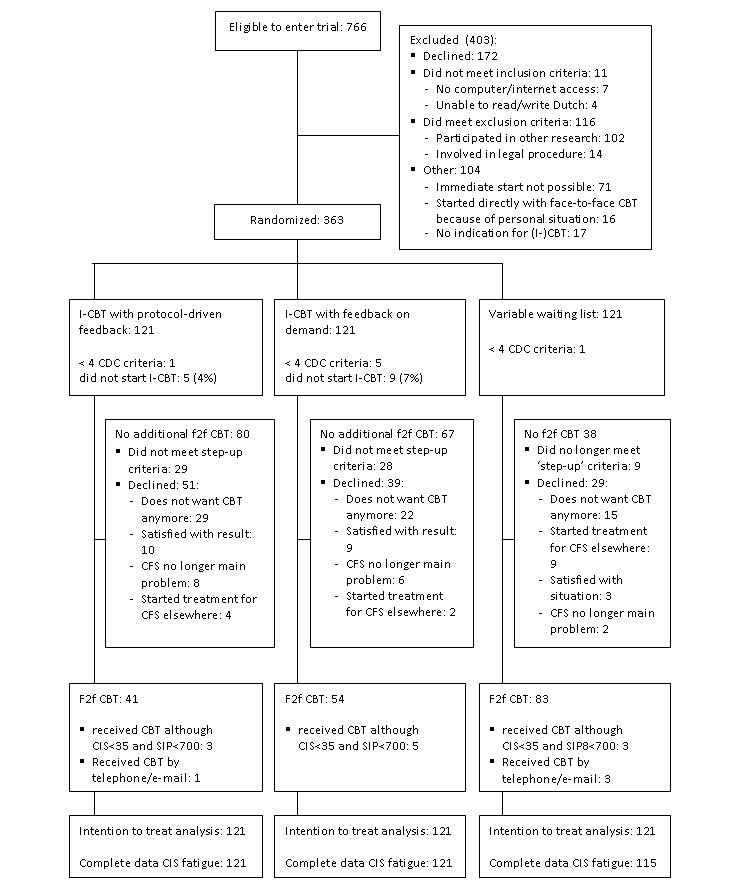
A total of 363 CFS patients were randomized to 1 of the 3 treatment arms (n=121). There were 2 stepped care conditions that differed in the therapists' feedback during I-CBT: prescheduled or on-demand. When still severely fatigued or disabled after I-CBT, the patients were offered f2f CBT. Noninferiority of both stepped care conditions to TAU was tested using analysis of covariance. The primary outcome was fatigue severity (Checklist Individual Strength). Disabilities (Sickness Impact Profile -8), physical functioning (Medical Outcomes Survey Short Form-36), psychological distress (Symptom Checklist-90), and proportion of patients with clinically significant improvement in fatigue were the secondary outcomes. The amount of invested therapist time was compared between stepped care and TAU. Exploratory comparisons were made between the stepped care conditions of invested therapist time and proportion of patients who continued with f2f CBT.

RESULTS

Noninferiority was indicated, as the upper boundary of the one-sided 98.75% CI of the difference in the change in fatigue severity between both forms of stepped care and TAU were below the noninferiority margin of 5.2 (4.25 and 3.81, respectively). The between-group differences on the secondary outcomes were also not significant (P=.11 to P=.79). Both stepped care formats required less therapist time than TAU (median 8 hours, 9 minutes and 7 hours, 25 minutes in stepped care vs 12 hours in TAU; P<.001). The difference in therapist time between both stepped care formats was not significant. Approximately half of the patients meeting step-up criteria for f2f CBT after I-CBT did not continue.

CONCLUSIONS

Stepped care, including I-CBT followed by f2f CBT when indicated, is noninferior to TAU of f2f CBT and requires less therapist time. I-CBT for CFS can be used as a first step in stepped care.

TRIAL REGISTRATION

Nederlands Trial Register NTR4809; http://www.trialregister.nl/trialreg/admin/rctview.asp?TC=4809 (Archived by WebCite at http://www.webcitation.org/74SWkw1V5).
https://cdn.ncbi.nlm.nih.gov/pmc/blobs/cb10/6437617/646b0ec430ee/jmir_v21i3e11276_fig1.jpg
摘要

背景

基于互联网的认知行为疗法(I-CBT)可减轻慢性疲劳综合征(CFS)成人患者的疲劳严重程度和残疾程度。然而,并非所有患者都能从中获益,目前尚不清楚如何将I-CBT最佳地融入CFS患者的护理中。

目的

本研究旨在比较阶梯式护理(使用治疗师辅助的I-CBT,必要时进行面对面(f2f)认知行为疗法(CBT))与f2f CBT(常规治疗[TAU])对疲劳严重程度的疗效。次要目的是调查治疗效率。

方法

总共363例CFS患者被随机分配到3个治疗组中的1组(n = 121)。有2种阶梯式护理条件,在I-CBT期间治疗师的反馈有所不同:预定或按需。在I-CBT后仍严重疲劳或残疾的患者可接受f2f CBT。使用协方差分析测试两种阶梯式护理条件相对于TAU的非劣效性。主要结局是疲劳严重程度(个人力量检查表)。残疾(疾病影响概况-8)、身体功能(医学结果调查简表-36)、心理困扰(症状清单-90)以及疲劳有临床显著改善的患者比例为次要结局。比较阶梯式护理和TAU之间投入的治疗师时间量。对投入的治疗师时间和继续接受f2f CBT的患者比例的阶梯式护理条件进行探索性比较。

结果

表明具有非劣效性,因为两种形式的阶梯式护理与TAU之间疲劳严重程度变化差异的单侧98.75%CI的上限低于非劣效界值5.2(分别为4.25和3.81)。次要结局的组间差异也不显著(P = 0.11至P = 0.79)。两种阶梯式护理形式所需的治疗师时间均少于TAU(阶梯式护理中位数为8小时9分钟和7小时25分钟,而TAU为12小时;P < 0.001)。两种阶梯式护理形式之间的治疗师时间差异不显著。I-CBT后符合f2f CBT升级标准的患者中约有一半没有继续接受治疗。

结论

阶梯式护理,包括I-CBT,必要时进行f2f CBT,不劣于f2f CBT的TAU,且所需治疗师时间更少。CFS的I-CBT可用作阶梯式护理的第一步。

试验注册

荷兰试验注册NTR4809;http://www.trialregister.nl/trialreg/admin/rctview.asp?TC = 4809(由WebCite存档于http://www.webcitation.org/74SWkw1V5)

相似文献

1
Internet-Based Cognitive Behavioral Therapy in Stepped Care for Chronic Fatigue Syndrome: Randomized Noninferiority Trial.基于互联网的认知行为疗法用于慢性疲劳综合征的分级护理:随机非劣效性试验
J Med Internet Res. 2019 Mar 14;21(3):e11276. doi: 10.2196/11276.
2
Internet-Based Cognitive Behavioral Therapy for Chronic Fatigue Syndrome Integrated in Routine Clinical Care: Implementation Study.基于互联网的慢性疲劳综合征认知行为疗法融入常规临床护理:实施研究
J Med Internet Res. 2019 Oct 10;21(10):e14037. doi: 10.2196/14037.
3
Testing the efficacy of web-based cognitive behavioural therapy for adult patients with chronic fatigue syndrome (CBIT): study protocol for a randomized controlled trial.测试基于网络的认知行为疗法对成年慢性疲劳综合征患者的疗效(CBIT):一项随机对照试验的研究方案
BMC Neurol. 2015 Aug 12;15:137. doi: 10.1186/s12883-015-0392-3.
4
Is the effect of cognitive behaviour therapy for chronic fatigue syndrome (ME/CFS) moderated by the presence of comorbid depressive symptoms? A meta-analysis of three treatment delivery formats.慢性疲劳综合征(肌痛性脑脊髓炎/慢性疲劳综合征,ME/CFS)的认知行为疗法效果是否会因共病抑郁症状的存在而受到调节?三种治疗方式的荟萃分析。
J Psychosom Res. 2024 Sep;184:111850. doi: 10.1016/j.jpsychores.2024.111850. Epub 2024 Jun 22.
5
Efficacy of web-based cognitive-behavioural therapy for chronic fatigue syndrome: randomised controlled trial.基于网络的认知行为疗法治疗慢性疲劳综合征的疗效:随机对照试验。
Br J Psychiatry. 2018 Feb;212(2):112-118. doi: 10.1192/bjp.2017.22.
6
Web-Based Cognitive Behavioral Therapy for Female Patients With Eating Disorders: Randomized Controlled Trial.针对饮食失调女性患者的基于网络的认知行为疗法:随机对照试验。
J Med Internet Res. 2015 Jun 18;17(6):e152. doi: 10.2196/jmir.3946.
7
Economic Evaluation of an Internet-Based Preventive Cognitive Therapy With Minimal Therapist Support for Recurrent Depression: Randomized Controlled Trial.一项针对复发性抑郁症的、在最少治疗师支持下基于互联网的预防性认知疗法的经济学评估:随机对照试验。
J Med Internet Res. 2018 Nov 26;20(11):e10437. doi: 10.2196/10437.
8
Investigating neural mechanisms of change of cognitive behavioural therapy for chronic fatigue syndrome: a randomized controlled trial.探究慢性疲劳综合征认知行为疗法改变的神经机制:一项随机对照试验。
BMC Psychiatry. 2015 Jul 3;15:144. doi: 10.1186/s12888-015-0515-9.
9
Therapist-Assisted Internet-Based Cognitive Behavioral Therapy Versus Progressive Relaxation in Obsessive-Compulsive Disorder: Randomized Controlled Trial.治疗师辅助的基于互联网的认知行为疗法与渐进性放松疗法治疗强迫症:随机对照试验
J Med Internet Res. 2018 Aug 8;20(8):e242. doi: 10.2196/jmir.9566.
10
Fatigue In Teenagers on the interNET--the FITNET Trial. A randomized clinical trial of web-based cognitive behavioural therapy for adolescents with chronic fatigue syndrome: study protocol. [ISRCTN59878666].青少年互联网疲劳症(FITNET)试验。一项基于网络的认知行为疗法治疗青少年慢性疲劳综合征的随机临床试验:研究方案。[ISRCTN59878666]。
BMC Neurol. 2011 Feb 19;11:23. doi: 10.1186/1471-2377-11-23.

引用本文的文献

1
User Experiences Among Patients and Health Care Professionals Who Participated in a Randomized Controlled Trial of E-nergEYEze, a Vision-Specific eHealth Intervention to Reduce Fatigue in Adults With Visual Impairment: Mixed Methods Study.参与E-nergEYEze随机对照试验的患者和医疗保健专业人员的体验:一项混合方法研究,E-nergEYEze是一种针对视力障碍成年人的特定视力电子健康干预措施,用于减轻疲劳。
JMIR Form Res. 2025 Aug 7;9:e53080. doi: 10.2196/53080.
2
Effectiveness of mindfulness-based online therapy or internet-delivered cognitive behavioral therapy compared with treatment as usual among patients with persistent somatic symptoms: Protocol for a randomized controlled trial.基于正念的在线治疗或互联网提供的认知行为疗法与常规治疗相比对持续性躯体症状患者的有效性:一项随机对照试验方案
PLoS One. 2025 Feb 12;20(2):e0316169. doi: 10.1371/journal.pone.0316169. eCollection 2025.
3

本文引用的文献

1
Efficacy of web-based cognitive-behavioural therapy for chronic fatigue syndrome: randomised controlled trial.基于网络的认知行为疗法治疗慢性疲劳综合征的疗效:随机对照试验。
Br J Psychiatry. 2018 Feb;212(2):112-118. doi: 10.1192/bjp.2017.22.
2
Transparency about the outcomes of mental health services (IAPT approach): an analysis of public data.精神卫生服务结果的透明度(IAPT 方法):公共数据分析。
Lancet. 2018 Feb 17;391(10121):679-686. doi: 10.1016/S0140-6736(17)32133-5. Epub 2017 Dec 7.
3
Internet-based vs. face-to-face cognitive behavior therapy for psychiatric and somatic disorders: an updated systematic review and meta-analysis.
Is Kinesiophobia Associated With Quality of Life, Level of Physical Activity, and Function in Older Adults With Knee Osteoarthritis?恐动症与老年膝骨关节炎患者的生活质量、身体活动水平及功能是否相关?
Clin Orthop Relat Res. 2025 Apr 1;483(4):667-676. doi: 10.1097/CORR.0000000000003278. Epub 2024 Oct 9.
4
Efficacy and Acceptance of Cognitive Behavioral Therapy in Adults with Chronic Fatigue Syndrome: A Meta-analysis.认知行为疗法治疗慢性疲劳综合征成人患者的疗效和可接受性:一项荟萃分析。
Int J Behav Med. 2024 Dec;31(6):895-910. doi: 10.1007/s12529-023-10254-2. Epub 2024 Jan 16.
5
Response Shift After Cognitive Behavioral Therapy Targeting Severe Fatigue: Explorative Analysis of Three Randomized Controlled Trials.针对严重疲劳的认知行为疗法后的反应转移:三项随机对照试验的探索性分析。
Int J Behav Med. 2023 Aug;30(4):473-485. doi: 10.1007/s12529-022-10111-8. Epub 2022 Jul 22.
6
Effectiveness of Internet-Based Cognitive Behavior Therapy (Fatigue in Teenagers on the Internet) for Adolescents With Chronic Fatigue Syndrome in Routine Clinical Care: Observational Study.基于互联网的认知行为疗法(互联网上青少年疲劳)对常规临床护理中慢性疲劳综合征青少年的疗效:观察性研究。
J Med Internet Res. 2021 Aug 13;23(8):e24839. doi: 10.2196/24839.
7
Impact of COVID-19 Pandemic Burnout on Cardiovascular Risk in Healthcare Professionals Study Protocol: A Multicenter Exploratory Longitudinal Study.COVID-19大流行倦怠对医护人员心血管风险的影响研究方案:一项多中心探索性纵向研究
Front Med (Lausanne). 2020 Dec 22;7:571057. doi: 10.3389/fmed.2020.571057. eCollection 2020.
8
Effectiveness of cognitive behavioral therapy on kinesiophobia and oral health-related quality of life in patients with temporomandibular disorders, study protocol for a randomized controlled trial.认知行为疗法对颞下颌关节紊乱症患者运动恐惧及口腔健康相关生活质量的有效性:一项随机对照试验的研究方案
Medicine (Baltimore). 2020 Nov 20;99(47):e23295. doi: 10.1097/MD.0000000000023295.
9
Mobile Health Usage, Preferences, Barriers, and eHealth Literacy in Rheumatology: Patient Survey Study.移动医疗的使用、偏好、障碍和风湿病患者的电子健康素养:患者调查研究。
JMIR Mhealth Uhealth. 2020 Aug 12;8(8):e19661. doi: 10.2196/19661.
10
Implementing guided ICBT for chronic pain and fatigue: A qualitative evaluation among therapists and managers.实施针对慢性疼痛和疲劳的指导性互联网认知行为疗法:治疗师和管理人员的定性评估
Internet Interv. 2019 Oct 31;18:100290. doi: 10.1016/j.invent.2019.100290. eCollection 2019 Dec.
基于互联网的与面对面的认知行为疗法治疗精神和躯体障碍:一项更新的系统评价和荟萃分析。
Cogn Behav Ther. 2018 Jan;47(1):1-18. doi: 10.1080/16506073.2017.1401115. Epub 2017 Dec 7.
4
Blending Face-to-Face and Internet-Based Interventions for the Treatment of Mental Disorders in Adults: Systematic Review.融合面对面和基于互联网的干预措施治疗成人精神障碍:系统评价
J Med Internet Res. 2017 Sep 15;19(9):e306. doi: 10.2196/jmir.6588.
5
The assessment of fatigue: Psychometric qualities and norms for the Checklist individual strength.疲劳评估:个人力量清单的心理测量学特性与常模。
J Psychosom Res. 2017 Jul;98:40-46. doi: 10.1016/j.jpsychores.2017.05.007. Epub 2017 May 8.
6
Guided Self-Help for Patients with Chronic Fatigue Syndrome Prior to Starting Cognitive Behavioural Therapy: a Cohort Study.慢性疲劳综合征患者在开始认知行为疗法之前的自助指导:一项队列研究。
Behav Cogn Psychother. 2017 Sep;45(5):448-466. doi: 10.1017/S135246581700025X. Epub 2017 May 5.
7
Cognitive behaviour therapy for chronic fatigue syndrome: Differences in treatment outcome between a tertiary treatment centre in the United Kingdom and the Netherlands.慢性疲劳综合征的认知行为疗法:英国和荷兰一家三级治疗中心的治疗效果差异。
J Psychosom Res. 2016 Aug;87:43-9. doi: 10.1016/j.jpsychores.2016.06.006. Epub 2016 Jun 11.
8
The Efficacy and Cost-Effectiveness of Stepped Care Prevention and Treatment for Depressive and/or Anxiety Disorders: A Systematic Review and Meta-Analysis.阶梯式护理预防和治疗抑郁和/或焦虑障碍的疗效和成本效益:系统评价和荟萃分析。
Sci Rep. 2016 Jul 5;6:29281. doi: 10.1038/srep29281.
9
Stepped Care Versus Direct Face-to-Face Cognitive Behavior Therapy for Social Anxiety Disorder and Panic Disorder: A Randomized Effectiveness Trial.阶梯式护理与直接面对面认知行为疗法治疗社交焦虑障碍和惊恐障碍:一项随机有效性试验。
Behav Ther. 2016 Mar;47(2):166-83. doi: 10.1016/j.beth.2015.10.004. Epub 2015 Oct 28.
10
Internet-delivered cognitive behavioural therapy in the treatment of psychiatric illness.通过互联网提供的认知行为疗法治疗精神疾病。
CMAJ. 2016 Mar 1;188(4):263-272. doi: 10.1503/cmaj.150007. Epub 2015 Nov 2.