Departamento de Ciencias Farmacéuticas y de La Salud, Facultad de Farmacia, Universidad San Pablo-CEU, CEU Universities, Urbanización Montepríncipe, 28925, Alcorcón, Madrid, Spain.
Departamento de Química y Bioquímica, Facultad de Farmacia, Universidad San Pablo-CEU, CEU Universities, Urbanización Montepríncipe, 28925, Alcorcón, Madrid, Spain.
Sci Rep. 2020 Nov 20;10(1):20259. doi: 10.1038/s41598-020-76415-5.
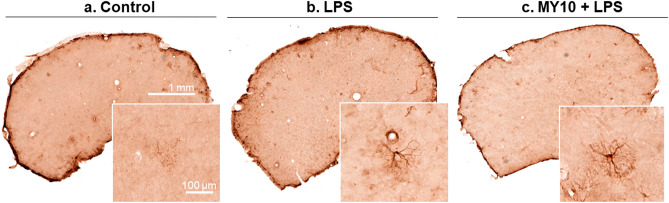
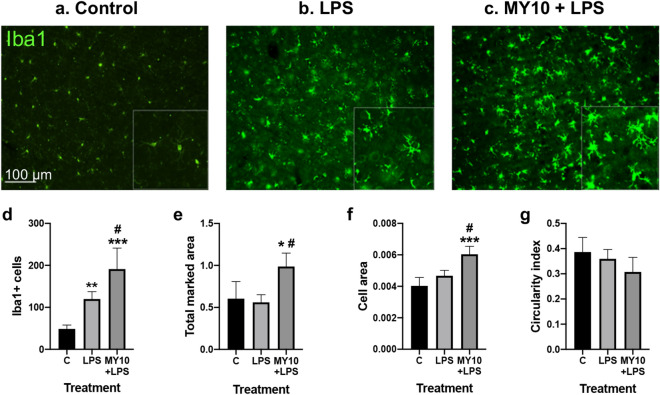
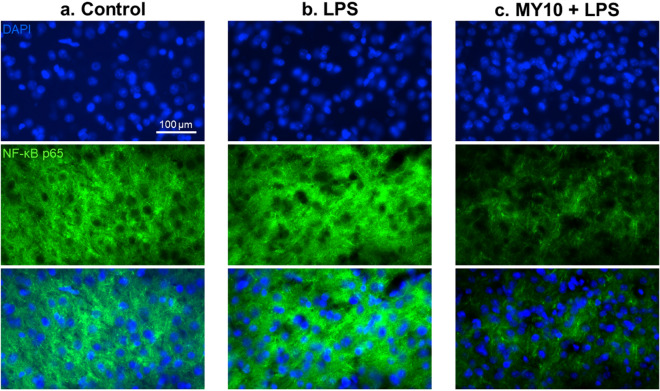
Pleiotrophin (PTN) is a cytokine that is upregulated in different neuroinflammatory disorders. Using mice with transgenic PTN overexpression in the brain (Ptn-Tg), we have found a positive correlation between iNos and Tnfα mRNA and Ptn mRNA levels in the prefrontal cortex (PFC) of LPS-treated mice. PTN is an inhibitor of Receptor Protein Tyrosine Phosphatase (RPTP) β/ζ, which is mainly expressed in the central nervous system. We aimed to test if RPTPβ/ζ is involved in the modulation of neuroinflammatory responses using specific inhibitors of RPTPβ/ζ (MY10 and MY33-3). Treatment with MY10 potentiated LPS-induced microglial responses in the mouse PFC. Surprisingly, MY10 caused a decrease in LPS-induced NF-κB p65 expression, suggesting that RPTPβ/ζ may be involved in a novel mechanism of potentiation of microglial activation independent of the NF-κB p65 pathway. MY33-3 and MY10 limited LPS-induced nitrites production and iNos increases in BV2 microglial cells. SH-SY5Y neuronal cells were treated with the conditioned media from MY10/LPS-treated BV2 cells. Conditioned media from non-stimulated and from LPS-stimulated BV2 cells increased the viability of SH-SY5Y cultures. RPTPβ/ζ inhibition in microglial cells disrupted this neurotrophic effect of microglia, suggesting that RPTPβ/ζ plays a role in the neurotrophic phenotype of microglia and in microglia-neuron communication.
多效蛋白(PTN)是一种细胞因子,在多种神经炎症性疾病中上调。使用脑中转基因过表达 PTN 的小鼠(Ptn-Tg),我们发现 LPS 处理的小鼠前额叶皮层(PFC)中 iNos 和 Tnfα mRNA 与 Ptn mRNA 水平之间存在正相关。PTN 是受体蛋白酪氨酸磷酸酶(RPTP)β/ζ的抑制剂,主要表达于中枢神经系统。我们旨在使用 RPTPβ/ζ 的特异性抑制剂(MY10 和 MY33-3)测试 RPTPβ/ζ 是否参与神经炎症反应的调节。MY10 处理增强了 LPS 诱导的小鼠 PFC 中小胶质细胞的反应。令人惊讶的是,MY10 导致 LPS 诱导的 NF-κB p65 表达减少,表明 RPTPβ/ζ 可能参与了一种独立于 NF-κB p65 途径的新型小胶质细胞激活增强机制。MY33-3 和 MY10 限制了 LPS 诱导的 BV2 小胶质细胞中硝酸盐的产生和 iNos 的增加。用来自 MY10/LPS 处理的 BV2 细胞的条件培养基处理 SH-SY5Y 神经元细胞。非刺激和 LPS 刺激的 BV2 细胞的条件培养基增加了 SH-SY5Y 培养物的活力。微胶质细胞中 RPTPβ/ζ 的抑制破坏了微胶质细胞的这种神经营养作用,表明 RPTPβ/ζ 在微胶质细胞的神经营养表型和微胶质细胞-神经元通讯中发挥作用。