Groningen Institute for Evolutionary Life Sciences, University of Groningen, Groningen, The Netherlands.
The Florey Institute of Neuroscience and Mental Health, Parkville, VIC, Australia.
Sleep. 2021 Apr 9;44(4). doi: 10.1093/sleep/zsaa244.
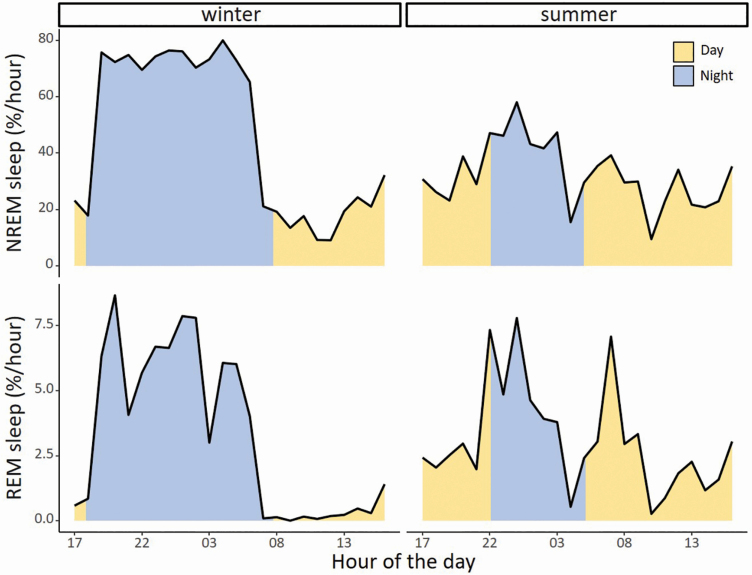
Sleep is a behavioral and physiological state that is thought to serve important functions. Many animals go through phases in the annual cycle where sleep time might be limited, for example, during the migration and breeding phases. This leads to the question whether there are seasonal changes in sleep homeostasis. Using electroencephalogram (EEG) data loggers, we measured sleep in summer and winter in 13 barnacle geese (Branta leucopsis) under semi-natural conditions. During both seasons, we examined the homeostatic regulation of sleep by depriving the birds of sleep for 4 and 8 h after sunset. In winter, barnacle geese showed a clear diurnal rhythm in sleep and wakefulness. In summer, this rhythm was less pronounced, with sleep being spread out over the 24-h cycle. On average, the geese slept 1.5 h less per day in summer compared with winter. In both seasons, the amount of NREM sleep was additionally affected by the lunar cycle, with 2 h NREM sleep less during full moon compared to new moon. During summer, the geese responded to 4 and 8 h of sleep deprivation with a compensatory increase in NREM sleep time. In winter, this homeostatic response was absent. Overall, sleep deprivation only resulted in minor changes in the spectral composition of the sleep EEG. In conclusion, barnacle geese display season-dependent homeostatic regulation of sleep. These results demonstrate that sleep homeostasis is not a rigid phenomenon and suggest that some species may tolerate sleep loss under certain conditions or during certain periods of the year.
睡眠是一种行为和生理状态,被认为具有重要的功能。许多动物在年度周期中会经历睡眠时间可能受限的阶段,例如在迁徙和繁殖阶段。这就引出了一个问题,即睡眠的稳态是否会随季节而变化。我们使用脑电图 (EEG) 数据记录仪,在半自然条件下测量了 13 只斑头雁 (Branta leucopsis) 在夏季和冬季的睡眠情况。在这两个季节中,我们通过在日落后剥夺鸟类 4 小时和 8 小时的睡眠来检查睡眠的稳态调节。在冬季,斑头雁表现出明显的昼夜节律性睡眠和清醒。在夏季,这种节律性不那么明显,睡眠分布在 24 小时周期内。平均而言,夏季斑头雁的睡眠时间比冬季少 1.5 小时。在这两个季节中,非快速眼动 (NREM) 睡眠时间还受到月相的影响,满月时的 NREM 睡眠时间比新月时少 2 小时。在夏季,斑头雁对 4 小时和 8 小时的睡眠剥夺做出反应,NREM 睡眠时间会相应增加。在冬季,这种稳态反应不存在。总的来说,睡眠剥夺只会导致睡眠 EEG 光谱组成的微小变化。总之,斑头雁表现出依赖季节的睡眠稳态调节。这些结果表明,睡眠的稳态不是一个僵化的现象,并表明某些物种在某些条件下或在一年中的某些时期可能能够耐受睡眠不足。