Department of Psychiatry, University of Wisconsin, Madison 6001 Research Park Blvd, Madison, WI 53719, USA.
BMC Neurosci. 2010 Jul 29;11:87. doi: 10.1186/1471-2202-11-87.
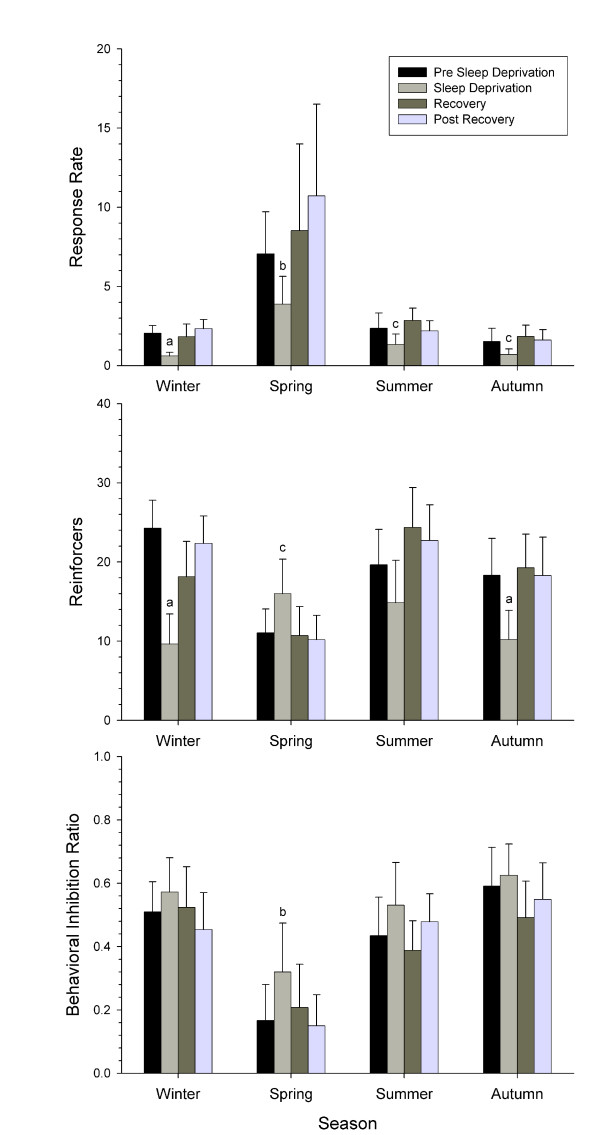
We have previously shown that the White-crowned Sparrow (WCS) decreases sleep by 60% during a period of migratory restlessness relative to a non-migratory period when housed in a 12 h light: 12 h dark cycle. Despite this sleep reduction, accuracy of operant performance was not impaired, and in fact rates of responding were elevated during the migratory period, effects opposite to those routinely observed following enforced sleep deprivation. To determine whether the previously observed increases in operant responding were due to improved performance or to the effects of migration on activity level, here we assessed operant performance using a task in which optimal performance depends on the bird's ability to withhold a response for a fixed interval of time (differential-reinforcement-of-low-rate-behavior, or DRL); elevated response rates ultimately impair performance by decreasing access to food reward. To determine the influence of seasonal changes in day length on sleep and behavioral patterns, we recorded sleep and assessed operant performance across 4 distinct seasons (winter, spring, summer and fall) under a changing photoperiod.
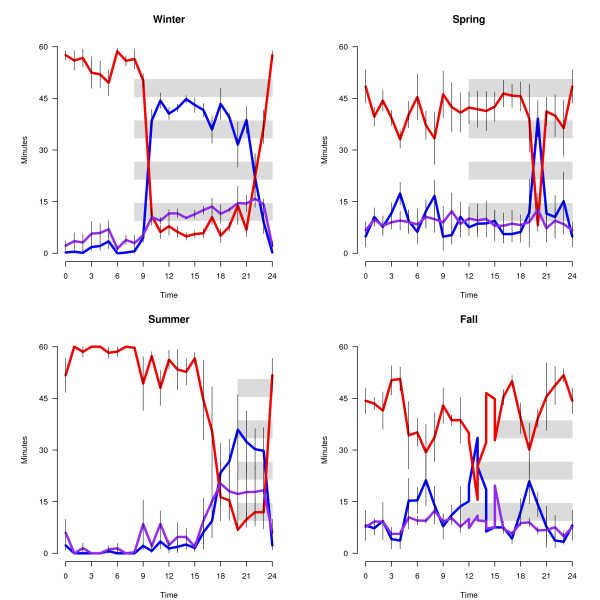
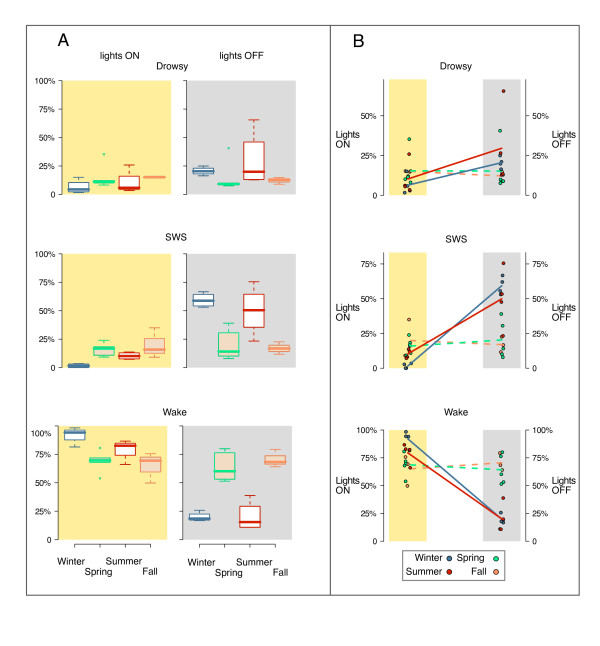
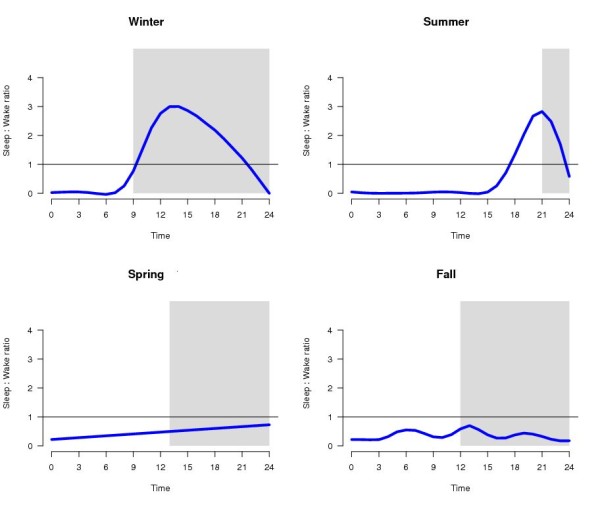
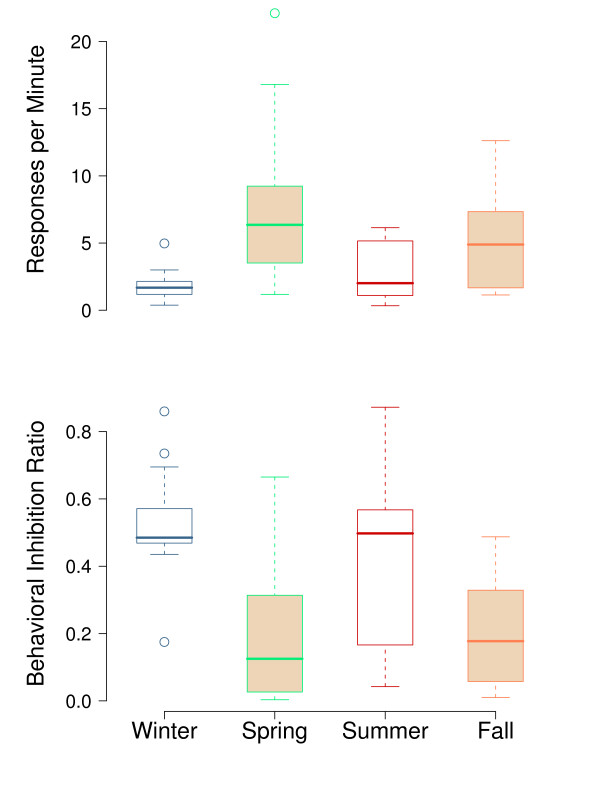
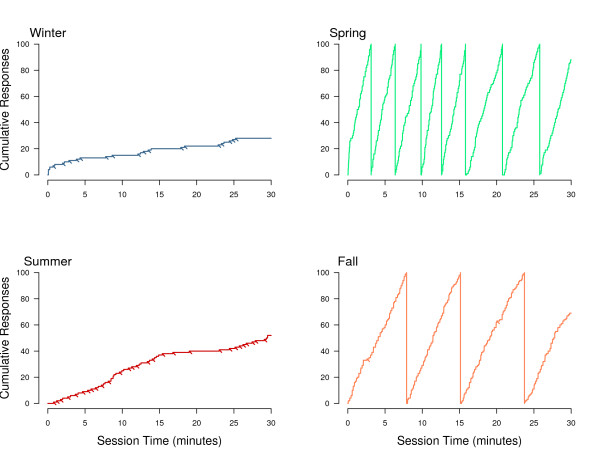
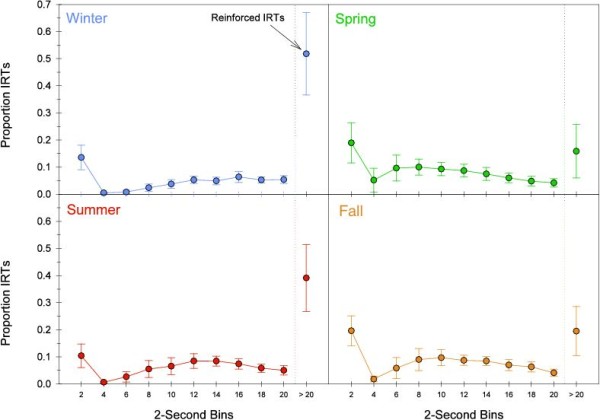
Sleep amount changed in response to photoperiod in winter and summer, with longest sleep duration in the winter. Sleep duration in the spring and fall migratory periods were similar to what we previously reported, and were comparable to sleep duration observed in summer. The most striking difference in sleep during the migratory periods compared to non-migratory periods was the change from discrete day-night temporal organization to an almost complete temporal fragmentation of sleep. The birds' ability to perform on the DRL task was significantly impaired during both migratory periods, but optimal performance was sustained during the two non-migratory periods.
Birds showed dramatic changes in sleep duration across seasons, related to day length and migratory status. Migration was associated with changes in sleep amount and diurnal distribution pattern, whereas duration of sleep in the non-migratory periods was largely influenced by the light-dark cycle. Elevated response rates on the DRL task were observed during migration but not during the short sleep duration of summer, suggesting that the migratory periods may be associated with decreased inhibition/increased impulsivity. Although their daily sleep amounts and patterns may vary by season, birds are susceptible to sleep loss throughout the year, as evidenced by decreased responding rates following enforced sleep deprivation.
我们之前已经表明,与非迁徙期相比,当被安置在 12 小时光照:12 小时黑暗周期中时,白头翁雀(WCS)的睡眠时间减少了 60%。尽管睡眠时间减少了,但操作性表现的准确性并未受损,实际上,在迁徙期间的反应率更高,这与通常在强制剥夺睡眠后观察到的效果相反。为了确定先前观察到的操作性反应增加是否是由于表现改善还是由于迁徙对活动水平的影响,我们在这里使用了一项任务来评估操作性表现,在该任务中,最佳表现取决于鸟保持固定时间间隔不反应的能力(差异强化低反应率行为,或 DRL);升高的反应率最终通过减少获得食物奖励的机会来损害性能。为了确定季节性日长变化对睡眠和行为模式的影响,我们在不断变化的光周期下,在 4 个不同季节(冬季,春季,夏季和秋季)中记录睡眠并评估操作性表现。
冬季和夏季,睡眠时间随光周期而变化,冬季睡眠时间最长。春季和秋季迁徙期的睡眠时间与我们之前报道的相似,与夏季观察到的睡眠时间相似。与非迁徙期相比,迁徙期睡眠最显着的变化是从离散的昼夜时间组织转变为几乎完全的睡眠时间碎片化。在两个迁徙期,鸟类执行 DRL 任务的能力都受到严重损害,但在两个非迁徙期仍保持最佳性能。
鸟类在整个季节中睡眠时间明显变化,与日长和迁徙状态有关。迁徙与睡眠量和昼夜分布模式的变化有关,而非迁徙期的睡眠时间主要受光-暗周期的影响。在迁徙期间观察到 DRL 任务的反应率升高,但在夏季短暂的睡眠时间内没有升高,这表明迁徙期可能与抑制力降低/冲动性增加有关。尽管它们的每日睡眠时间和模式可能因季节而异,但鸟类全年都容易受到睡眠不足的影响,这从强制剥夺睡眠后的反应率下降中可以看出。