Portugal Steven J, White Craig R, Frappell Peter B, Green Jonathan A, Butler Patrick J
School of Biological Sciences, Royal Holloway University of London Egham Surrey UK.
Centre for Geometric Biology, School of Biological Sciences Monash University Melbourne Victoria Australia.
Ecol Evol. 2019 Jun 25;9(14):7974-7984. doi: 10.1002/ece3.5311. eCollection 2019 Jul.
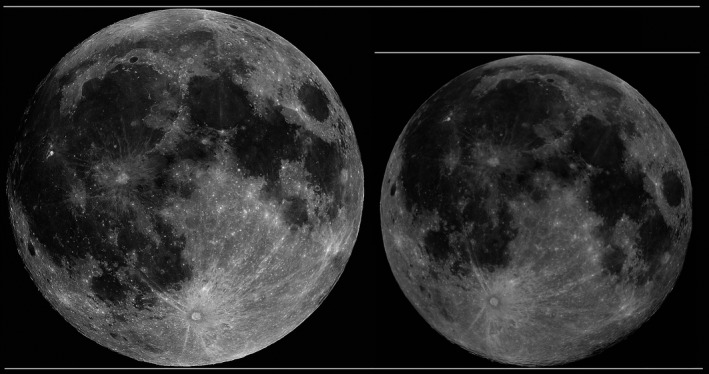
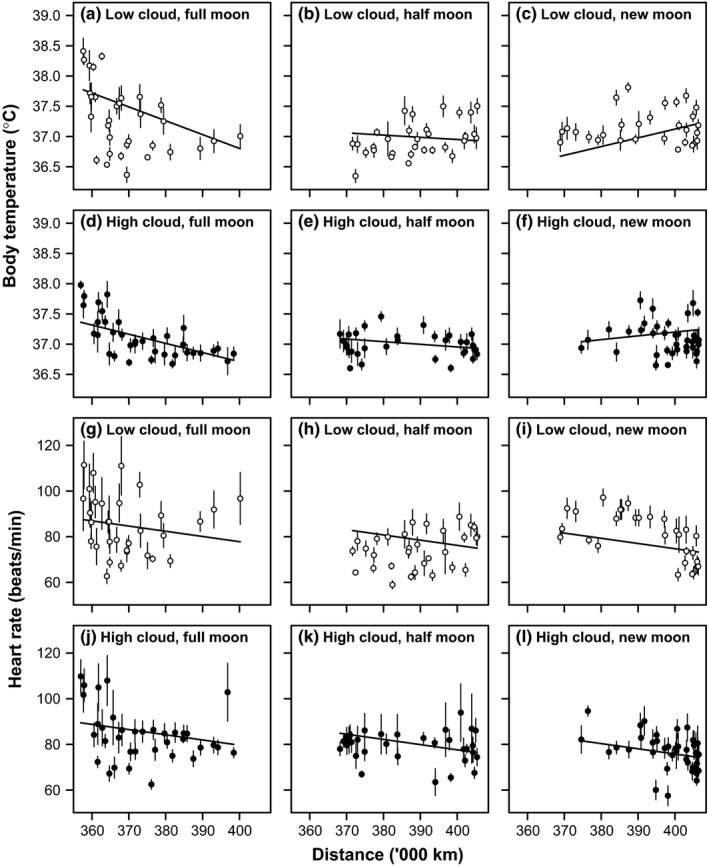
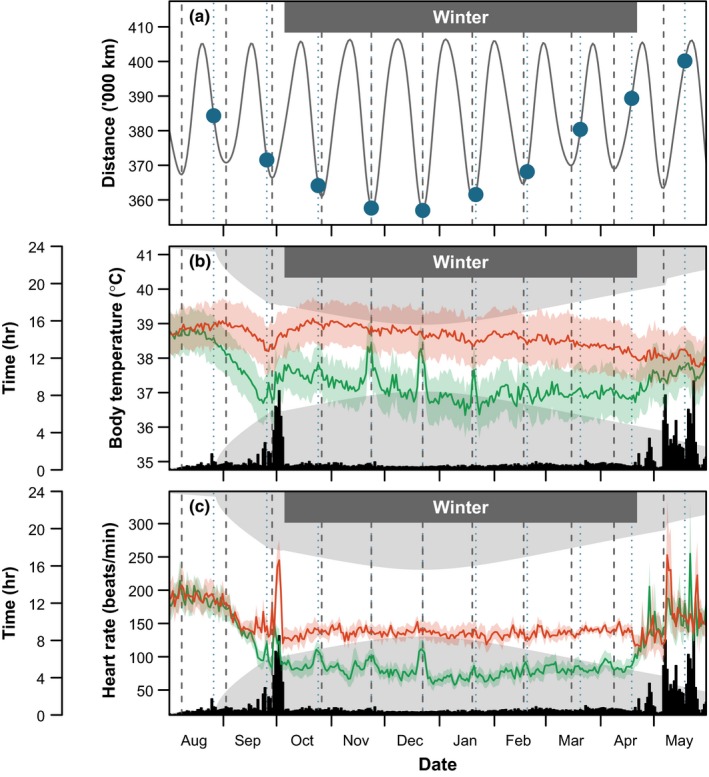
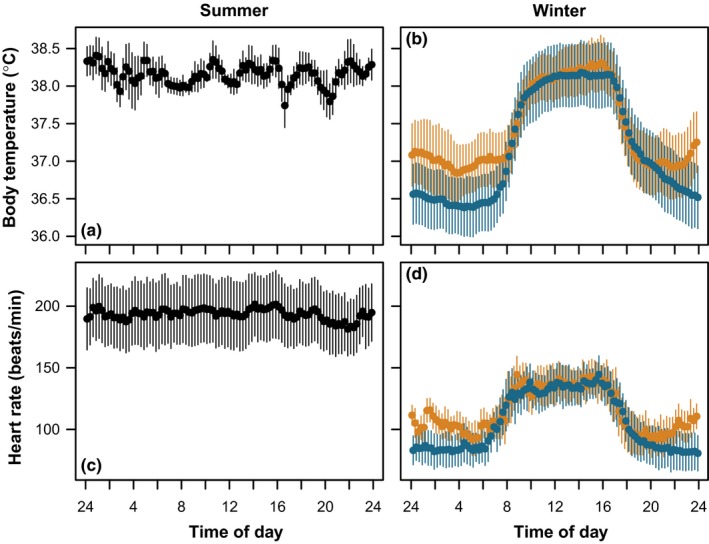
The position of the Moon in relation to the Earth and the Sun gives rise to several predictable cycles, and natural changes in nighttime light intensity are known to cause alterations to physiological processes and behaviors in many animals. The limited research undertaken to date on the physiological responses of animals to the lunar illumination has exclusively focused on the synodic lunar cycle (full moon to full moon, or moon phase) but the moon's orbit-its distance from the Earth-may also be relevant. Every month, the moon moves from , its most distant point from Earth-and then to its closest point to Earth. Here, we studied wild barnacle geese () to investigate the influence of multiple interacting lunar cycles on the physiology of diurnally active animals. Our study, which uses biologging technology to continually monitor body temperature and heart rate for an entire annual cycle, asks whether there is evidence for a physiological response to natural cycles in lunar brightness in wild birds, particularly "supermoon" phenomena, where perigee coincides with a full moon. There was a three-way interaction between lunar phase, lunar distance, and cloud cover as predictors of nighttime mean body temperature, such that body temperature was highest on clear nights when the full moon coincided with perigee moon. Our study is the first to report the physiological responses of wild birds to "supermoon" events; the wild geese responded to the combination of two independent lunar cycles, by significantly increasing their body temperature at night. That wild birds respond to natural fluctuations in nighttime ambient light levels support the documented responses of many species to anthropogenic sources of artificial light, that birds seem unable to override. As most biological systems are arguably organized foremost by light, this suggests that any interactions between lunar cycles and local weather conditions could have significant impacts on the energy budgets of birds.
月球相对于地球和太阳的位置引发了几个可预测的周期,而且已知夜间光强度的自然变化会导致许多动物的生理过程和行为发生改变。迄今为止,针对动物对月球光照的生理反应所开展的有限研究仅仅聚焦于朔望月周期(满月到满月,即月相),但月球的轨道——它与地球的距离——可能也有关系。每个月,月球从距离地球最远的点移动到距离地球最近的点。在此,我们研究了野生黑雁,以探究多个相互作用的月球周期对昼行性动物生理的影响。我们的研究使用生物记录技术在一整个年度周期内持续监测体温和心率,探讨野生鸟类是否有证据表明其对月球亮度的自然周期存在生理反应,特别是“超级月亮”现象,即近地点与满月重合的情况。作为夜间平均体温预测指标的月相、月球距离和云层覆盖之间存在三向相互作用,即当满月与近地点重合且夜晚晴朗时体温最高。我们的研究首次报告了野生鸟类对“超级月亮”事件的生理反应;这些野生大雁对两个独立月球周期的组合做出了反应,夜间显著提高了体温。野生鸟类对夜间环境光水平的自然波动做出反应,这支持了许多物种对人为光源已有记录的反应,而鸟类似乎无法克服这种反应。由于大多数生物系统可以说主要是由光组织的,这表明月球周期与当地天气条件之间的任何相互作用都可能对鸟类的能量预算产生重大影响。