Department of Epidemiology and Biostatistics, MRC Centre for Environment and Health, School of Public Health, Imperial College London, London, UK.
MRC Integrative Epidemiology Unit, Population Health Sciences, University of Bristol, Bristol, UK.
Int J Epidemiol. 2021 Jul 9;50(3):768-782. doi: 10.1093/ije/dyaa188.
Low socio-economic position (SEP) is a risk factor for multiple health outcomes, but its molecular imprints in the body remain unclear.
We examined SEP as a determinant of serum nuclear magnetic resonance metabolic profiles in ∼30 000 adults and 4000 children across 10 UK and Finnish cohort studies.
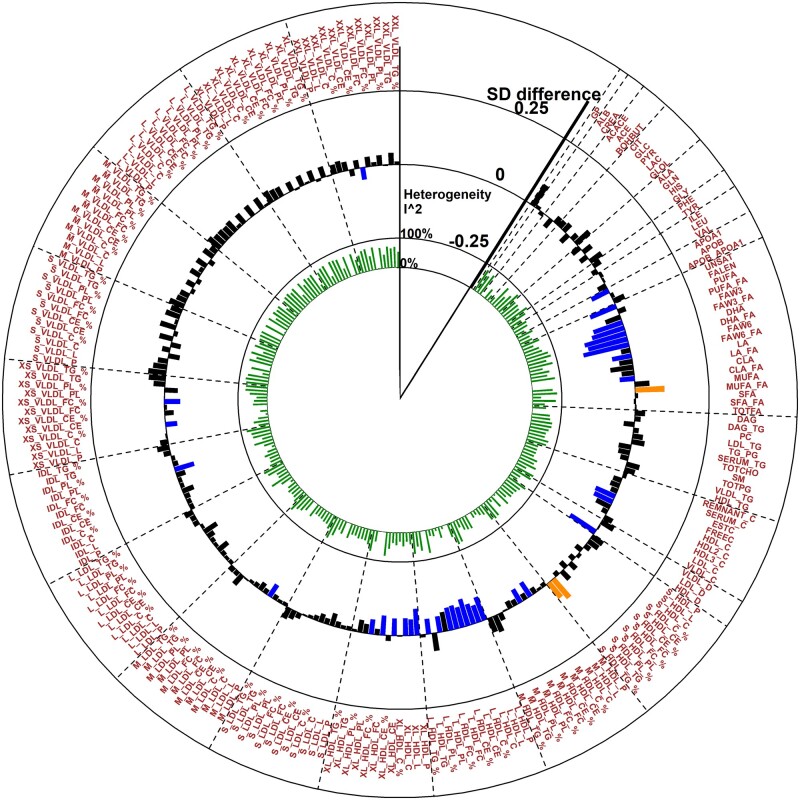
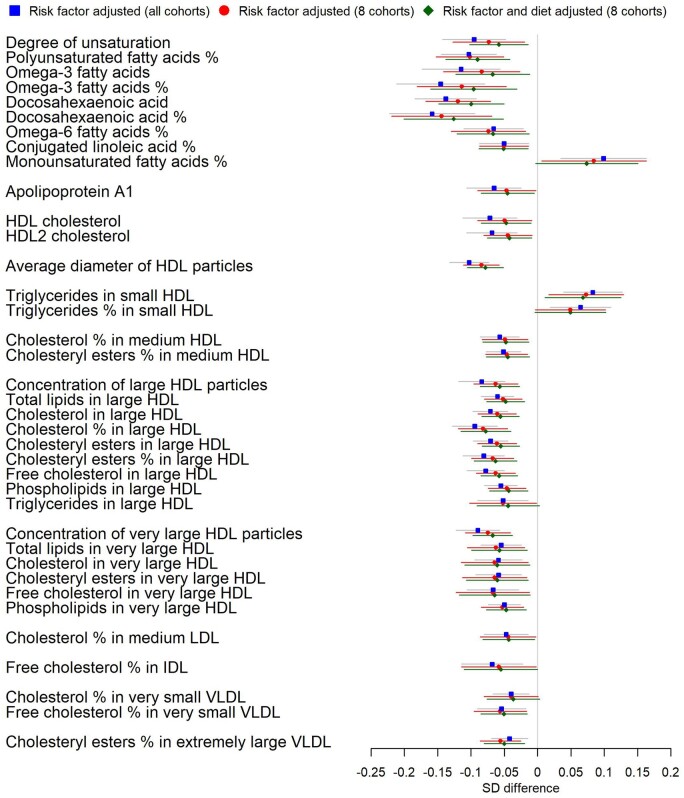
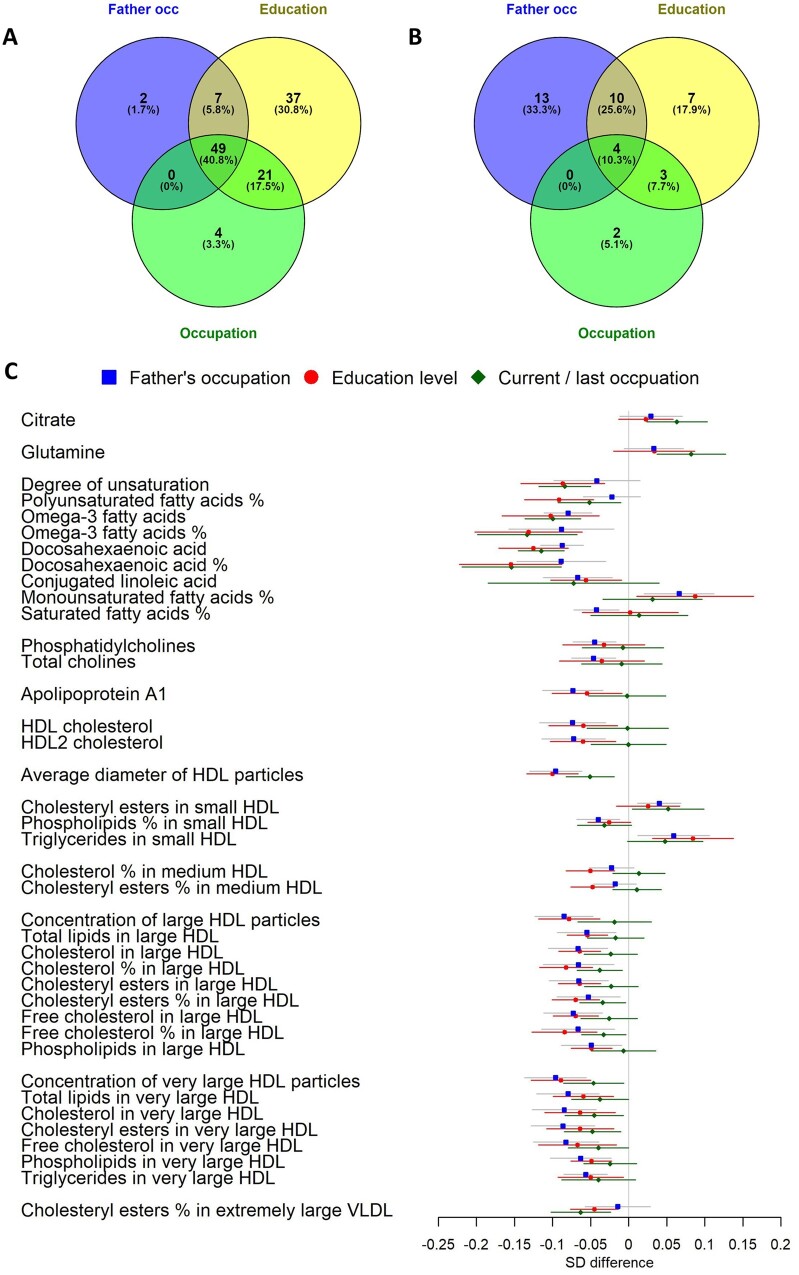
In risk-factor-adjusted analysis of 233 metabolic measures, low educational attainment was associated with 37 measures including higher levels of triglycerides in small high-density lipoproteins (HDL) and lower levels of docosahexaenoic acid (DHA), omega-3 fatty acids, apolipoprotein A1, large and very large HDL particles (including levels of their respective lipid constituents) and cholesterol measures across different density lipoproteins. Among adults whose father worked in manual occupations, associations with apolipoprotein A1, large and very large HDL particles and HDL-2 cholesterol remained after adjustment for SEP in later life. Among manual workers, levels of glutamine were higher compared with non-manual workers. All three indicators of low SEP were associated with lower DHA, omega-3 fatty acids and HDL diameter. At all ages, children of manual workers had lower levels of DHA as a proportion of total fatty acids.
Our work indicates that social and economic factors have a measurable impact on human physiology. Lower SEP was independently associated with a generally unfavourable metabolic profile, consistent across ages and cohorts. The metabolites we found to be associated with SEP, including DHA, are known to predict cardiovascular disease and cognitive decline in later life and may contribute to health inequalities.
社会经济地位(SEP)较低是多种健康结果的一个风险因素,但它在人体中的分子印记尚不清楚。
我们在 10 项英国和芬兰队列研究中,研究了 SEP 作为约 30000 名成年人和 4000 名儿童血清磁共振代谢谱决定因素的情况。
在对 233 项代谢指标进行的风险因素调整分析中,低教育程度与 37 项指标相关,包括小而高密度脂蛋白(HDL)中的甘油三酯水平升高和二十二碳六烯酸(DHA)、ω-3 脂肪酸、载脂蛋白 A1、大而非常大的 HDL 颗粒(包括各自脂质成分的水平)和不同密度脂蛋白中的胆固醇水平降低。在其父亲从事体力劳动职业的成年人中,与载脂蛋白 A1、大而非常大的 HDL 颗粒和 HDL-2 胆固醇的关联在调整晚年 SEP 后仍然存在。在体力劳动者中,与非体力劳动者相比,谷氨酰胺水平较高。低 SEP 的三个指标均与 DHA、ω-3 脂肪酸和 HDL 直径降低相关。在所有年龄段,体力劳动者的子女 DHA 占总脂肪酸的比例较低。
我们的工作表明,社会和经济因素对人体生理学有可衡量的影响。SEP 较低与一般不利的代谢特征独立相关,在不同年龄和队列中都一致。我们发现与 SEP 相关的代谢物,包括 DHA,已知可预测晚年心血管疾病和认知能力下降,并且可能导致健康不平等。