Huțanu Adina, Iancu Mihaela, Maier Smaranda, Bălaşa Rodica, Dobreanu Minodora
Center for Advanced Medical and Pharmaceutical Research, University of Medicine, Pharmacy, Sciences and Technology Tîrgu-Mureş, Romania.
Department of Laboratory Medicine, University of Medicine, Pharmacy, Sciences and Technology Tîrgu-Mureş, Romania.
Ann Indian Acad Neurol. 2020 Jul-Aug;23(4):496-503. doi: 10.4103/aian.AIAN_74_19. Epub 2019 May 14.
Despite advances made in the treatment of ischemic stroke, it still remains one of the leading causes of mortality and disability worldwide. The main objective of this study was to identify from a panel of 10 inflammatory markers and chemokines those biomarkers that have a potential predictive role in the evolution of disability and functional dependence in daily activities after an ischemic stroke.
The study included 116 patients with ischemic stroke and 40 healthy volunteers matched for gender and age. Stroke severity was assessed by the National Institute of Health Stroke Scale (NIHSS) on admission and during hospitalization and functional mobility in daily activities by Barthel index (BI). Multiplex panel with 10 biomarkers [brain-derived neurotrophic factor (BDNF), platelet-derived growth factor (PDGF)-AA, PDGF-AB/BB, neural cell adhesion molecule (NCAM), cathepsin D, soluble vascular cell adhesion molecule (sVCAM), soluble intercellular cell adhesion molecule (sICAM), myeloperoxidase (MPO), regulated on activation, normal T cell expressed and secreted (RANTES), plasminogen activator inhibitor (PAI)-1] was analyzed on days 1 and 5 after admission using the xMAP technology.
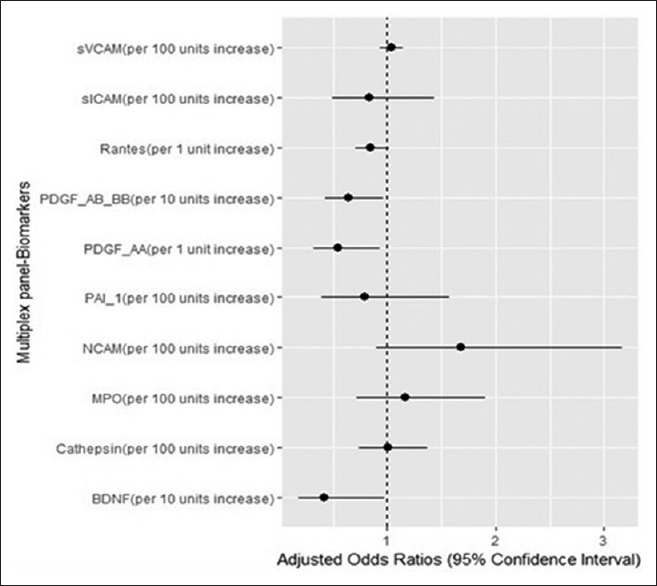
Plasma concentrations of RANTES and NCAM were significantly lower in patients with ischemic stroke compared with healthy controls, while MPO and sICAM were significantly higher in patients versus controls. Plasma concentrations of sICAM, sVCAM, and RANTES significantly decreased during the analyzed period. For the first-day measurement, the bivariate analysis revealed the association of NIHSS on admission with sVCAM, and on discharge negative association with PDGF-AA, PDGR-AB/BB, BDNF, and RANTES. Plasma levels of PDGF-AA, PDGF-AB/BB, BDNF, and RANTES were found to be significantly lower in patients with BI ≤ 80, on day 5 after disease onset. PDGF-AA, PDGF-AB/BB, and BDNF were univariate and multivariate predictors for functional dependence in daily life activity (BI ≤ 80), having a protective effect (odds ratio < 1).
Plasma levels of BDNF, PDGF-AA, and PDGF-AB/BB are independent predictors for functional dependency in daily life activities and may be useful prognostic markers in the evaluation of ischemic stroke patients.
尽管缺血性脑卒中的治疗取得了进展,但它仍是全球范围内导致死亡和残疾的主要原因之一。本研究的主要目的是从一组10种炎症标志物和趋化因子中识别出那些对缺血性脑卒中后日常生活中残疾和功能依赖的演变具有潜在预测作用的生物标志物。
该研究纳入了116例缺血性脑卒中患者和40名年龄及性别匹配的健康志愿者。入院时和住院期间通过美国国立卫生研究院卒中量表(NIHSS)评估卒中严重程度,通过巴氏指数(BI)评估日常生活中的功能活动能力。入院第1天和第5天使用xMAP技术分析包含10种生物标志物[脑源性神经营养因子(BDNF)、血小板衍生生长因子(PDGF)-AA、PDGF-AB/BB、神经细胞黏附分子(NCAM)、组织蛋白酶D、可溶性血管细胞黏附分子(sVCAM)、可溶性细胞间黏附分子(sICAM)、髓过氧化物酶(MPO)、活化调节正常T细胞表达和分泌因子(RANTES)、纤溶酶原激活物抑制剂(PAI)-1]的多指标组合。
与健康对照组相比,缺血性脑卒中患者血浆RANTES和NCAM浓度显著降低,而患者血浆MPO和sICAM浓度显著高于对照组。在分析期间,血浆sICAM、sVCAM和RANTES浓度显著下降。对于第1天的测量,双变量分析显示入院时NIHSS与sVCAM相关,出院时与PDGF-AA、PDGR-AB/BB、BDNF和RANTES呈负相关。发病后第5天,BI≤80的患者血浆PDGF-AA、PDGF-AB/BB、BDNF和RANTES水平显著降低。PDGF-AA、PDGF-AB/BB和BDNF是日常生活活动中功能依赖的单变量和多变量预测因子,具有保护作用(比值比<1)。
血浆BDNF、PDGF-AA和PDGF-AB/BB水平是日常生活活动中功能依赖的独立预测因子,可能是评估缺血性脑卒中患者的有用预后标志物。