Wisitrassameewong Komsit, Park Myung Soo, Lee Hyun, Ghosh Aniket, Das Kanad, Buyck Bart, Looney Brian P, Caboň Miroslav, Adamčík Slavomír, Kim Changmu, Kim Chang Sun, Lim Young Woon
School of Biological Sciences and Institute of Microbiology, Seoul National University, Seoul 08826, South Korea Seoul National University Seoul South Korea.
National Biobank of Thailand (NBT), National Science and Technology Development Agency (NSTDA), Thailand Science Park, Thanon Phahonyothin, Tambon Khlong Neung, Amphoe Klong Luang, Pathum Thani 12120, Thailand National Biobank of Thailand Pathum Thani Thailand.
MycoKeys. 2020 Nov 9;75:1-29. doi: 10.3897/mycokeys.75.53673. eCollection 2020.
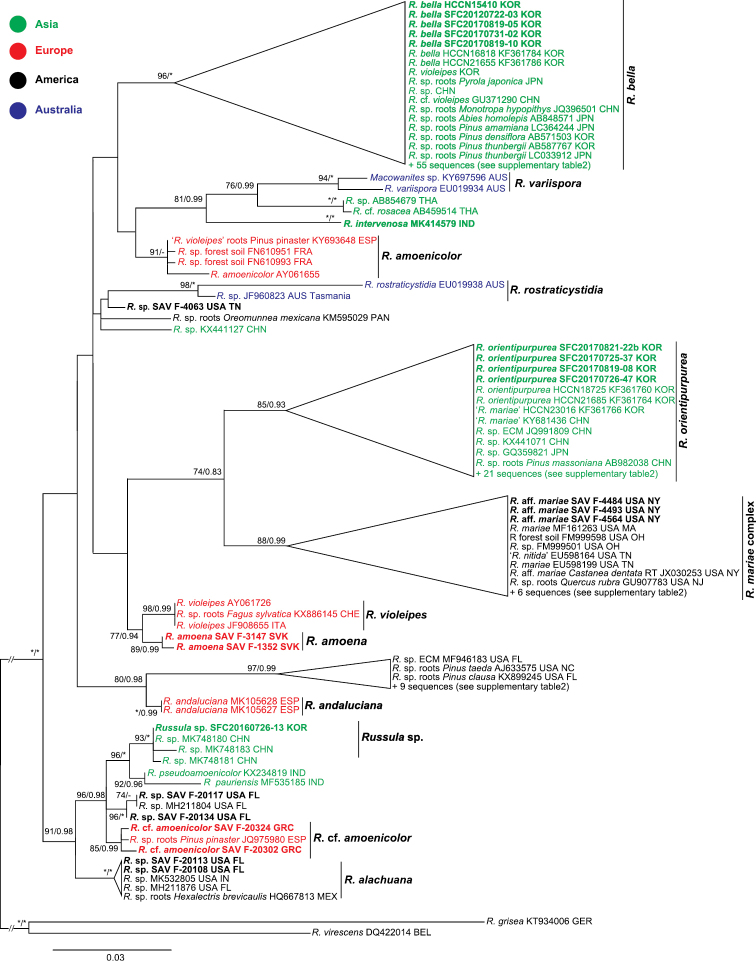
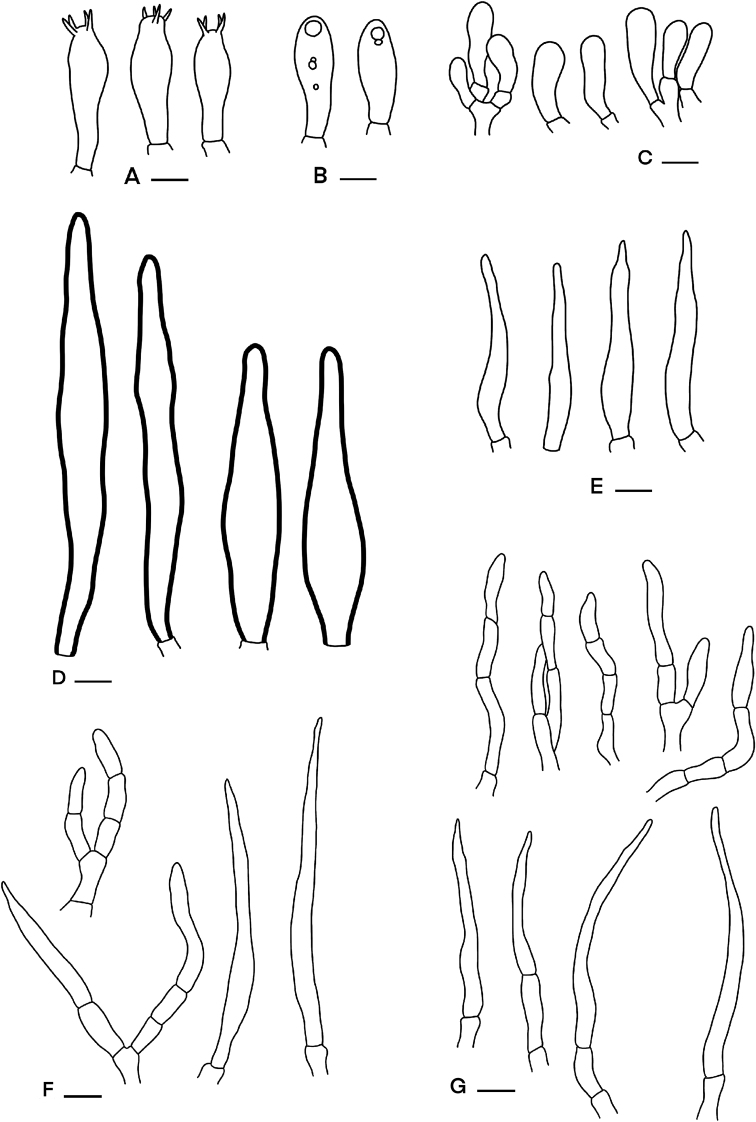
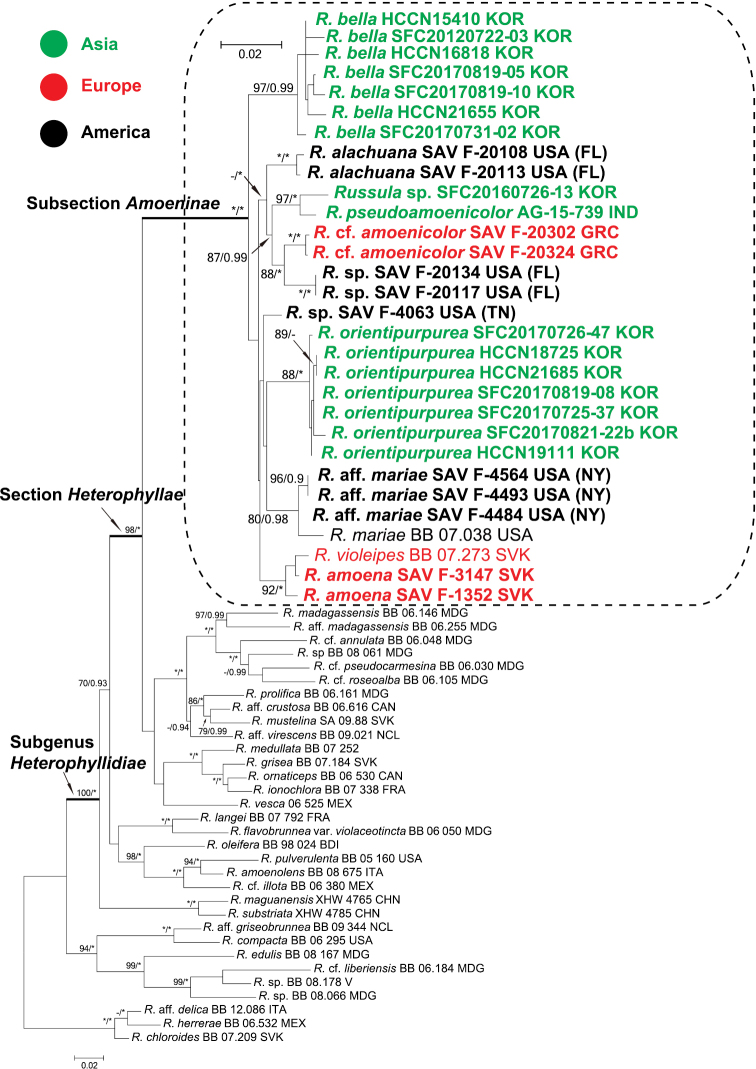
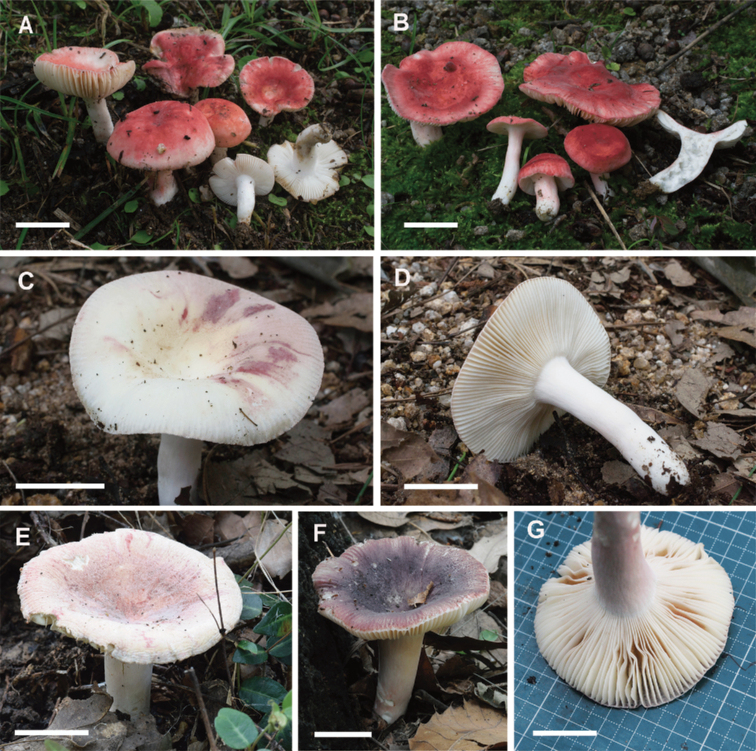
Russula subsection Amoeninae is morphologically defined by a dry velvety pileus surface, a complete absence of cystidia with heteromorphous contents in all tissues, and spores without amyloid suprahilar spot. Thirty-four species within subsection Amoeninae have been published worldwide. Although most species in South Korea have been assigned European or North American names, recent molecular studies have shown that species from different continents are not conspecific. Therefore, the present study aims to: 1) define which species of Russula subsection Amoeninae occur on each continent using molecular phylogenetic analyses; 2) revise the taxonomy of Korean . The phylogenetic analyses using the internal transcribed spacer (ITS) and multilocus sequences showed that subsection Amoeninae is monophyletic within subgenus Heterophyllidiae section Heterophyllae. A total of 21 Russula subsection Amoeninae species were confirmed from Asia, Australia, Europe, North America, and Central America, and species from different continents formed separate clades. Three species were recognized from South Korea and were clearly separated from the European and North American species. These species are , also reported from Japan, a new species described herein, , and a new species undescribed due to insufficient material.
红菇属Amoeninae亚组在形态学上的定义为菌盖表面干燥且具绒毛,所有组织中完全不存在具有异形内含物的囊状体,以及孢子无淀粉质脐上斑点。全世界已发表了Amoeninae亚组内的34个物种。尽管韩国的大多数物种都被赋予了欧洲或北美的名称,但最近的分子研究表明,来自不同大陆的物种并非同种。因此,本研究旨在:1)利用分子系统发育分析确定红菇属Amoeninae亚组的哪些物种出现在每个大陆上;2)修订韩国红菇的分类学。使用内部转录间隔区(ITS)和多位点序列进行的系统发育分析表明,Amoeninae亚组在异叶红菇亚属异叶红菇组内是单系的。总共从亚洲、澳大利亚、欧洲、北美和中美洲确认了21种红菇属Amoeninae亚组物种,来自不同大陆的物种形成了单独的分支。从韩国识别出了3个物种,它们与欧洲和北美的物种明显分开。这些物种是也在日本有报道的、本文描述的一个新物种以及因材料不足未描述的一个新物种。