Stokes Mark G, Muhle-Karbe Paul S, Myers Nicholas E
Wellcome Centre for Integrative Neuroimaging and Department of Experimental Psychology, University of Oxford, Oxford, UK.
Vis cogn. 2020 Sep 24;28(5-8):420-432. doi: 10.1080/13506285.2020.1825141.
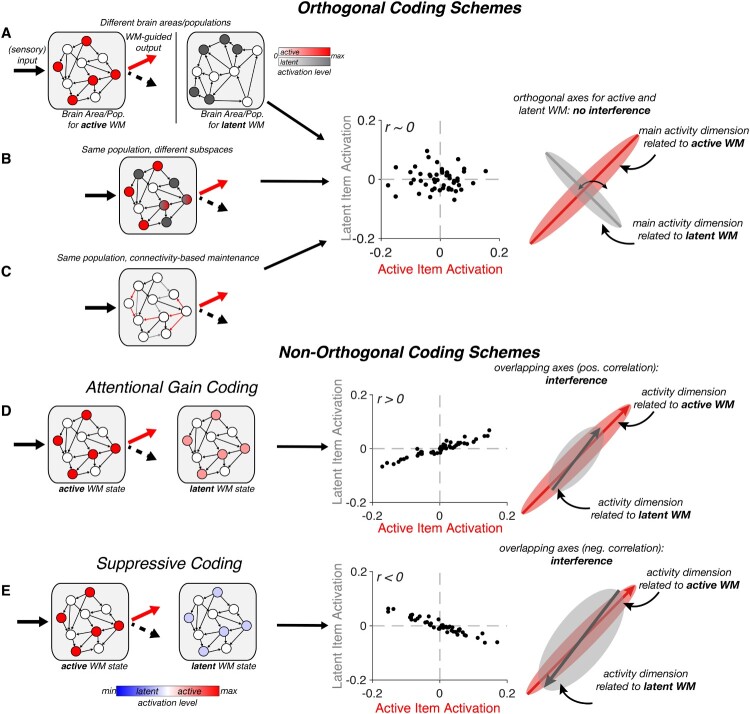
Working memory (WM) is important for guiding behaviour, but not always for the next possible action. Here we define a WM item that is currently relevant for guiding behaviour as the functionally "active" item; whereas items maintained in WM, but not immediately relevant to behaviour, are defined as functionally "latent". Traditional neurophysiological theories of WM proposed that content is maintained via persistent neural activity (e.g., stable attractors); however, more recent theories have highlighted the potential role for "activity-silent" mechanisms (e.g., short-term synaptic plasticity). Given these somewhat parallel dichotomies, functionally active and latent cognitive states of WM have been associated with storage based on persistent-activity and activity-silent neural mechanisms, respectively. However, in this article we caution against a one-to-one correspondence between functional and activity states. We argue that the principal theoretical requirement for active and latent WM is that the corresponding neural states play qualitatively different functional roles. We consider a number of candidate solutions, and conclude that the neurophysiological mechanisms for functionally active and latent WM items are theoretically independent of the distinction between persistent activity-based and activity-silent forms of WM storage.
工作记忆(WM)对指导行为很重要,但并不总是对下一个可能的行动起作用。在这里,我们将当前与指导行为相关的WM项目定义为功能上“活跃”的项目;而保存在WM中但与行为无直接关联的项目则被定义为功能上“潜在”的项目。传统的WM神经生理学理论提出,内容是通过持续的神经活动(例如,稳定吸引子)来维持的;然而,最近的理论强调了“活动沉默”机制(例如,短期突触可塑性)的潜在作用。鉴于这些在某种程度上平行的二分法,WM的功能活跃和潜在认知状态分别与基于持续活动和活动沉默神经机制的存储相关联。然而,在本文中,我们提醒不要在功能状态和活动状态之间建立一一对应关系。我们认为,活跃和潜在WM的主要理论要求是相应的神经状态发挥质的不同功能作用。我们考虑了一些候选解决方案,并得出结论,功能活跃和潜在WM项目的神经生理机制在理论上独立于基于持续活动和活动沉默形式的WM存储之间的区别。