De Roo C, Lierman S, Tilleman K, De Sutter P
Department of Reproductive Medicine, Ghent-Fertility and Stem Cell Team (G-FaST), Ghent University Hospital, 9000 Ghent, Belgium.
Hum Reprod Open. 2020 Nov 16;2020(4):hoaa048. doi: 10.1093/hropen/hoaa048. eCollection 2020.
What is the role of the Hippo and PI3K/Akt pathway in follicles during ovarian tissue culture in tissue derived from oncological patients and transgender men?
Results highlight a Hippo pathway driven primordial follicle activation , predominantly from Day 0 to Day 4.
ovarian tissue culture aims at activating and maturing primordial follicles for fertility restoration in patients with a threatened ovarian reserve. Not all patients are eligible for ovarian cortex transplantation and therefore several groups are attempting to culture ovarian tissue . Cortex fragmentation disrupts the Hippo pathway, leading to increased expression of downstream growth factors and follicle growth. The PI3K/Akt pathway is considered the intracellular pathway to where different extracellular factors involved in primordial follicle activation converge. In order to optimise current ovarian tissue culture models, information on progression of these pathways during tissue culture is mandatory.
The first step of a multistep cortex culture system was performed using 144 ovarian cortex pieces from a total of six patients. Per patient, 24 cortical strips were cultured for 6 days and six pieces per patient were collected for downstream analysis of follicle development and Hippo and PI3K/Akt pathway targets every second day.
PARTICIPANTS/MATERIALS SETTING METHODS: Ovarian tissue was obtained from oncological (N = 3; 28.67 ± 4.51 years) and transgender (N = 3; 23.33 ± 1.53 years) patients. Follicles were analysed using haematoxylin-eosin staining and pathways were studied using immunohistochemistry and precise follicle excision by laser capture micro-dissection for RT-qPCR analysis. MIQE guidelines for RT-qPCR were pursued. Reference gene selection (GAPDH, RPL3A, 18s rRNA) was performed using GeNorm Reference Gene Selection Kit. Statistical analysis was conducted with IBM SPSS Statistics 23 (Poisson regression, negative binomial regression, ANOVA and paired -test).
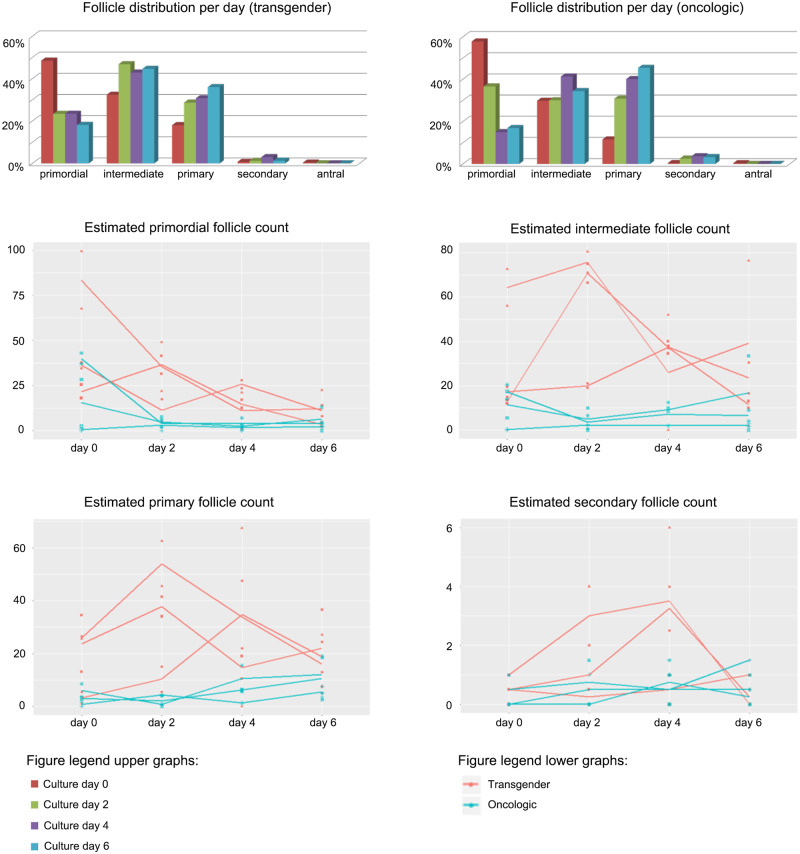
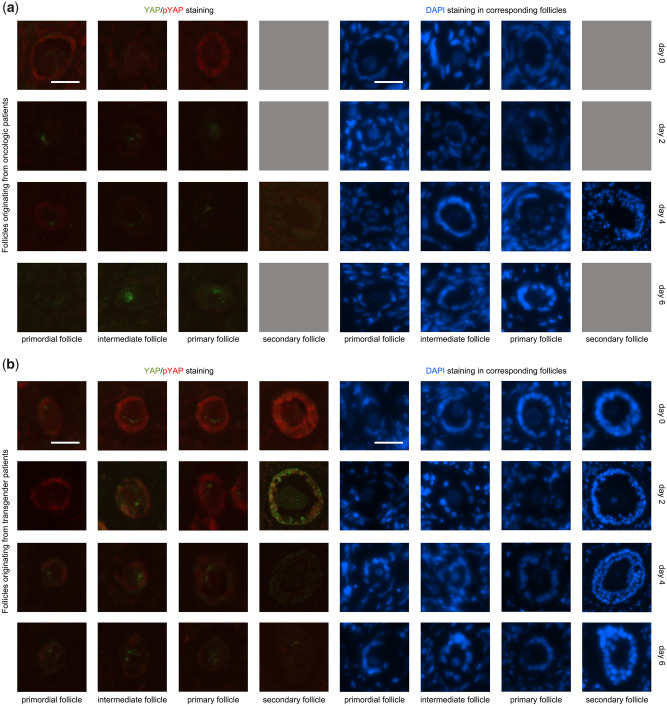
Immunohistochemical analysis confirmed a Hippo pathway driven primordial follicle activation due to mechanical manipulation of the cortical strips. Ovarian tissue preparation and culture induced the inhibitory phosphorylated Yes-associated protein (pYAP) to disappear in granulosa cells of primordial follicles on Day 2. The stimulatory YAP on the contrary appeared in primordial granulosa cells over increasing culture days. Looking at the YAP target connective tissue growth factor (CTGF), a significantly up-regulated CTGF was noted in primordial follicles when comparing Day 2 and Day 4 (ratio Day 2/4 = 0.082; < 0.05), clearly showing an effect on the Hippo pathway in primordial follicles during tissue culture. Follicle classification showed a significant drop in estimated primordial follicle counts in the oncological cohort (-78%; = 0.021) on Day 2 and in the transgender cohort on Day 4 (-634%; = 0.008). Intermediate follicle counts showed a non-significant increasing trend to during culture and this follicle recruitment and growth resulted in a significant rise in estimated primary follicle counts on Day 6 in oncological patients (170%; = 0.025) and, although limited in absolute numbers, a significant increase in secondary follicles on Day 4 (367%; = 0.021) in the transgender cohort. Subsequent antral follicle development could not be observed.
A limitation is the small sample size, inherent to this study subject, especially as a large amount of tissue was needed per patient to reduce inter-patient variation in different downstream analysis techniques. A particular and specific weakness of this study is the inability to include an age-matched control group.
These findings support an adapted tissue preparation for Hippo pathway disruption and a shorter first phase of tissue culture. This work may also have implications for transplantation of cryopreserved tissue as larger strips (and thus slower burnout due to less Hippo pathway disruption) could be a benefit.
STUDY FUNDING/COMPETING INTERESTS: This research was financially supported by the Foundation Against Cancer (Stichting tegen Kanker, TBMT001816N), the Flemish Foundation of Scientific Research (FWO Vlaanderen, FWO G0.065.11N10) and the Gender Identity Research and Education Society (GIRES) foundation. The authors declare no competing interests.
N/A.
在肿瘤患者和跨性别男性来源的组织进行卵巢组织培养过程中,河马(Hippo)信号通路和磷脂酰肌醇-3-激酶/蛋白激酶B(PI3K/Akt)信号通路在卵泡中发挥着什么作用?
结果表明,从第0天到第4天,河马信号通路驱动原始卵泡激活,且作用显著。
卵巢组织培养旨在激活和成熟原始卵泡,以恢复卵巢储备功能受威胁患者的生育能力。并非所有患者都适合进行卵巢皮质移植,因此多个研究团队正在尝试进行卵巢组织培养。皮质分割会破坏河马信号通路,导致下游生长因子表达增加以及卵泡生长。PI3K/Akt信号通路被认为是参与原始卵泡激活的不同细胞外因子汇聚的细胞内信号通路。为了优化当前的卵巢组织培养模型,必须了解这些信号通路在组织培养过程中的进展情况。
研究设计、规模、持续时间:使用来自6名患者的144个卵巢皮质片进行了多步骤皮质培养系统的第一步实验。每位患者的24条皮质条培养6天,每隔一天收集每位患者的6个皮质片用于卵泡发育以及河马信号通路和PI3K/Akt信号通路靶点的下游分析。
研究对象/材料、设置、方法:卵巢组织取自肿瘤患者(n = 3;年龄28.67±4.51岁)和跨性别患者(n = 3;年龄23.33±1.53岁)。使用苏木精-伊红染色分析卵泡,并使用免疫组织化学以及通过激光捕获显微切割精确切除卵泡进行逆转录定量聚合酶链反应(RT-qPCR)分析来研究信号通路。遵循RT-qPCR的MIQE指南。使用GeNorm参考基因选择试剂盒进行参考基因选择(甘油醛-3-磷酸脱氢酶、核糖体蛋白L3A、18s核糖体RNA)。使用IBM SPSS Statistics 23进行统计分析(泊松回归、负二项回归、方差分析和配对检验)。
免疫组织化学分析证实,由于皮质条的机械操作,河马信号通路驱动了原始卵泡激活。卵巢组织制备和培养导致原始卵泡颗粒细胞中抑制性磷酸化Yes相关蛋白(pYAP)在第2天消失。相反,随着培养天数增加,刺激性YAP出现在原始颗粒细胞中。观察YAP靶点结缔组织生长因子(CTGF),与第2天和第4天相比,原始卵泡中CTGF显著上调(第2天/第4天比值 = 0.082;P<0.05),清楚地表明在组织培养过程中对原始卵泡中的河马信号通路有影响。卵泡分类显示,肿瘤患者队列在第2天原始卵泡估计数量显著下降(-78%;P = 0.021),跨性别患者队列在第4天下降(-634%;P = 0.008)。中间卵泡数量在培养过程中呈非显著增加趋势,这种卵泡募集和生长导致肿瘤患者在第6天初级卵泡估计数量显著增加(170%;P = 0.025),跨性别患者队列在第4天次级卵泡数量虽绝对数量有限但也显著增加(367%;P = 0.021)。随后未观察到窦状卵泡发育。
局限性、谨慎的原因:局限性在于样本量小,这是本研究主题所固有的,特别是因为每位患者需要大量组织以减少不同下游分析技术中患者间的差异。本研究一个特别的弱点是无法纳入年龄匹配的对照组。
这些发现支持针对河马信号通路破坏进行适应性组织制备以及缩短组织培养的第一阶段。这项工作可能对冷冻保存组织的移植也有影响,因为更大的皮质条(因此由于河马信号通路破坏较少而消耗较慢)可能有益。
研究资金/利益冲突:本研究得到抗癌基金会(Stichting tegen Kanker,TBMT001816N)、弗拉芒科学研究基金会(FWO Vlaanderen,FWO G0.065.11N10)和性别认同研究与教育协会(GIRES)基金会的资助。作者声明无利益冲突。
无。