Vlot Jessica A, Vive Marissa G D, Brockhoff Henricus J, van Genderen Pieter J J, Trompenaars Marie-Christine E, van Steenbergen James E, Visser Leonardus G
Department of Infectious Diseases, Leiden University Medical Center, Albinusdreef 2, 2333 ZA Leiden, The Netherlands.
Department of Infectious Diseases, Municipal Health Service, Westeinde 128, 2512 HE The Hague, The Netherlands.
J Travel Med. 2021 Jan 6;28(1). doi: 10.1093/jtm/taaa216.
Older persons may suffer more from travel-related health problems because of ageing and underlying chronic disorders. Knowledge on who is more likely to have these health problems helps to tailor travel health advice more specifically. This study aimed to determine predictors of travel-related morbidity in older travellers by assessing their pre-travel characteristics and performance using physical and cognitive functioning tests.
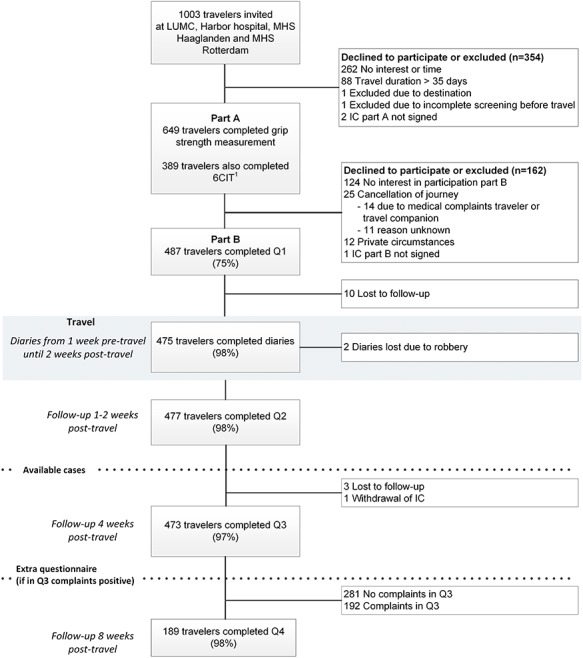
Multicentre prospective cohort study among older travellers (≥60 years) who consulted one of the participating Dutch travel clinics. Handgrip strength and cognitive performance were measured pre-travel. Participants completed questionnaires before departure and 1 and 4 weeks after return. A diary recorded health complaints during travel until 2-week post-travel.
In total, 477 travellers completed the study (follow-up rate of 97%). Participants' median age was 66 years. The most visited regions were South-East Asia (34%) and South Asia (14%). Median travel duration was 19 days. Polypharmacy (≥5 medications per day) was not uncommon (16%). The median Charlson Comorbidity Index (CCI) score was 0. Self-reported travel-related infectious diseases concerned primarily respiratory tract infections (21%) and gastroenteritis (10%) whereas non-infectious complaints were injuries (13%), peripheral edema (12%) and dehydration (3%). Medical assistance was sought by 18%, mostly post-travel from their general practitioner (87%). Self-reported physical and mental health-related quality of life significantly improved during and after travel. Predictors for an increased risk of travel-related morbidity were higher CCI score, more travel experience, longer travel duration, higher number of daily medications, visiting northern Africa or South-East and East Asia, and phone and social media use.
Older Dutch travellers are generally fit, well-prepared and suffer not only from common infectious health problems, but also from injuries. Travel improved their self-perceived health. The predictors could be used to identify the more at-risk older traveller and to decrease travel-related morbidity by optimizing pre-travel advice.
由于衰老和潜在的慢性疾病,老年人可能更容易出现与旅行相关的健康问题。了解哪些人更有可能出现这些健康问题有助于更有针对性地提供旅行健康建议。本研究旨在通过使用身体和认知功能测试评估老年旅行者旅行前的特征和表现,以确定与旅行相关发病的预测因素。
对咨询参与研究的荷兰旅行诊所之一的老年旅行者(≥60岁)进行多中心前瞻性队列研究。旅行前测量握力和认知表现。参与者在出发前、返回后1周和4周完成问卷调查。一本日记记录旅行期间直至旅行后2周的健康投诉。
共有477名旅行者完成了研究(随访率为97%)。参与者的中位年龄为66岁。访问最多的地区是东南亚(34%)和南亚(14%)。中位旅行时长为19天。多重用药(每天≥5种药物)并不少见(16%)。查尔森合并症指数(CCI)中位得分为0。自我报告的与旅行相关的传染病主要是呼吸道感染(21%)和肠胃炎(10%),而非传染性投诉是受伤(13%)、外周水肿(12%)和脱水(3%)。18%的人寻求了医疗帮助,大多数是在旅行后向他们的全科医生寻求帮助(87%)。自我报告的与身心健康相关的生活质量在旅行期间和旅行后显著改善。与旅行相关发病风险增加的预测因素是较高的CCI评分、更多的旅行经历、更长的旅行时长、每日用药数量更多、前往北非或东南亚及东亚,以及使用电话和社交媒体。
荷兰老年旅行者总体健康状况良好、准备充分,不仅会遭遇常见的传染性健康问题,还会受伤。旅行改善了他们自我感知的健康状况。这些预测因素可用于识别风险更高的老年旅行者,并通过优化旅行前建议来降低与旅行相关的发病率。