Department of Public Health and Primary Care, University of Cambridge, Cambridge, UK.
Department of Population Health, London School of Hygiene and Tropical Medicine, London, UK.
Diabetologia. 2021 Mar;64(3):521-529. doi: 10.1007/s00125-020-05330-1. Epub 2020 Nov 23.
AIMS/HYPOTHESIS: We aimed to estimate the lifetime risk of diabetes and diabetes-free life expectancy in metropolitan cities in India among the population aged 20 years or more, and their variation by sex, age and BMI.
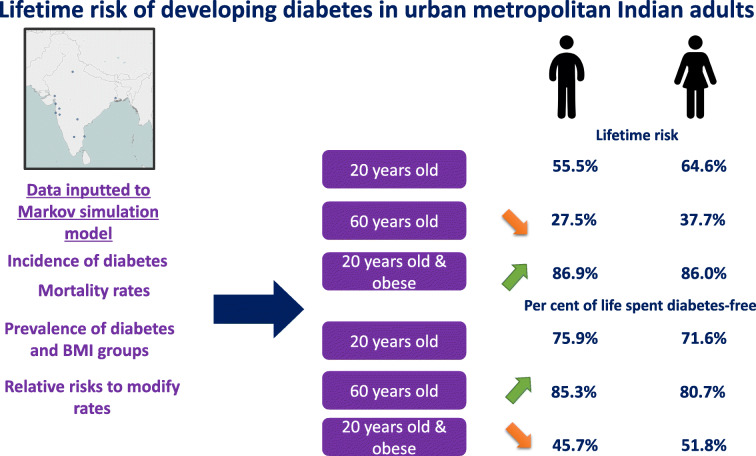
A Markov simulation model was adopted to estimate age-, sex- and BMI-specific lifetime risk of developing diabetes and diabetes-free life expectancy. The main data inputs used were as follows: age-, sex- and BMI-specific incidence rates of diabetes in urban India taken from the Centre for Cardiometabolic Risk Reduction in South Asia (2010-2018); age-, sex- and urban-specific rates of mortality from period lifetables reported by the Government of India (2014); and prevalence of diabetes from the Indian Council for Medical Research INdia DIABetes study (2008-2015).
Lifetime risk (95% CI) of diabetes in 20-year-old men and women was 55.5 (51.6, 59.7)% and 64.6 (60.0, 69.5)%, respectively. Women generally had a higher lifetime risk across the lifespan. Remaining lifetime risk (95% CI) declined with age to 37.7 (30.1, 46.7)% at age 60 years among women and 27.5 (23.1, 32.4)% in men. Lifetime risk (95% CI) was highest among obese Indians: 86.0 (76.6, 91.5)% among 20-year-old women and 86.9 (75.4, 93.8)% among men. We identified considerably higher diabetes-free life expectancy at lower levels of BMI.
CONCLUSIONS/INTERPRETATION: Lifetime risk of diabetes in metropolitan cities in India is alarming across the spectrum of weight and rises dramatically with higher BMI. Prevention of diabetes among metropolitan Indians of all ages is an urgent national priority, particularly given the rapid increase in urban obesogenic environments across the country. Graphical abstract.
目的/假设:我们旨在估计印度大都市 20 岁及以上人群的糖尿病终身风险和无糖尿病预期寿命,并评估其性别、年龄和 BMI 的差异。
采用马尔可夫模拟模型估计糖尿病的年龄、性别和 BMI 特异性终生发病风险和无糖尿病预期寿命。主要数据输入包括以下内容:印度城市中心心血管代谢风险降低研究(2010-2018 年)报告的年龄、性别和 BMI 特异性糖尿病发病率;印度政府报告的时期生命表的年龄、性别和城市特异性死亡率;印度医学研究理事会印度糖尿病研究(2008-2015 年)的糖尿病患病率。
20 岁男性和女性的糖尿病终生风险(95%CI)分别为 55.5%(51.6%,59.7%)和 64.6%(60.0%,69.5%)。女性在整个生命周期中终生风险普遍较高。剩余终生风险(95%CI)随着年龄的增长而下降,女性在 60 岁时降至 37.7%(30.1%,46.7%),男性降至 27.5%(23.1%,32.4%)。肥胖印度人的终生风险最高:20 岁女性为 86.0%(76.6%,91.5%),男性为 86.9%(75.4%,93.8%)。我们发现 BMI 水平较低时,无糖尿病预期寿命较高。
结论/解释:印度大都市的糖尿病终生风险在整个体重范围内令人担忧,并随着 BMI 的增加而急剧上升。预防印度大都市各个年龄段的糖尿病是一项紧迫的国家优先事项,特别是考虑到该国城市肥胖环境的快速增长。