Department of Pathology, University of Cambridge, Cambridge, UK.
Centre for Mathematical Sciences, University of Cambridge, Cambridge, UK.
J Pathol. 2021 Mar;253(3):279-291. doi: 10.1002/path.5592. Epub 2021 Jan 6.
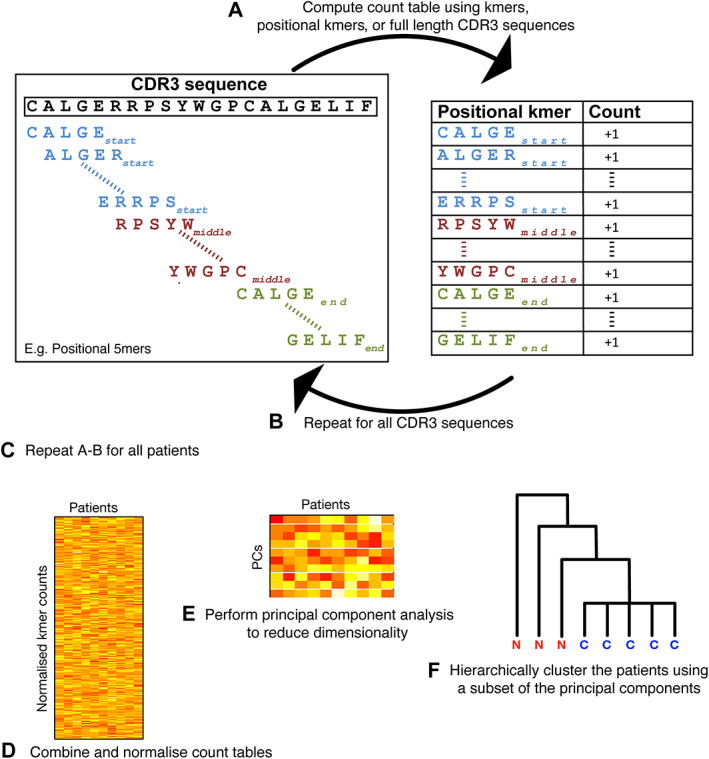
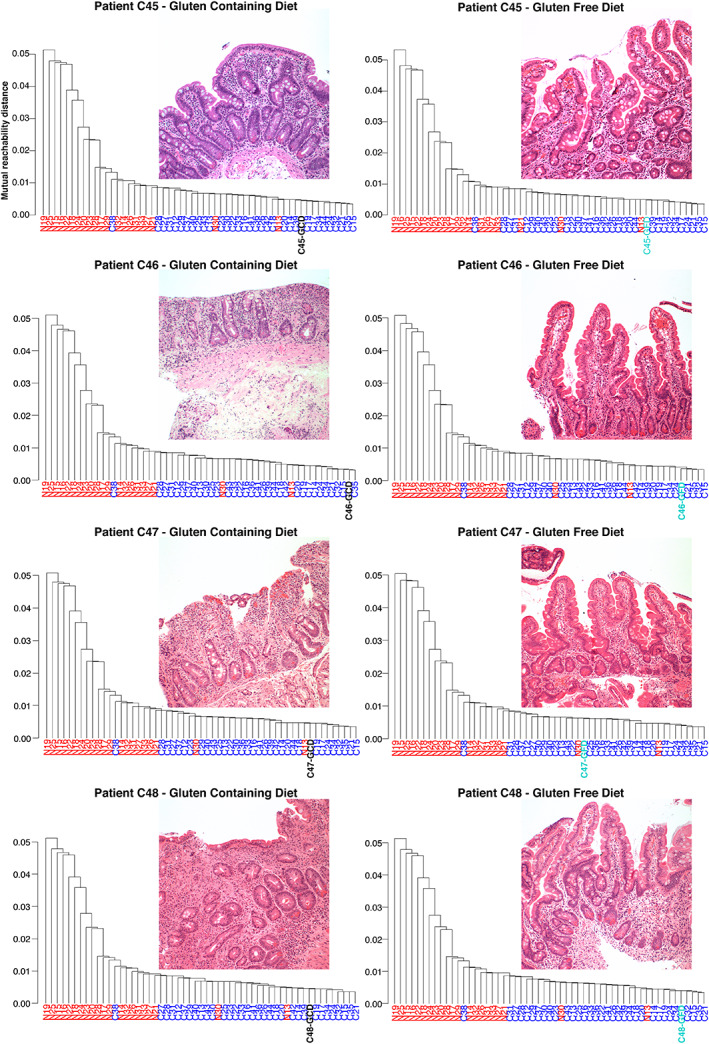
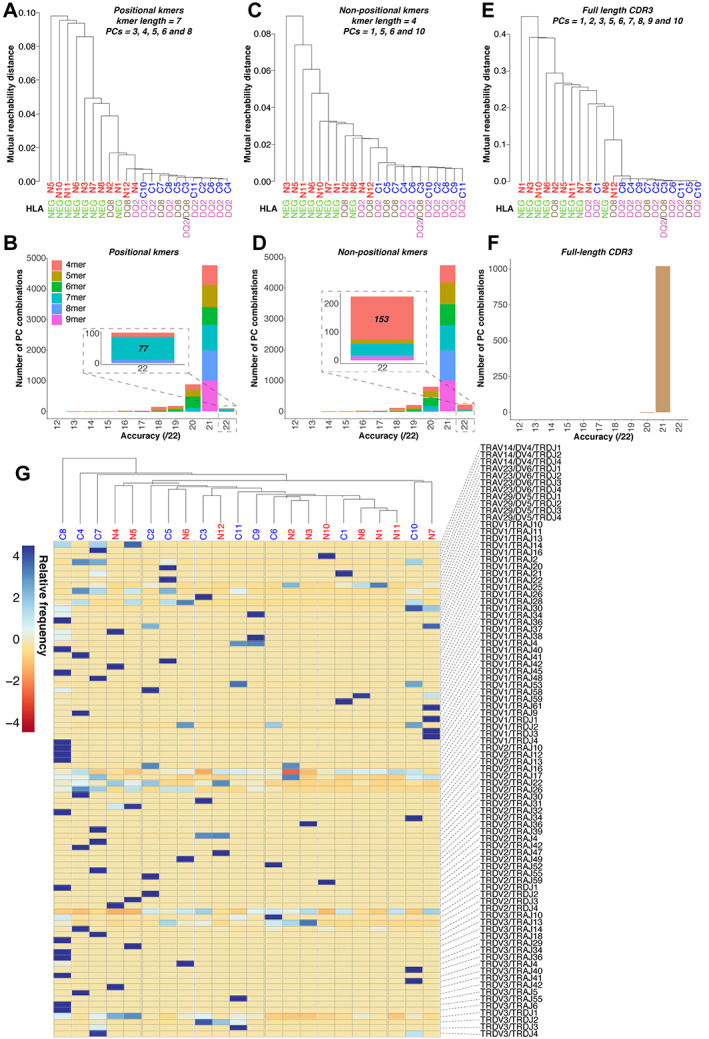
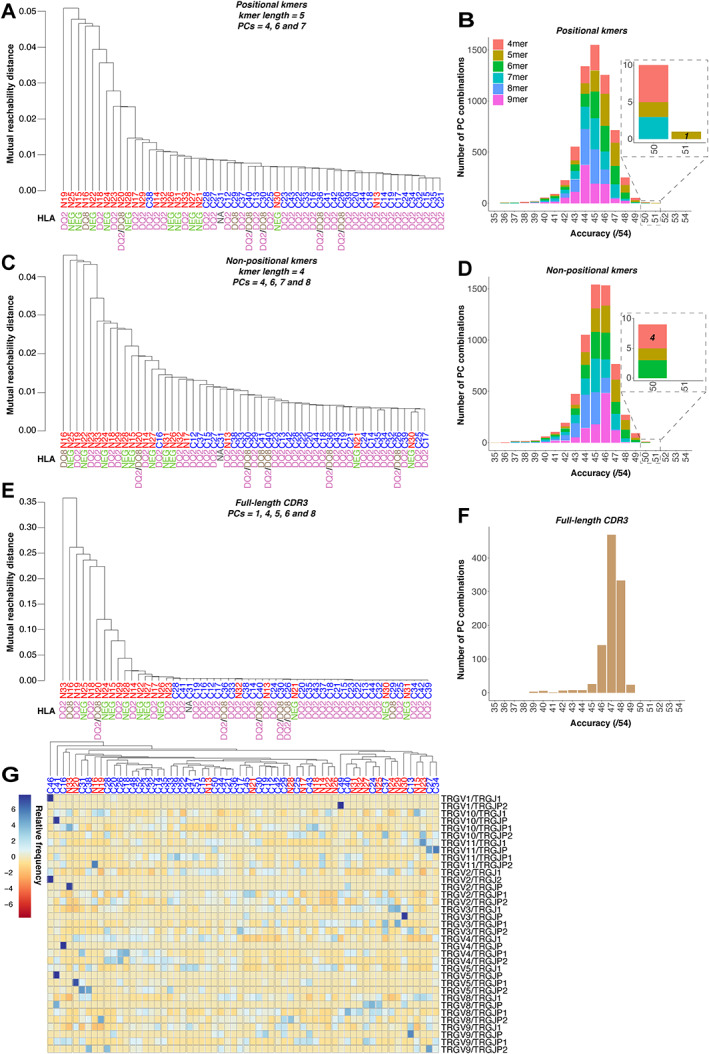
In coeliac disease (CeD), immune-mediated small intestinal damage is precipitated by gluten, leading to variable symptoms and complications, occasionally including aggressive T-cell lymphoma. Diagnosis, based primarily on histopathological examination of duodenal biopsies, is confounded by poor concordance between pathologists and minimal histological abnormality if insufficient gluten is consumed. CeD pathogenesis involves both CD4 T-cell-mediated gluten recognition and CD8 and γδ T-cell-mediated inflammation, with a previous study demonstrating a permanent change in γδ T-cell populations in CeD. We leveraged this understanding and explored the diagnostic utility of bulk T-cell receptor (TCR) sequencing in assessing duodenal biopsies in CeD. Genomic DNA extracted from duodenal biopsies underwent sequencing for TCR-δ (TRD) (CeD, n = 11; non-CeD, n = 11) and TCR-γ (TRG) (CeD, n = 33; non-CeD, n = 21). We developed a novel machine learning-based analysis of the TCR repertoire, clustering samples by diagnosis. Leave-one-out cross-validation (LOOCV) was performed to validate the classification algorithm. Using TRD repertoire, 100% (22/22) of duodenal biopsies were correctly classified, with a LOOCV accuracy of 91%. Using TCR-γ (TRG) repertoire, 94.4% (51/54) of duodenal biopsies were correctly classified, with LOOCV of 87%. Duodenal biopsy TRG repertoire analysis permitted accurate classification of biopsies from patients with CeD following a strict gluten-free diet for at least 6 months, who would be misclassified by current tests. This result reflects permanent changes to the duodenal γδ TCR repertoire in CeD, even in the absence of gluten consumption. Our method could complement or replace histopathological diagnosis in CeD and might have particular clinical utility in the diagnostic testing of patients unable to tolerate dietary gluten, and for assessing duodenal biopsies with equivocal features. This approach is generalisable to any TCR/BCR locus and any sequencing platform, with potential to predict diagnosis or prognosis in conditions mediated or modulated by the adaptive immune response. © 2020 The Authors. The Journal of Pathology published by John Wiley & Sons, Ltd. on behalf of The Pathological Society of Great Britain and Ireland.
在乳糜泻(CeD)中,免疫介导的小肠损伤是由麸质引发的,导致不同的症状和并发症,偶尔包括侵袭性 T 细胞淋巴瘤。诊断主要基于十二指肠活检的组织病理学检查,但由于病理学家之间的一致性差,如果摄入的麸质不足,组织学异常极小,因此诊断会变得复杂。CeD 的发病机制涉及 CD4 T 细胞介导的麸质识别以及 CD8 和 γδ T 细胞介导的炎症,先前的研究表明 CeD 中 γδ T 细胞群体发生了永久性改变。我们利用这一认识,探讨了批量 T 细胞受体(TCR)测序在评估 CeD 中十二指肠活检的诊断效用。从十二指肠活检中提取的基因组 DNA 进行 TCR-δ(TRD)(CeD,n=11;非 CeD,n=11)和 TCR-γ(TRG)(CeD,n=33;非 CeD,n=21)测序。我们开发了一种基于机器学习的新型 TCR 库分析方法,通过诊断对样本进行聚类。采用留一法交叉验证(LOOCV)验证分类算法。使用 TRD 库,100%(22/22)的十二指肠活检被正确分类,LOOCV 准确率为 91%。使用 TCR-γ(TRG)库,94.4%(51/54)的十二指肠活检被正确分类,LOOCV 为 87%。在严格遵循无麸质饮食至少 6 个月的 CeD 患者的十二指肠活检中,TRG 分析允许对活检进行准确分类,而目前的检测方法会对这些患者进行错误分类。这一结果反映了 CeD 中十二指肠 γδ TCR 库的永久性改变,即使没有摄入麸质也是如此。我们的方法可以补充或替代 CeD 的组织病理学诊断,对于无法耐受饮食麸质的患者的诊断测试,以及对于具有不确定特征的十二指肠活检,可能具有特殊的临床应用价值。这种方法适用于任何 TCR/BCR 基因座和任何测序平台,具有预测适应性免疫反应介导或调节的疾病诊断或预后的潜力。