Department of Community Medicine, UiT-The Arctic University of Norway, Tromsø, Norway.
Department of Occupational and Environmental Medicine, University Hospital of North Norway, Tromsø, Norway.
Int Arch Occup Environ Health. 2021 May;94(4):611-619. doi: 10.1007/s00420-020-01606-6. Epub 2020 Nov 23.
Exposure to a cold environment at work is associated with a higher prevalence of musculoskeletal pain and chronic pain in cross-sectional studies. This study aims to determine the association between working in a cold environment ≥ 25% of the time and musculoskeletal complaints (MSC) 7-8 years later.
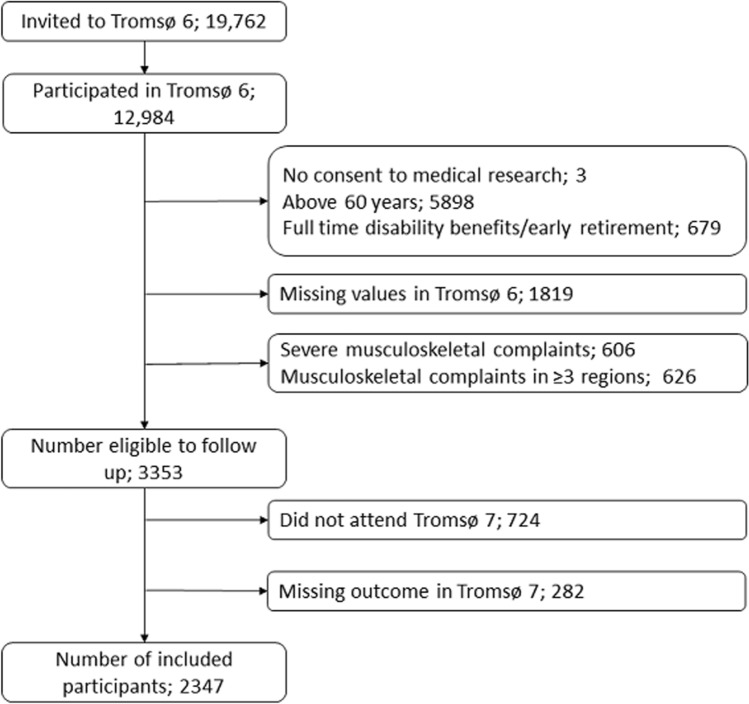
We followed participants from the sixth survey (Tromsø 6, 2007-2008) to the seventh survey (Tromsø 7, 2015-2016) of the Tromsø Study. Analyses included 2347 men and women aged 32-60 years who were not retired and not receiving full-time disability benefits in Tromsø 6. Three different binary outcomes were investigated in Tromsø 7: any MSC, severe MSC, and MSC in ≥ 3 anatomical regions. We excluded participants with severe MSC, MSC in ≥ 3 regions, or missing values in Tromsø 6. The association between working in a cold environment and future MSC were examined using Poisson regression and adjusted for age, sex, number of moderate MSC, education, physical activity at work, smoking status, body mass index, and self-reported health in Tromsø 6.
258 participants reported to work in a cold environment ≥ 25% of the time in Tromsø 6. They had an increased risk of having any MSC in Tromsø 7 (incidence rate ratio 1.15; 95% confidence interval 1.03-1.29). There was no significantly increased risk of severe MSC or MSC in ≥ 3 regions.
Working in a cold environment was associated with future MSC, but not with future severe MSC or future MSC in ≥ 3 regions.
横断面研究表明,在工作环境中接触寒冷与肌肉骨骼疼痛和慢性疼痛的患病率较高有关。本研究旨在确定在寒冷环境中工作≥25%的时间与 7-8 年后肌肉骨骼投诉(MSC)之间的关联。
我们随访了来自特罗姆瑟研究第六次调查(2007-2008 年)到第七次调查(2015-2016 年)的参与者。分析包括 2347 名年龄在 32-60 岁之间、在特罗姆瑟 6 时未退休且未领取全时残疾津贴的男性和女性。在特罗姆瑟 7 中调查了三种不同的二元结果:任何 MSC、严重 MSC 和≥3 个解剖区域的 MSC。我们排除了在特罗姆瑟 6 中患有严重 MSC、≥3 个区域的 MSC 或有缺失值的参与者。使用泊松回归检验了在寒冷环境中工作与未来 MSC 之间的关系,并在特罗姆瑟 6 中调整了年龄、性别、中度 MSC 的数量、教育、工作时的体力活动、吸烟状况、体重指数和自我报告的健康状况。
258 名参与者在特罗姆瑟 6 中报告工作环境中≥25%的时间处于寒冷环境中。他们在特罗姆瑟 7 中出现任何 MSC 的风险增加(发病率比 1.15;95%置信区间 1.03-1.29)。严重 MSC 或≥3 个区域的 MSC 风险没有显著增加。
在寒冷环境中工作与未来 MSC 相关,但与未来严重 MSC 或≥3 个区域的 MSC 无关。