Sundstrup Emil, Jakobsen Markus D, Brandt Mikkel, Jay Kenneth, Persson Roger, Andersen Lars L
National Research Centre for the Working Environment, 2100 Copenhagen, Denmark ; Institute for Sports Science and Clinical Biomechanics, University of Southern Denmark, 5230 Odense, Denmark.
National Research Centre for the Working Environment, 2100 Copenhagen, Denmark ; Physical Activity and Human Performance Group, SMI, Department of Health Science and Technology, Aalborg University, 9220 Aalborg, Denmark.
Pain Res Treat. 2015;2015:793750. doi: 10.1155/2015/793750. Epub 2015 Sep 6.
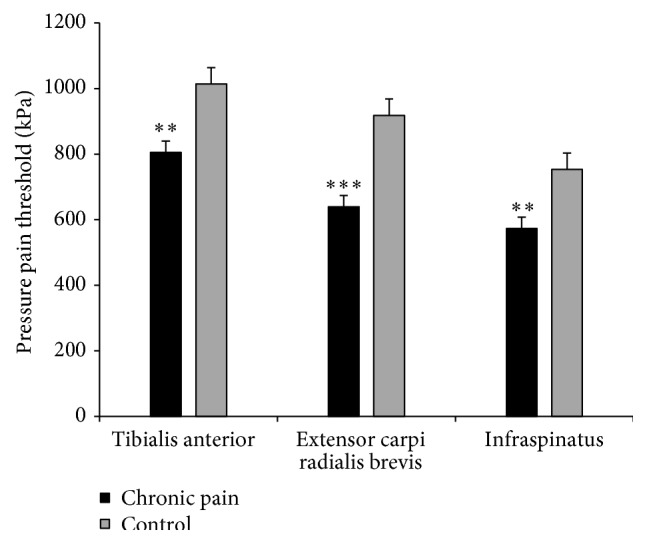
Monitoring of indoor climate is an essential part of occupational health and safety. While questionnaires are commonly used for surveillance, not all workers may perceive an identical indoor climate similarly. The aim of this study was to evaluate perceived indoor climate among workers with chronic pain compared with pain-free colleagues and to determine the influence of central sensitization on this perception. Eighty-two male slaughterhouse workers, 49 with upper-limb chronic pain and 33 pain-free controls, replied to a questionnaire with 13 items of indoor climate complaints. Pressure pain threshold (PPT) was measured in muscles of the arm, shoulder, and lower leg. Cross-sectional associations were determined using general linear models controlled for age, smoking, and job position. The number of indoor climate complaints was twice as high among workers with chronic pain compared with pain-free controls (1.8 [95% CI: 1.3-2.3] versus 0.9 [0.4-1.5], resp.). PPT of the nonpainful leg muscle was negatively associated with the number of complaints. Workers with chronic pain reported more indoor climate complaints than pain-free controls despite similar actual indoor climate. Previous studies that did not account for musculoskeletal pain in questionnaire assessment of indoor climate may be biased. Central sensitization likely explains the present findings.
室内气候监测是职业健康与安全的重要组成部分。虽然问卷调查通常用于监测,但并非所有工人对相同的室内气候都有相同的感受。本研究的目的是评估与无疼痛的同事相比,慢性疼痛工人对室内气候的感受,并确定中枢敏化对这种感受的影响。82名男性屠宰场工人,49名患有上肢慢性疼痛,33名无疼痛对照,回答了一份包含13项室内气候投诉的问卷。测量了手臂、肩部和小腿肌肉的压痛阈值(PPT)。使用控制年龄、吸烟和工作岗位的一般线性模型确定横断面关联。与无疼痛对照相比,慢性疼痛工人的室内气候投诉数量高出两倍(分别为1.8[95%CI:1.3 - 2.3]对0.9[0.4 - 1.5])。无痛腿部肌肉的PPT与投诉数量呈负相关。尽管实际室内气候相似,但慢性疼痛工人报告的室内气候投诉比无疼痛对照更多。之前在室内气候问卷评估中未考虑肌肉骨骼疼痛的研究可能存在偏差。中枢敏化可能解释了目前的研究结果。