Biomedical Ethics Unit, McGill University, Montreal, Quebec, Canada (A.M., N.H., O.S., E.O., E.F., C.O., J.S., F.A., C.W., J.K.).
McGill University, Montreal, Quebec, Canada (J.P., N.E.B.).
Ann Intern Med. 2021 Mar;174(3):326-334. doi: 10.7326/M20-5350. Epub 2020 Nov 24.
Anticipated success rates and timelines for COVID-19 vaccine development vary. Recent experience with developing and testing viral vaccine candidates can inform expectations regarding the development of safe and effective vaccines.
To estimate timelines and probabilities of success for recent vaccine candidates.
ClinicalTrials.gov was searched to identify trials testing viral vaccines that had not advanced to phase 2 before 2005, and the progress of each vaccine from phase 1 through to U.S. Food and Drug Administration (FDA) licensure was tracked. Trial characteristics were double-coded. (Registration: Open Science Framework [https://osf.io/dmuzx/]).
Trials launched between January 2005 and March 2020.
Preventive viral vaccine candidates for 23 emerging or reemerged viral infectious diseases.
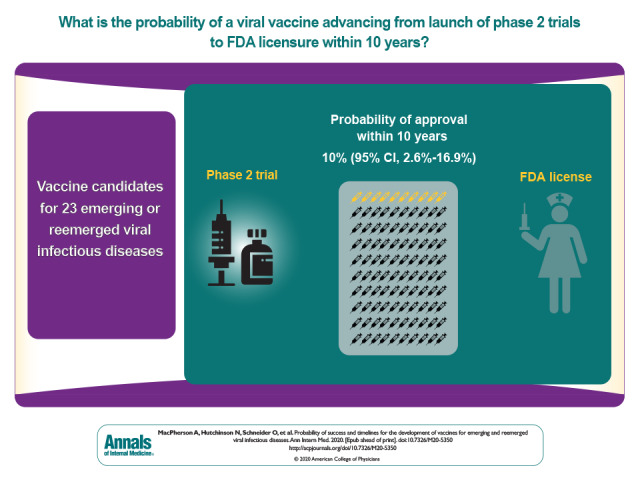
The primary end point was the probability of vaccines advancing from launch of phase 2 to FDA licensure within 10 years.
In total, 606 clinical trials forming 220 distinct development trajectories (267 343 enrolled participants) were identified. The probability of vaccines progressing from phase 2 to licensure within 10 years was 10.0% (95% CI, 2.6% to 16.9%), with most approvals representing H1N1 or H5N1 vaccines. The average timeline from phase 2 to approval was 4.4 years (range, 6.4 weeks to 13.9 years). The probabilities of advancing from phase 1 to 2, phase 2 to 3, and phase 3 to licensure within the total available follow-up time were 38.2% (CI, 30.7% to 45.0%), 38.3% (CI, 23.1% to 50.5%), and 61.1% (CI, 3.7% to 84.3%), respectively.
The study did not account for preclinical development and relied primarily on ClinicalTrials.gov and FDA resources. Success probabilities do not capture the varied reasons why vaccines fail to advance to regulatory approval.
Success probabilities and timelines varied widely across different vaccine types and diseases. If a SARS-CoV-2 vaccine is licensed within 18 months of the start of the pandemic, it will mark an unprecedented achievement for noninfluenza viral vaccine development.
McGill Interdisciplinary Initiative in Infection and Immunity (MI4) Emergency COVID-19 Research Funding program.
新冠疫苗开发的预期成功率和时间框架各不相同。最近在开发和测试病毒疫苗方面的经验可以为开发安全有效的疫苗提供预期。
估计最近疫苗候选者的时间框架和成功概率。
在 2005 年之前,在 ClinicalTrials.gov 上搜索了尚未进入 2 期临床试验的正在开发和测试的病毒候选疫苗,并跟踪了每种疫苗从 1 期到美国食品和药物管理局(FDA)许可的进展。试验特征经过了双重编码。(注册:Open Science Framework [https://osf.io/dmuzx/])。
2005 年 1 月至 2020 年 3 月期间启动的试验。
针对 23 种新出现或重新出现的病毒性传染病的预防性病毒疫苗候选物。
主要终点是疫苗在 10 年内从 2 期临床试验推进到 FDA 许可的概率。
共确定了 606 项临床试验,形成了 220 个不同的开发轨迹(267343 名参与者)。在 10 年内从 2 期临床试验推进到许可的疫苗概率为 10.0%(95%CI,2.6%至 16.9%),大多数批准的疫苗代表 H1N1 或 H5N1 疫苗。从 2 期到批准的平均时间为 4.4 年(范围:6.4 周至 13.9 年)。在总随访时间内,从 1 期到 2 期、2 期到 3 期和 3 期到许可的推进概率分别为 38.2%(CI,30.7%至 45.0%)、38.3%(CI,23.1%至 50.5%)和 61.1%(CI,3.7%至 84.3%)。
该研究没有考虑临床前开发,主要依赖于 ClinicalTrials.gov 和 FDA 资源。成功率并不能捕捉到疫苗未能获得监管批准的各种原因。
不同疫苗类型和疾病的成功率和时间框架差异很大。如果在大流行开始后 18 个月内获得 SARS-CoV-2 疫苗许可,这将标志着非流感病毒疫苗开发的一个前所未有的成就。
麦吉尔传染病与免疫学跨学科倡议(MI4)紧急 COVID-19 研究资助计划。