Laboratory of Regulatory Biology, Department of Life Sciences, School of Agriculture, Meiji University, Kanagawa 214-8571, Japan.
Department of Reproductive Biology, National Research Institute for Child Health and Development, Tokyo 157-8535, Japan.
Int J Mol Sci. 2020 Nov 19;21(22):8731. doi: 10.3390/ijms21228731.
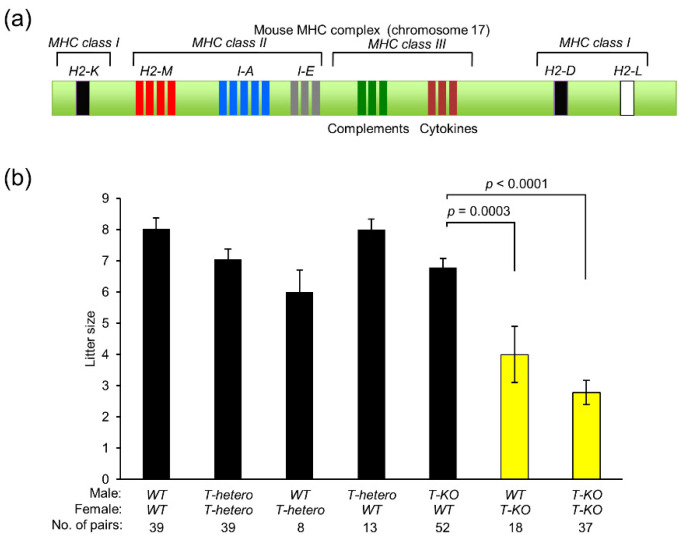
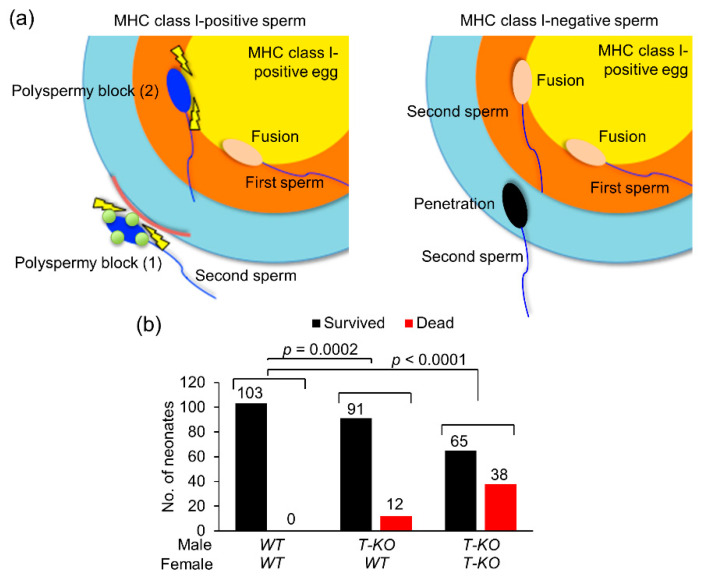
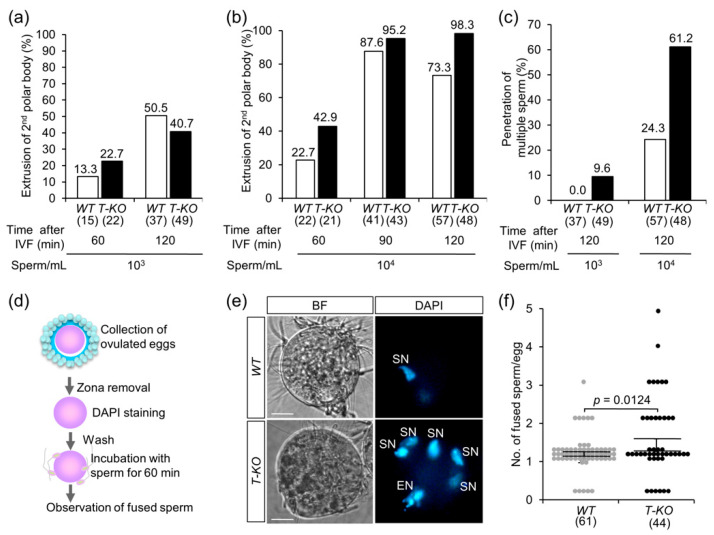
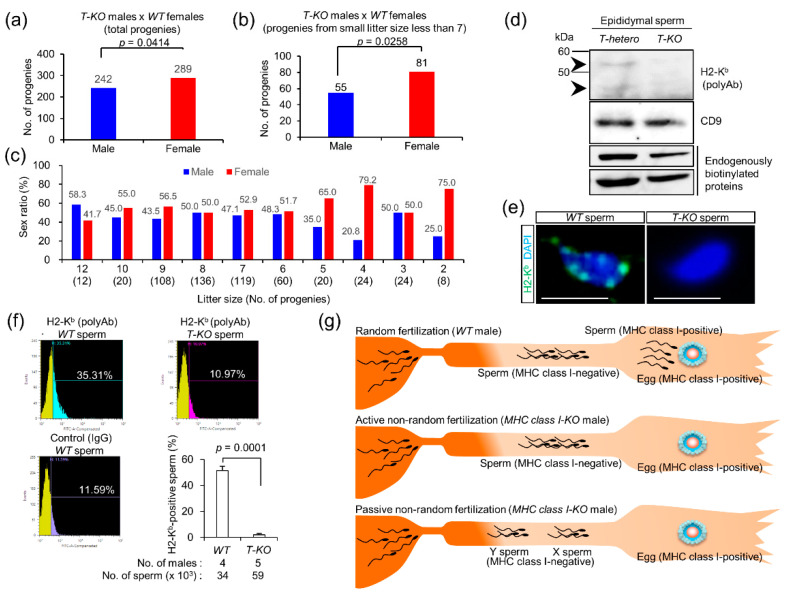
Hermaphroditic invertebrates and plants have a self-recognition system on the cell surface of sperm and eggs, which prevents their self-fusion and enhances non-self-fusion, thereby contributing to genetic variation. However, the system of sperm-egg recognition in mammals is under debate. To address this issue, we explored the role of major histocompatibility complex class I (MHC class I, also known as histocompatibility 2-K or H2-K and H2-D in mice) antigens by analyzing () triple-knockout () male mice with full fertility. sperm exhibited an increased sperm number in the perivitelline space of wild-type () eggs in vitro. Moreover, sperm showed multiple fusion with zona pellucida (ZP)-free eggs, implying that the ability of polyspermy block for sperm from males was weakened in eggs. When male mice were intercrossed with female mice, the percentage of females in progeny increased. We speculate that eggs prefer fusion with sperm, more specifically X-chromosome-bearing sperm (X sperm), suggesting the presence of preferential (non-random) fertilization in mammals, including humans.
雌雄同体的无脊椎动物和植物在精子和卵子的细胞表面具有自我识别系统,该系统可防止它们的自我融合并增强非自我融合,从而有助于遗传变异。然而,哺乳动物的精卵识别系统仍存在争议。为了解决这个问题,我们通过分析具有完全生育能力的()三重敲除()雄性小鼠,探讨了主要组织相容性复合体 I 类(MHC I 类,也称为组织相容性 2-K 或 H2-K 和 H2-D 在小鼠中)抗原的作用。()精子在野生型()卵的卵周腔中显示出精子数量增加。此外,()精子与无透明带(ZP)的()卵多次融合,这意味着来自()雄性的精子的多精入卵阻滞能力在()卵中减弱。当()雄性小鼠与()雌性小鼠杂交时,后代中雌性的比例增加。我们推测()卵更喜欢与()精子融合,更具体地说是 X 染色体携带的精子(X 精子)融合,这表明哺乳动物(包括人类)中存在优先(非随机)受精现象。