Department of Human Physiology and Pathophysiology, School of Medicine, Collegium Medicum, University of Warmia and Mazury in Olsztyn, Warszawska Str. 30, 10-082 Olsztyn, Poland.
Department of Clinical Diagnostics, Faculty of Veterinary Medicine, University of Warmia and Mazury, Oczapowskiego Str. 13, 10-719 Olsztyn, Poland.
Int J Mol Sci. 2020 Nov 19;21(22):8743. doi: 10.3390/ijms21228743.
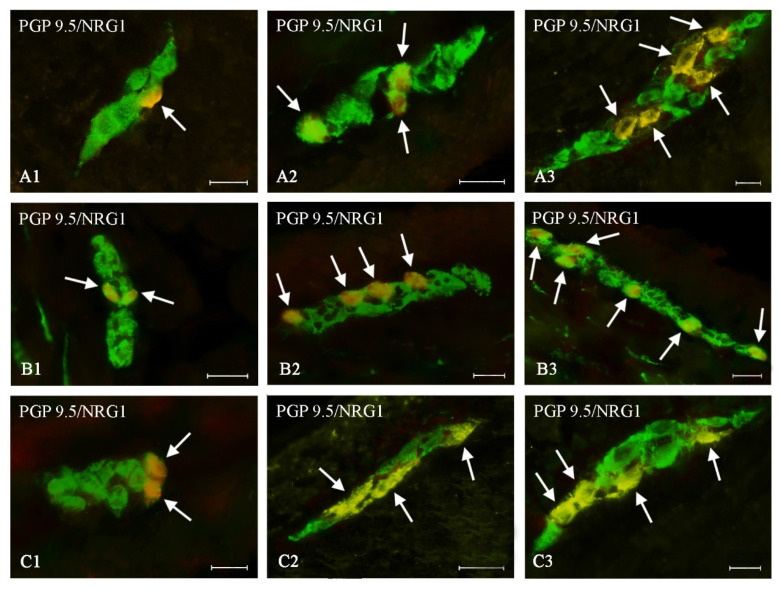
The enteric nervous system (ENS), located in the wall of the gastrointestinal (GI) tract, is characterized by complex organization and a high degree of neurochemical diversity of neurons. One of the less known active neuronal substances found in the enteric neurons is neuregulin 1 (NRG1), a factor known to be involved in the assurance of normal development of the nervous system. During the study, made up using the double immunofluorescence technique, the presence of NRG1 in the ENS of the selected segment of porcine large intestine (caecum, ascending and descending colon) was observed in physiological conditions, as well as under the impact of low and high doses of bisphenol A (BPA) which is commonly used in the production of plastics. In control animals in all types of the enteric plexuses, the percentage of NRG1-positive neurons oscillated around 20% of all neurons. The administration of BPA caused an increase in the number of NRG1-positive neurons in all types of the enteric plexuses and in all segments of the large intestine studied. The most visible changes were noted in the inner submucous plexus of the ascending colon, where in animals treated with high doses of BPA, the percentage of NRG1-positive neurons amounted to above 45% of all neuronal cells. The mechanisms of observed changes are not entirely clear, but probably result from neurotoxic, neurodegenerative and/or proinflammatory activity of BPA and are protective and adaptive in nature.
肠神经系统(ENS)位于胃肠道壁内,其特点是神经元具有复杂的组织和高度的神经化学多样性。在肠神经元中发现的一种不太为人知的活性神经元物质是神经调节蛋白 1(NRG1),已知这种物质参与神经系统的正常发育。在研究中,使用双重免疫荧光技术,观察到在生理条件下以及在低剂量和高剂量双酚 A(BPA)的影响下,NRG1 存在于所选猪大肠段(盲肠、升结肠和降结肠)的 ENS 中。在所有类型的肠丛中,在对照动物中,NRG1 阳性神经元的百分比在所有神经元的 20%左右波动。BPA 的给药导致所有类型的肠丛和研究的大肠所有节段中 NRG1 阳性神经元的数量增加。在升结肠的黏膜下内丛中观察到最明显的变化,在接受高剂量 BPA 治疗的动物中,NRG1 阳性神经元的百分比达到所有神经元的 45%以上。观察到的变化的机制尚不完全清楚,但可能是由于 BPA 的神经毒性、神经退行性和/或促炎活性引起的,并且具有保护和适应性。