Department of Hematology, The First Affiliated Hospital of Zhengzhou University, No. 1, Jianshe East Road, Zhengzhou, 450052, Henan, P. R. China.
Mol Med. 2020 Nov 24;26(1):114. doi: 10.1186/s10020-020-00229-4.
Long non-coding RNAs (lncRNAs) are biomarkers participating in multiple disease development including acute myeloid leukemia (AML). Here, we investigated molecular mechanism of X Inactive-Specific Transcript (XIST) in regulating cellular viability, apoptosis and drug resistance in AML.
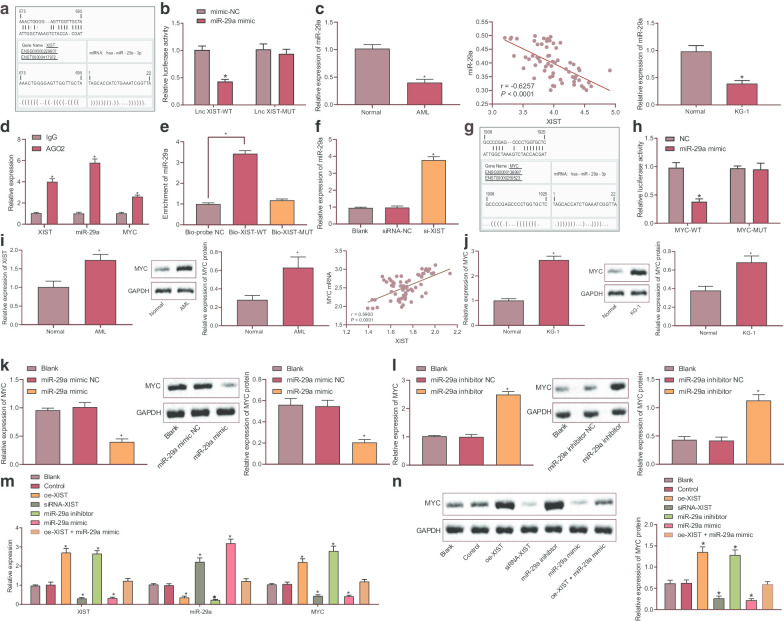
XIST, miR-29a and myelocytomatosis oncogene (MYC) expression in AML bone marrow cells collected from 62 patients was evaluated by RT-qPCR and Western blot analysis. Besides, the relationship among XIST, miR-29a and MYC was analyzed by dual luciferase reporter assay, RIP, and RNA pull down assays. AML KG-1 cells were treated with anti-tumor drug Adriamycin. The role of XIST/miR-29a/MYC in cellular viability, apoptosis and drug resistance in AML was accessed via gain- and loss-of-function approaches. At last, we evaluated role of XIST/miR-29a/MYC on tumorigenesis in vivo.
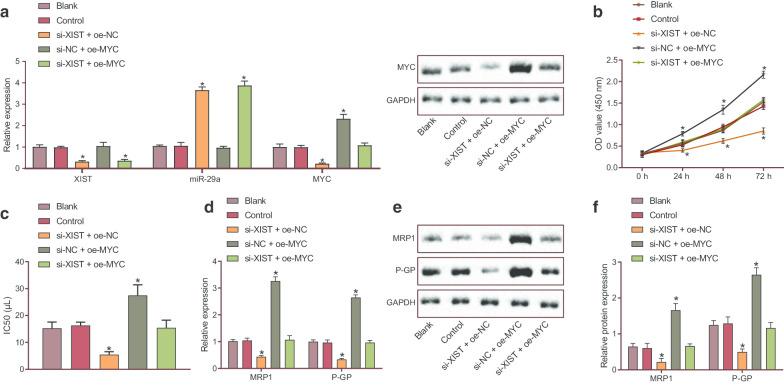
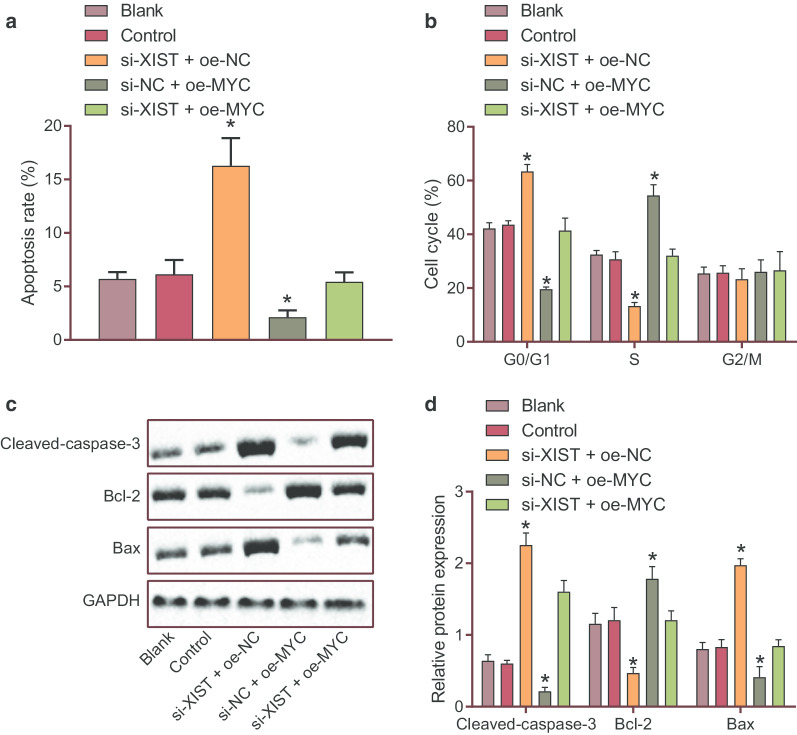
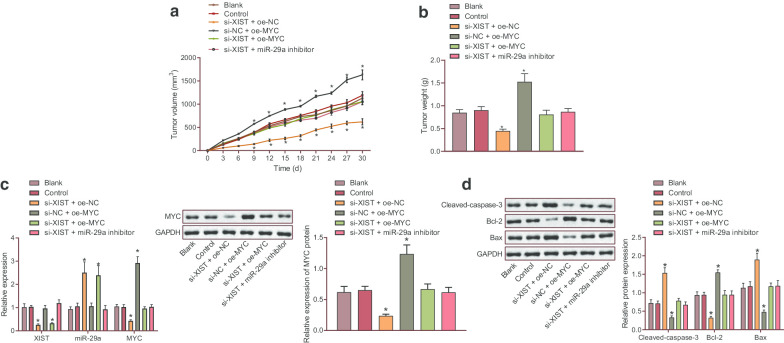
XIST and MYC were up-regulated, and miR-29a was down-regulated in AML bone marrow cells. Silencing XIST inhibited cellular activity and drug resistance but promoted cellular apoptosis of KG-1 cells by down-regulating MYC. XIST inhibited miR-29a expression to up-regulate MYC. Moreover, silencing XIST inhibited tumorigenesis of AML cells in vivo.
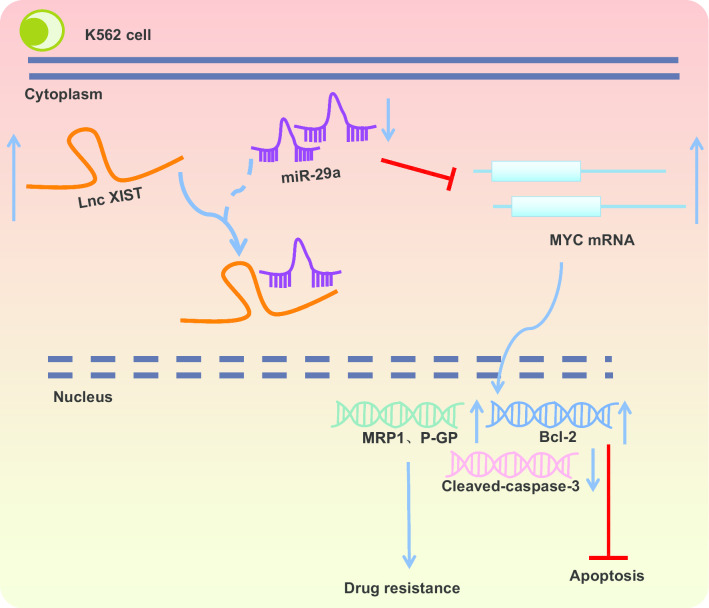
Overall, down-regulation of XIST decreased MYC expression through releasing the inhibition on miR-29a, thereby reducing drug resistance, inhibiting viability and promoting apoptosis of AML cells.
长非编码 RNA(lncRNA)是参与包括急性髓细胞白血病(AML)在内的多种疾病发展的生物标志物。在这里,我们研究了 X 失活特异性转录物(XIST)在调节 AML 细胞活力、凋亡和耐药性方面的分子机制。
通过 RT-qPCR 和 Western blot 分析评估了 62 例 AML 患者骨髓细胞中 XIST、miR-29a 和髓细胞瘤致癌基因(MYC)的表达。此外,通过双荧光素酶报告基因检测、RIP 和 RNA 下拉实验分析了 XIST、miR-29a 和 MYC 之间的关系。用抗肿瘤药物阿霉素处理 AML KG-1 细胞。通过增益和失活功能方法评估 XIST/miR-29a/MYC 在 AML 细胞活力、凋亡和耐药性中的作用。最后,我们评估了 XIST/miR-29a/MYC 对体内肿瘤发生的作用。
AML 骨髓细胞中 XIST 和 MYC 上调,miR-29a 下调。沉默 XIST 通过下调 MYC 抑制 KG-1 细胞的细胞活性和耐药性,但促进细胞凋亡。XIST 抑制 miR-29a 的表达,从而上调 MYC。此外,沉默 XIST 抑制 AML 细胞在体内的肿瘤发生。
总的来说,下调 XIST 通过释放对 miR-29a 的抑制作用,降低 MYC 表达,从而降低 AML 细胞的耐药性、抑制活力并促进凋亡。