UMR LEASP, Université de Toulouse III, UPS, Inserm, Toulouse, France.
CESP, Faculté de Médecine, Université Paris-Saclay, UVSQ, INSERM, Villejuif, France.
BMC Cancer. 2020 Nov 23;20(1):1138. doi: 10.1186/s12885-020-07648-w.
Women with an advantaged socioeconomic position (SEP) have a higher risk of developing breast cancer (BC). The reasons for this association do not seem to be limited to reproductive factors and remain to be understood. We aimed to investigate the impact of lifecourse SEP from childhood and social mobility on the risk of BC considering a broad set of potential mediators.
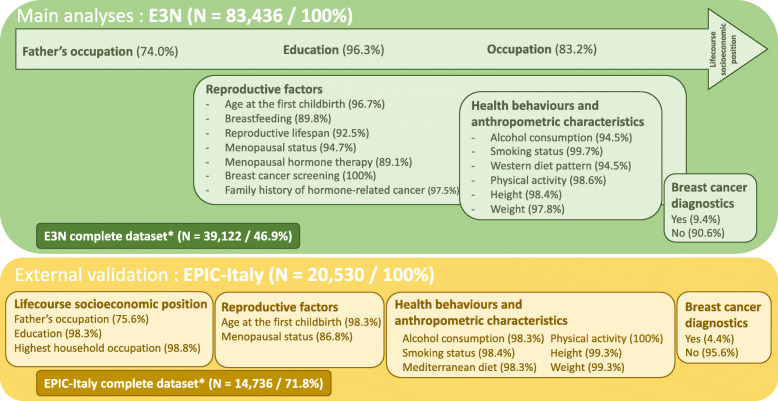
We used a discovery-replication strategy in two European prospective cohorts, E3N (N = 83,436) and EPIC-Italy (N = 20,530). In E3N, 7877 women were diagnosed with BC during a median 24.4 years of follow-up, while in EPIC-Italy, 893 BC cases were diagnosed within 15.1 years. Hazard ratios (HR) were estimated using Cox proportional hazard models on imputed data.
In E3N, women with higher education had a higher risk of BC (HR [95%CI] = 1.21 [1.12, 1.30]). This association was attenuated by adjusting for reproductive factors, in particular age at first childbirth (HR[95%CI] = 1.13 [1.04, 1.22]). Health behaviours, anthropometric variables, and BC screening had a weaker effect on the association. Women who remained in a stable advantaged SEP had a higher risk of BC (HR [95%CI] = 1.24 [1.07; 1.43]) attenuated after adjustment for potential mediators (HR [95%CI] = 1.13 [0.98; 1.31]). These results were replicated in EPIC-Italy.
These results confirm the important role of reproductive factors in the social gradient in BC risk, which does not appear to be fully explained by the large set of potential mediators, including cancer screening, suggesting that further research is needed to identify additional mechanisms.
社会经济地位(SEP)较高的女性患乳腺癌(BC)的风险更高。这种关联的原因似乎不仅限于生殖因素,仍有待理解。我们旨在研究从儿童期到社会流动性的整个生命周期 SEP 对 BC 风险的影响,同时考虑广泛的潜在中介因素。
我们在两个欧洲前瞻性队列 E3N(N=83436)和 EPIC-Italy(N=20530)中使用了发现-复制策略。在 E3N 中,7877 名女性在中位 24.4 年的随访期间被诊断患有 BC,而在 EPIC-Italy 中,893 名 BC 病例在 15.1 年内被诊断。使用 Cox 比例风险模型在推断数据上估计风险比(HR)。
在 E3N 中,受教育程度较高的女性患 BC 的风险更高(HR[95%CI]=1.21[1.12, 1.30])。通过调整生殖因素,特别是初产年龄(HR[95%CI]=1.13[1.04, 1.22]),该关联减弱。健康行为、人体测量变量和 BC 筛查对该关联的影响较弱。那些保持稳定优势 SEP 的女性患 BC 的风险更高(HR[95%CI]=1.24[1.07; 1.43]),在调整潜在中介因素后减弱(HR[95%CI]=1.13[0.98; 1.31])。这些结果在 EPIC-Italy 中得到了复制。
这些结果证实了生殖因素在 BC 风险的社会梯度中起着重要作用,而这似乎并没有被包括癌症筛查在内的大量潜在中介因素完全解释,这表明需要进一步研究以确定其他机制。