AJ Drexel Autism Institute, Drexel University, 3020 Market St, Suite 560, Philadelphia, PA, 19104, USA.
Department of Epidemiology and Biostatistics, Drexel University School of Public Health, 3215 Market Street, Philadelphia, PA, 19104, USA.
Mol Autism. 2020 Nov 23;11(1):93. doi: 10.1186/s13229-020-00395-6.
Prenatal exposure to increased androgens has been suggested as a risk factor for autism spectrum disorder (ASD). This hypothesis has been examined by measurement of steroids in amniotic fluid, cord blood, saliva, and blood with mixed results.
To provide an orthogonal measure of fetal exposure, this study used meconium, the first stool of a newborn, to measure prenatal androgen exposure from infants in the Early Autism Risk Longitudinal Investigation (EARLI). EARLI is a familial-enriched risk cohort that enrolled pregnant mothers who already had a child with an ASD diagnosis. In the younger child, we investigated the association between meconium unconjugated (u) and total (t) concentrations of major androgens testosterone (T), dehydroepiandrosterone (DHEA), and androstenedione (A4), and ASD-related traits at 12 and 36 months of age. Traits were measured at 12 months with Autism Observation Scale for Infants (AOSI) and at 36 months with total score on the Social Responsiveness Scale (SRS). One hundred and seventy children had meconium and AOSI, 140 had meconium and SRS, and 137 had meconium and both AOSI and SRS.
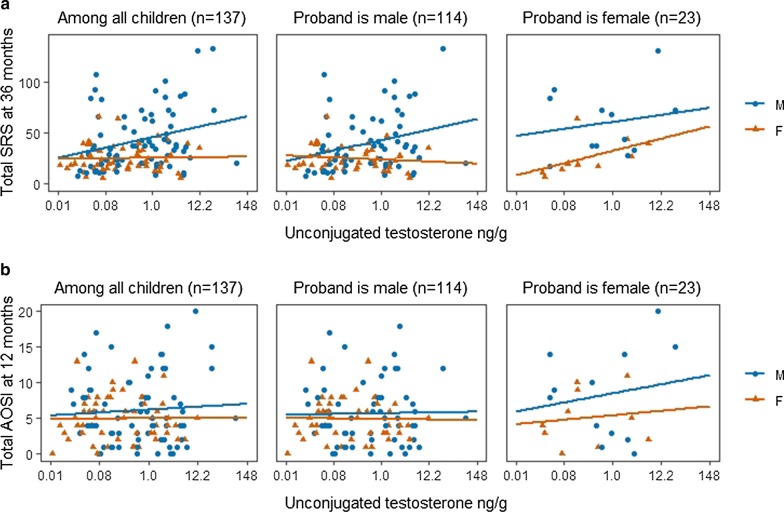
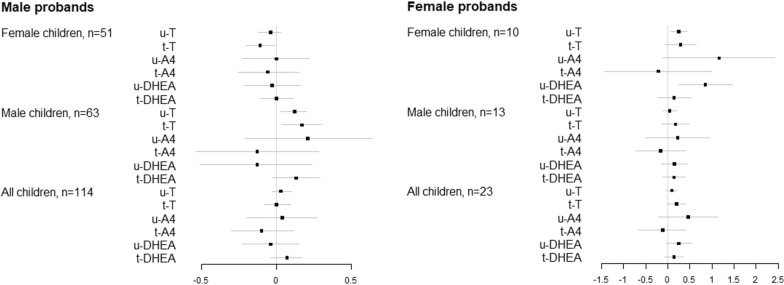
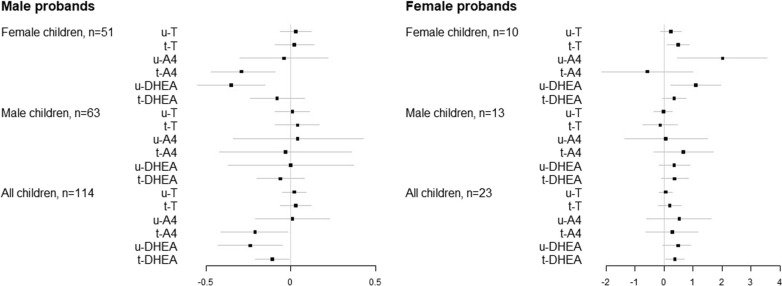
Separate robust linear regressions between each of the log-transformed androgens and log-transformed SRS scores revealed three-way interaction between sex of the child, sex of the proband, and testosterone concentration. In the adjusted analyses, t-T, u-A4, and u-DHEA (P ≤ 0.01) were positively associated with AOSI scores, while u-T (P = 0.004) and u-DHEA (P = 0.007) were positively associated with SRS total score among females with female probands (n = 10). Additionally, higher concentrations of u-T (P = 0.01) and t-T (P = 0.01) predicted higher SRS total score in males with male probands (n = 63). Limitations Since we explored three-way interactions, this resulted in a limited sample size for some analyses. This study was from an enriched-risk cohort which may limit generalizability, and this study used ASD-assessment scales as outcomes instead of diagnostic categories. Additionally, the novel use of meconium in this study limits the ability to compare the results in this cohort to others due to the paucity of research on meconium.
This study supports the utility of meconium for studies of endogenous fetal metabolism and suggests the sex of older siblings with autism should be considered as a biological variable in relevant studies.
产前暴露于增加的雄激素被认为是自闭症谱系障碍(ASD)的一个风险因素。通过测量羊水、脐带血、唾液和血液中的类固醇,对这一假说进行了检验,但结果喜忧参半。
为了提供胎儿暴露的正交测量,本研究使用了新生儿的第一次粪便(胎粪),来测量早期自闭症风险纵向研究(EARLI)中婴儿的产前雄激素暴露情况。EARLI 是一个家族性富集风险队列,招募了已经有自闭症谱系障碍诊断的孩子的孕妇。在较小的孩子中,我们研究了胎粪中未结合(u)和总(t)浓度的主要雄激素睾酮(T)、脱氢表雄酮(DHEA)和雄烯二酮(A4)与 12 个月和 36 个月时自闭症相关特征之间的关系。12 个月时使用婴儿自闭症观察量表(AOSI)测量特征,36 个月时使用社会反应量表(SRS)的总分测量特征。有 170 名儿童有胎粪和 AOSI,140 名儿童有胎粪和 SRS,137 名儿童有胎粪和 AOSI 以及 SRS。
对每个对数转换的雄激素和对数转换的 SRS 评分进行独立的稳健线性回归,揭示了儿童的性别、先证者的性别和睾酮浓度之间的三向相互作用。在调整后的分析中,t-T、u-A4 和 u-DHEA(P≤0.01)与 AOSI 评分呈正相关,而 u-T(P=0.004)和 u-DHEA(P=0.007)与女性先证者的女性儿童的 SRS 总分呈正相关(n=10)。此外,在男性先证者的男性儿童中,较高的 u-T(P=0.01)和 t-T(P=0.01)浓度预测了较高的 SRS 总分(n=63)。
由于我们探索了三向相互作用,这导致了一些分析的样本量有限。本研究来自一个富集风险队列,这可能限制了其普遍性,并且本研究使用自闭症评估量表作为结果,而不是诊断类别。此外,由于关于胎粪的研究很少,本研究中胎粪的新用途限制了将该队列的结果与其他结果进行比较的能力。
本研究支持胎粪在研究内源性胎儿代谢中的效用,并表明自闭症的哥哥或姐姐的性别应被视为相关研究中的一个生物学变量。