Department of Biochemistry & Molecular Biology, University of Georgia, Athens, Georgia, USA.
Complex Carbohydrate Research Center, University of Georgia, Athens, Georgia, USA.
J Biol Chem. 2021 Jan-Jun;296:100110. doi: 10.1074/jbc.RA120.015305. Epub 2020 Dec 3.
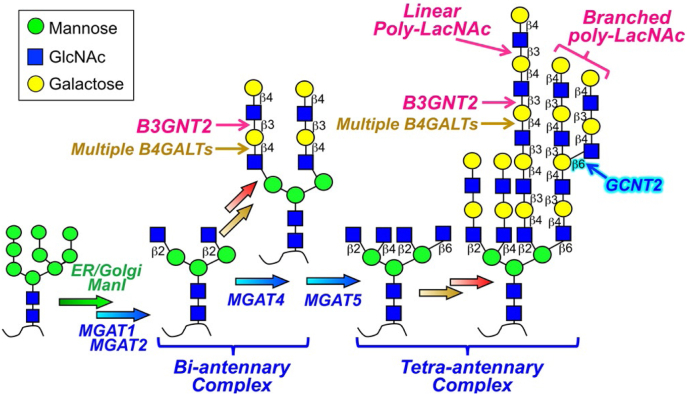
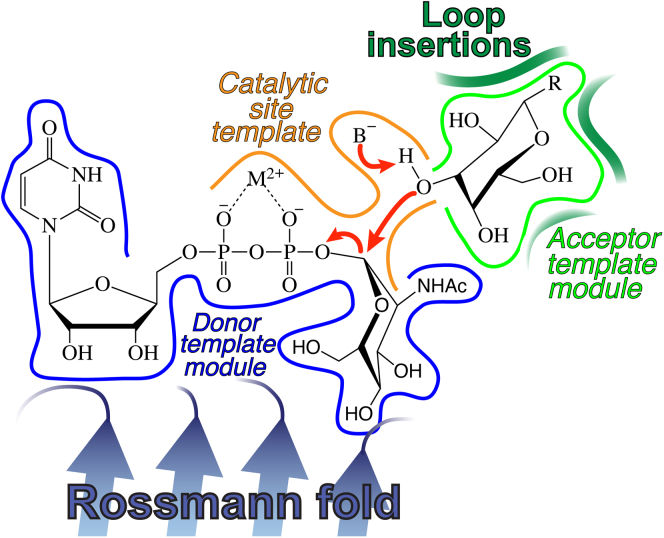
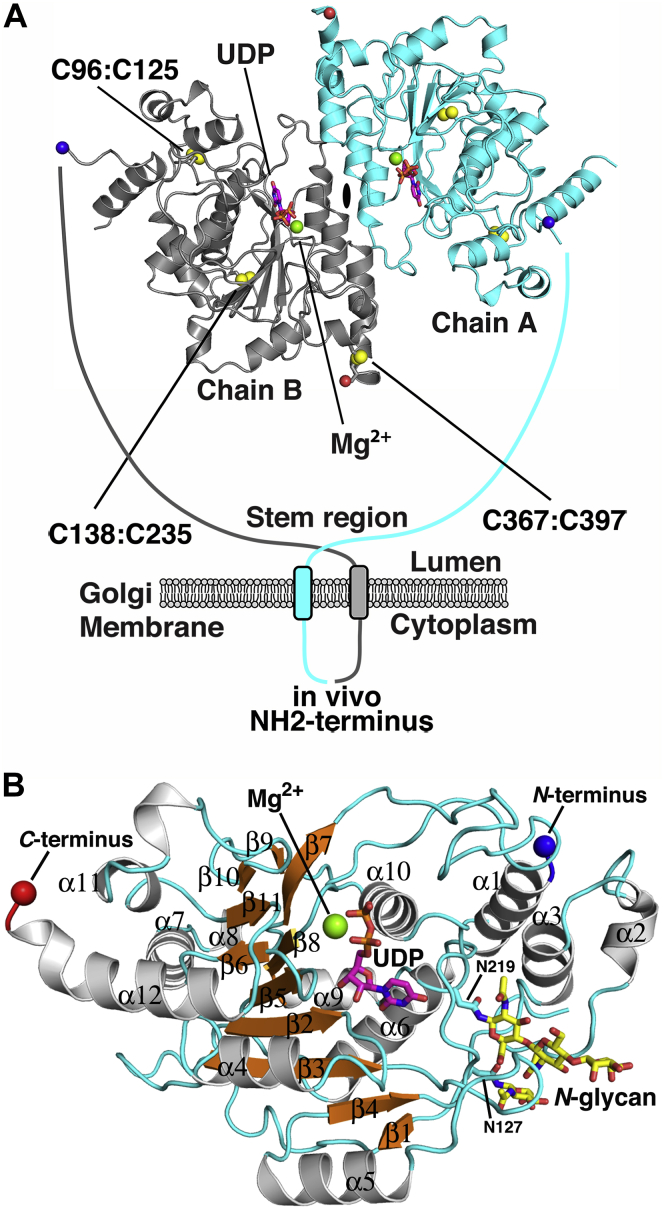
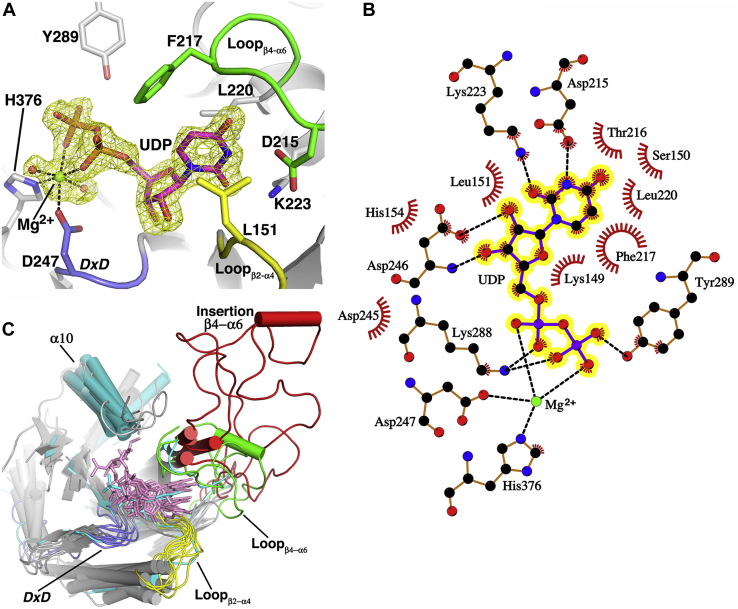
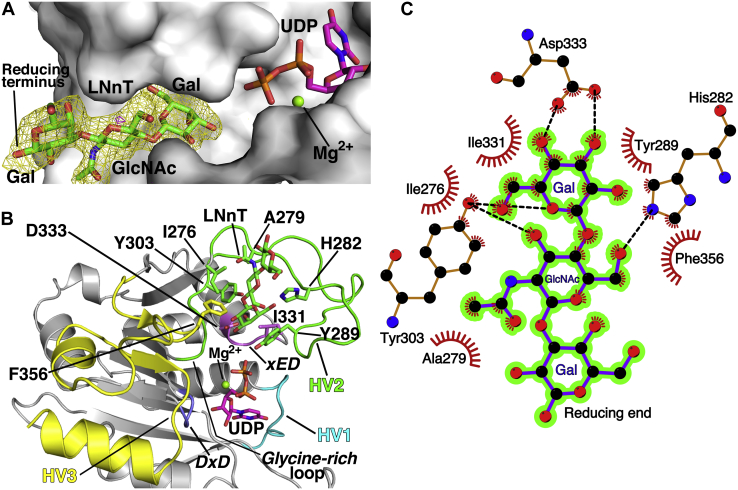
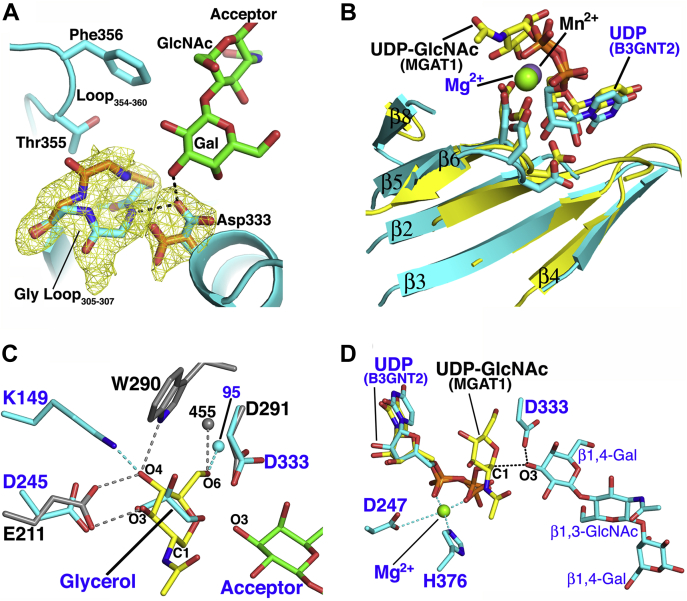
Poly-N-acetyl-lactosamine (poly-LacNAc) structures are composed of repeating [-Galβ(1,4)-GlcNAcβ(1,3)-] glycan extensions. They are found on both N- and O-glycoproteins and glycolipids and play an important role in development, immune function, and human disease. The majority of mammalian poly-LacNAc is synthesized by the alternating iterative action of β1,3-N-acetylglucosaminyltransferase 2 (B3GNT2) and β1,4-galactosyltransferases. B3GNT2 is in the largest mammalian glycosyltransferase family, GT31, but little is known about the structure, substrate recognition, or catalysis by family members. Here we report the structures of human B3GNT2 in complex with UDP:Mg and in complex with both UDP:Mg and a glycan acceptor, lacto-N-neotetraose. The B3GNT2 structure conserves the GT-A fold and the DxD motif that coordinates a Mg ion for binding the UDP-GlcNAc sugar donor. The acceptor complex shows interactions with only the terminal Galβ(1,4)-GlcNAcβ(1,3)- disaccharide unit, which likely explains the specificity for both N- and O-glycan acceptors. Modeling of the UDP-GlcNAc donor supports a direct displacement inverting catalytic mechanism. Comparative structural analysis indicates that nucleotide sugar donors for GT-A fold glycosyltransferases bind in similar positions and conformations without conserving interacting residues, even for enzymes that use the same donor substrate. In contrast, the B3GNT2 acceptor binding site is consistent with prior models suggesting that the evolution of acceptor specificity involves loops inserted into the stable GT-A fold. These observations support the hypothesis that GT-A fold glycosyltransferases employ coevolving donor, acceptor, and catalytic subsite modules as templates to achieve the complex diversity of glycan linkages in biological systems.
多聚-N-乙酰乳糖胺(poly-LacNAc)结构由重复的[-Galβ(1,4)-GlcNAcβ(1,3)-]聚糖延伸组成。它们存在于 N-和 O-糖蛋白和糖脂上,在发育、免疫功能和人类疾病中发挥重要作用。大多数哺乳动物的 poly-LacNAc 是由交替的β1,3-N-乙酰氨基葡萄糖基转移酶 2(B3GNT2)和β1,4-半乳糖基转移酶的迭代作用合成的。B3GNT2 是最大的哺乳动物糖基转移酶家族 GT31 的成员,但对其结构、底物识别或家族成员的催化作用知之甚少。在这里,我们报道了人 B3GNT2 与 UDP:Mg 复合物以及与 UDP:Mg 和糖受体乳糖-N-新四糖复合物的结构。B3GNT2 结构保留了 GT-A 折叠和 DxD 基序,该基序协调一个 Mg 离子以结合 UDP-GlcNAc 糖供体。受体复合物仅与末端 Galβ(1,4)-GlcNAcβ(1,3)-二糖单元相互作用,这可能解释了其对 N-和 O-聚糖受体的特异性。UDP-GlcNAc 供体的建模支持直接取代反转催化机制。比较结构分析表明,GT-A 折叠糖基转移酶的核苷酸糖供体以相似的位置和构象结合,而不保守相互作用的残基,即使对于使用相同供体底物的酶也是如此。相比之下,B3GNT2 受体结合位点与先前的模型一致,表明受体特异性的进化涉及插入稳定的 GT-A 折叠中的环。这些观察结果支持了 GT-A 折叠糖基转移酶利用共进化的供体、受体和催化亚基模块作为模板来实现生物系统中糖链连接的复杂多样性的假说。