Laboratory for Brain-Gut Axis Studies (LaBGAS), Translational Research Center for Gastrointestinal Disorders (TARGID), Department of Chronic Diseases, Metabolism, and Ageing, KU Leuven, Leuven, Belgium.
Leuven Brain Institute, KU Leuven, Leuven, Belgium.
Nat Commun. 2020 Nov 23;11(1):5939. doi: 10.1038/s41467-020-19688-8.
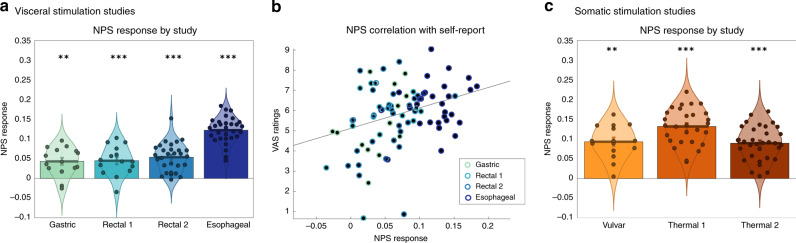
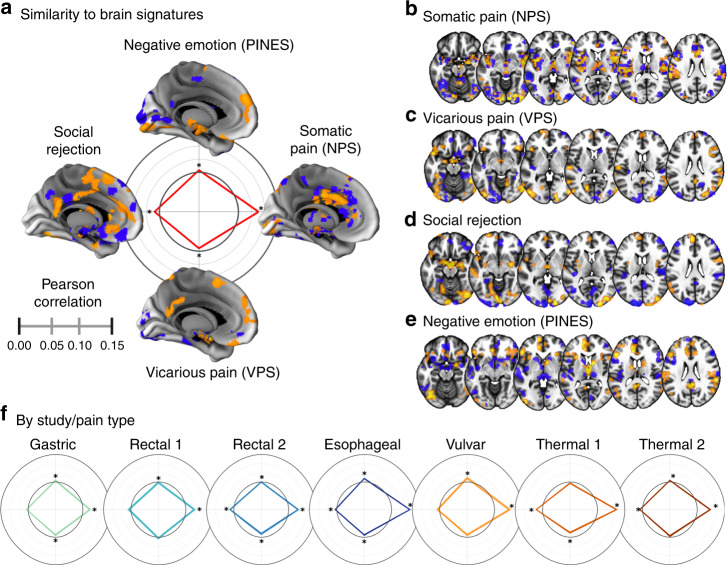
Different pain types may be encoded in different brain circuits. Here, we examine similarities and differences in brain processing of visceral and somatic pain. We analyze data from seven fMRI studies (N = 165) and five types of pain and discomfort (esophageal, gastric, and rectal distension, cutaneous thermal stimulation, and vulvar pressure) to establish and validate generalizable pain representations. We first evaluate an established multivariate brain measure, the Neurologic Pain Signature (NPS), as a common nociceptive pain system across pain types. Then, we develop a multivariate classifier to distinguish visceral from somatic pain. The NPS responds robustly in 98% of participants across pain types, correlates with perceived intensity of visceral pain and discomfort, and shows specificity to pain when compared with cognitive and affective conditions from twelve additional studies (N = 180). Pre-defined signatures for non-pain negative affect do not respond to visceral pain. The visceral versus the somatic classifier reliably distinguishes somatic (thermal) from visceral (rectal) stimulation in both cross-validation and independent cohorts. Other pain types reflect mixtures of somatic and visceral patterns. These results validate the NPS as measuring a common core nociceptive pain system across pain types, and provide a new classifier for visceral versus somatic pain.
不同类型的疼痛可能在不同的大脑回路中编码。在这里,我们研究内脏痛和躯体痛在大脑处理过程中的相似性和差异。我们分析了来自七个 fMRI 研究(N=165)和五种疼痛和不适类型(食管、胃和直肠扩张、皮肤热刺激和外阴压力)的数据,以建立和验证可推广的疼痛表现。我们首先评估了一种成熟的多变量大脑测量方法,即神经疼痛特征(NPS),作为一种跨疼痛类型的共同伤害性疼痛系统。然后,我们开发了一种多变量分类器来区分内脏痛和躯体痛。NPS 在 98%的疼痛类型参与者中反应强烈,与内脏疼痛和不适的感知强度相关,并且与来自另外 12 项研究的认知和情感条件相比具有特异性(N=180)。预先定义的非疼痛负性情绪特征不会对内脏疼痛产生反应。内脏与躯体分类器在交叉验证和独立队列中可靠地区分躯体(热)刺激和内脏(直肠)刺激。其他疼痛类型反映了躯体和内脏模式的混合物。这些结果验证了 NPS 作为一种跨疼痛类型测量共同核心伤害性疼痛系统的方法,并提供了一种用于内脏与躯体疼痛的新分类器。