Department of Microbiology, Dolphin (PG) College of Science and Agriculture, Fatehgarh Sahib, Chandigarh, Punjab, 140307, India.
Department of Microbiology, Dolphin (PG) Institute of Biomedical and Natural Sciences, Dehradun, Uttarakhand, 248007, India.
Sci Rep. 2020 Nov 23;10(1):20409. doi: 10.1038/s41598-020-77460-w.
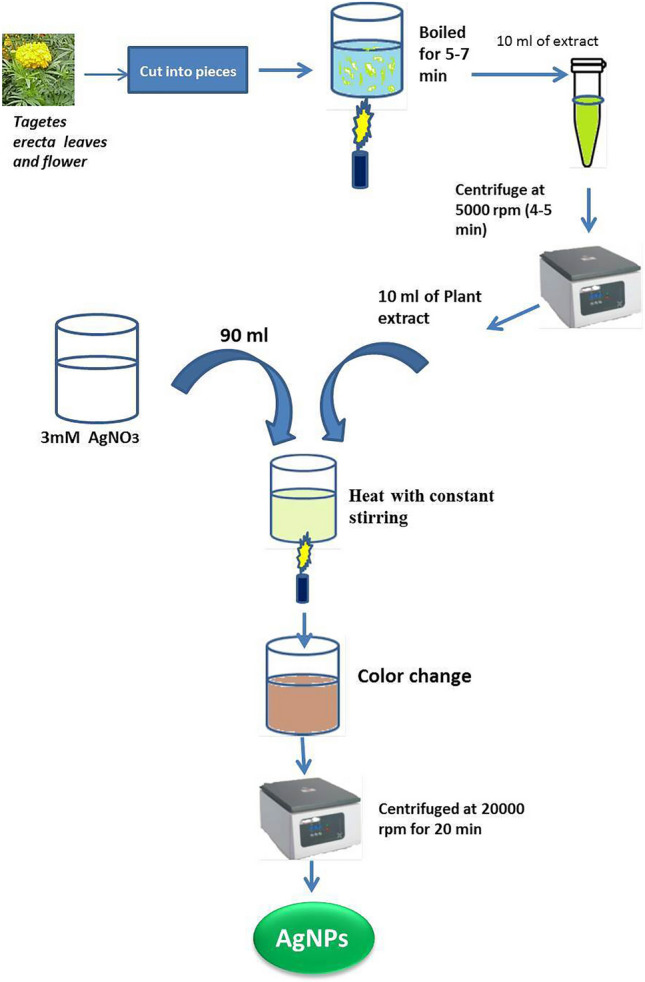
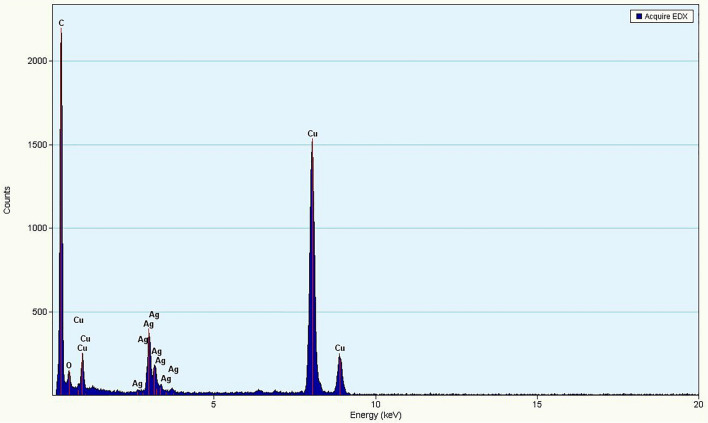
The effect of Plant Growth Promoting Rhizobacteria (Bacillus sp.) and silver nanoparticles on Zea mays was evaluated. The silver nanoparticles were synthesized from Tagetes erecta (Marigold) leaf and flower extracts, whereas PGPR isolated from spinach rhizosphere. The silver nanoparticles (AgNPs) were purified using ultra centrifugation and were characterized using UV-Vis spectroscopy at gradient wavelength and also by High Resolution Transmission Electron microscopy (HRTEM). The average particles size of AgNPs was recorded approximately 60 nm. Almost all potential isolates were able to produce Indole Acetic Acid (IAA), ammonia and Hydrogen cyanide (HCN), solubilized tricalcium phosphate and inhibited the growth of Macrophomina phaseolina in vitro but the isolate LPR2 was found the best among all. On the basis of 16S rRNA gene sequence, the isolate LPR2 was characterized as Bacillus cereus LPR2. The maize seeds bacterized with LPR2 and AgNPs individually showed a significant increase in germination (87.5%) followed by LPR2 + AgNPs (75%). But the maximum growth of root and shoot of maize plant was observed in seeds coated with LPR2 followed by AgNPs and a combination of both. Bacillus cereus LPR2 and silver nanoparticles enhanced the plant growth and LPR2 strongly inhibited the growth of deleterious fungal pathogen. Therefore, LPR2 and AgNPs could be utilized as bioinoculant and growth stimulator, respectively for maize.
研究了植物促生根际细菌(芽孢杆菌)和银纳米粒子对玉米的影响。银纳米粒子是从万寿菊的叶和花提取物中合成的,而 PGPR 则是从菠菜根际中分离出来的。使用超速离心法对银纳米粒子(AgNPs)进行纯化,并使用 UV-Vis 光谱在梯度波长下进行表征,同时还使用高分辨率透射电子显微镜(HRTEM)进行表征。AgNPs 的平均粒径约为 60nm。几乎所有潜在的分离株都能够产生吲哚乙酸(IAA)、氨和氢氰酸(HCN)、溶解磷酸三钙并在体外抑制大丽轮枝菌的生长,但分离株 LPR2 在所有分离株中表现最好。根据 16S rRNA 基因序列,分离株 LPR2 被鉴定为蜡状芽孢杆菌 LPR2。单独用 LPR2 和 AgNPs 接种的玉米种子发芽率显著提高(87.5%),其次是 LPR2+AgNPs(75%)。但用 LPR2 包被的玉米种子的根和芽生长最大,其次是 AgNPs,然后是两者的组合。蜡状芽孢杆菌 LPR2 和银纳米粒子促进了植物的生长,LPR2 强烈抑制了有害真菌病原体的生长。因此,LPR2 和 AgNPs 可以分别用作玉米的生物接种剂和生长刺激剂。