The BioRobotics Institute, Scuola Superiore Sant'Anna, 56127 Pisa, Italy.
Department of Excellence in Robotics & AI, Scuola Superiore Sant'Anna, 56127 Pisa, Italy.
Sensors (Basel). 2020 Nov 20;20(22):6644. doi: 10.3390/s20226644.
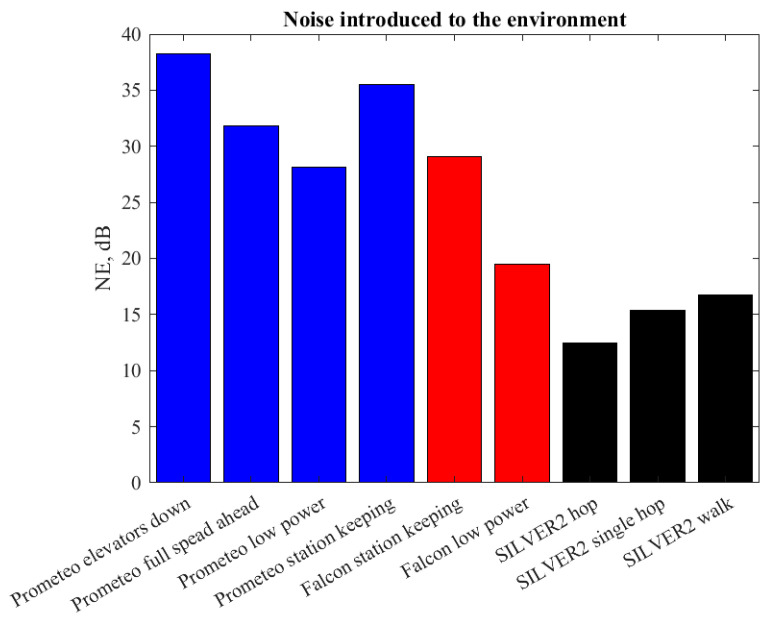
Underwater robots emit sound during operations which can deteriorate the quality of acoustic data recorded by on-board sensors or disturb marine fauna during in vivo observations. Notwithstanding this, there have only been a few attempts at characterizing the acoustic emissions of underwater robots in the literature, and the datasheets of commercially available devices do not report information on this topic. This work has a twofold goal. First, we identified a setup consisting of a camera directly mounted on the robot structure to acquire the acoustic data and two indicators (i.e., spectral roll-off point and noise introduced to the environment) to provide a simple and intuitive characterization of the acoustic emissions of underwater robots carrying out specific maneuvers in specific environments. Second, we performed the proposed analysis on three underwater robots belonging to the classes of remotely operated vehicles and underwater legged robots. Our results showed how the legged device produced a clearly different signature compared to remotely operated vehicles which can be an advantage in operations that require low acoustic disturbance. Finally, we argue that the proposed indicators, obtained through a standardized procedure, may be a useful addition to datasheets of existing underwater robots.
水下机器人在作业时会发出声音,这可能会降低机载传感器记录的声数据质量,或在体内观察时干扰海洋动物。尽管如此,文献中只有少数几次尝试对水下机器人的声发射进行特征描述,并且市售设备的数据表并未报告有关此主题的信息。这项工作有两个目标。首先,我们确定了一个由直接安装在机器人结构上的摄像机组成的设置,以获取声数据,以及两个指标(即频谱滚降点和对环境引入的噪声),以提供对在特定环境中执行特定操作的水下机器人的声发射进行简单直观的描述。其次,我们对属于遥控潜水器和水下腿式机器人类别的三艘水下机器人进行了拟议的分析。我们的结果表明,与遥控潜水器相比,腿式设备产生的特征明显不同,这在需要低声干扰的操作中可能是一个优势。最后,我们认为,通过标准化程序获得的建议指标可能是对现有水下机器人数据表的有益补充。