School of Nursing and Midwifery, Aras Moyola, NUI, Galway, Ireland.
College of Engineering and Science, Alice Perry Building, NUI, Galway, Ireland.
Int J Environ Res Public Health. 2020 Nov 20;17(22):8621. doi: 10.3390/ijerph17228621.
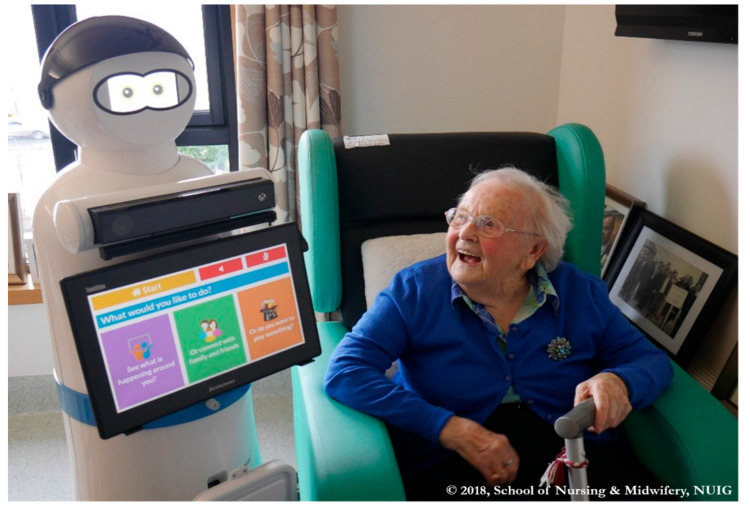
People with dementia often experience loneliness and social isolation. This can result in increased cognitive decline which, in turn, has a negative impact on quality of life. This paper explores the use of the social robot, MARIO, with older people living with dementia as a way of addressing these issues. A descriptive qualitative study was conducted to explore the perceptions and experiences of the use and impact of MARIO. The research took place in the UK, Italy and Ireland. Semi-structured interviews were held in each location with people with dementia ( = 38), relatives/carers ( = 28), formal carers ( = 28) and managers ( = 13). The data was analyzed using qualitative content analysis. The findings revealed that despite challenges in relation to voice recognition and the practicalities of conducting research involving robots in real-life settings, most participants were positive about MARIO. Through the robot's user-led design and personalized applications, MARIO provided a point of interest, social activities, and cognitive engagement increased. However, some formal carers and managers voiced concern that robots might replace care staff.
痴呆症患者常常感到孤独和社会隔离。这可能导致认知能力进一步下降,进而对生活质量产生负面影响。本文探讨了使用社交机器人 MARIO 来解决这些问题的方法。本研究采用描述性定性研究方法,探讨了 MARIO 的使用和影响的认知和体验。研究在英国、意大利和爱尔兰进行。在每个地点,与痴呆症患者(=38 人)、亲属/照顾者(=28 人)、正式照顾者(=28 人)和管理人员(=13 人)进行了半结构化访谈。使用定性内容分析对数据进行了分析。研究结果表明,尽管在语音识别方面存在挑战,并且在实际生活环境中研究涉及机器人存在实际困难,但大多数参与者对 MARIO 持积极态度。通过机器人的用户主导设计和个性化应用,MARIO 提供了一个兴趣点,增加了社交活动和认知参与。然而,一些正式照顾者和管理人员担心机器人可能会取代护理人员。