Faruk Tasnuva, King Catherine, Muhit Mohammad, Islam Md Kafiul, Jahan Israt, Baset Kamran Ul, Badawi Nadia, Khandaker Gulam
Asian Institute of Disability and Development, University of South Asia, Dhaka, Bangladesh
Department of Public Health, Independent University Bangladesh, Dhaka, Bangladesh.
BMJ Open. 2020 Nov 23;10(11):e038182. doi: 10.1136/bmjopen-2020-038182.
To systematically review, identify and report the screening tools used for early identification of developmental delay in low- and middle-income countries.
Systematic review.
Four bibliographic databases: Medline (1946 to 13 July 2020), Embase (1974 to 13 July 2020), Scopus (1823 to 11 July 2020) and PsycINFO (1987 to July week 1 2020).
Peer-reviewed original articles published in English addressing validated culturally sensitive developmental screening tools among children aged <5 years were included in this review.
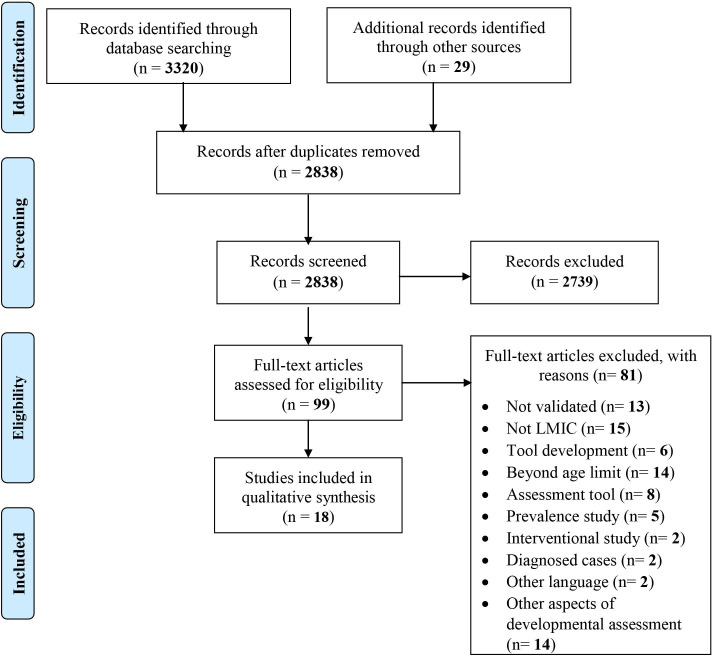
One author (CK, medical librarian) developed the search strategy. Three authors conducted the database search (phase I: CK; phase II: IJ and MKI). Three authors (TF, IJ and MKI) independently screened the title and abstracts. TF, MKI and GK independently performed the full-text review of the screened articles. During each step of the study selection process, disagreements were resolved through discussion. The Preferred Reporting Items for Systematic Reviews and Meta-Analyses statement was used to guide the systematic review. Data extraction and analysis were performed using MS Excel. Meta-analysis was not possible due to heterogeneity of the study findings.
We identified 3349 articles, of which 18 studies from 10 countries, reporting 16 screening tools, were selected for qualitative synthesis. Six cultural contexts were explored. Twelve general, two motor and two speech-language tools were identified. Seven of them found to be parent-completed ones. Five screening tools (American Speech-Language and Hearing Association, Guide for Monitoring Child Development, Infant Neurological International Battery, New Delhi-Development Screening Questionnaire and Woodside Screening Technique) reported relatively higher sensitivity (82.5%-100%) and specificity (83%-98.93%).
Limited number of culturally sensitive developmental screening tools were validated for children aged <5 years in low- and middle-income countries. Revising existing screening tools in different ethnic and cultural settings and subsequent validation with normative value should be a research priority.
系统回顾、识别并报告低收入和中等收入国家用于早期识别发育迟缓的筛查工具。
系统回顾。
四个文献数据库:Medline(1946年至2020年7月13日)、Embase(1974年至2020年7月13日)、Scopus(1823年至2020年7月11日)和PsycINFO(1987年至2020年7月第1周)。
纳入以英文发表的、针对5岁以下儿童经验证的具有文化敏感性的发育筛查工具的同行评审原创文章。
一位作者(CK,医学图书馆员)制定检索策略。三位作者进行数据库检索(第一阶段:CK;第二阶段:IJ和MKI)。三位作者(TF、IJ和MKI)独立筛选标题和摘要。TF、MKI和GK独立对筛选出的文章进行全文评审。在研究选择过程的每个步骤中,通过讨论解决分歧。采用系统评价和Meta分析的首选报告项目声明来指导系统评价。使用MS Excel进行数据提取和分析。由于研究结果的异质性,无法进行Meta分析。
我们识别出3349篇文章,其中来自10个国家的18项研究报告了16种筛查工具,被选入定性综合分析。探讨了六种文化背景。识别出12种通用工具、2种运动工具和2种语言工具。其中7种被发现是家长完成的工具。五种筛查工具(美国言语语言听力协会、儿童发育监测指南、国际婴儿神经学量表、新德里发育筛查问卷和伍德赛德筛查技术)报告的敏感性相对较高(82.5%-100%),特异性相对较高(83%-98.93%)。
在低收入和中等收入国家,针对5岁以下儿童经验证的具有文化敏感性的发育筛查工具数量有限。在不同种族和文化背景下修订现有筛查工具并随后进行具有规范价值的验证应成为研究重点。