Department of Infectious Diseases, College of Veterinary Medicine, University of Georgia, Athens, GA, USA.
Methods Mol Biol. 2021;2236:115-127. doi: 10.1007/978-1-0716-1060-2_11.
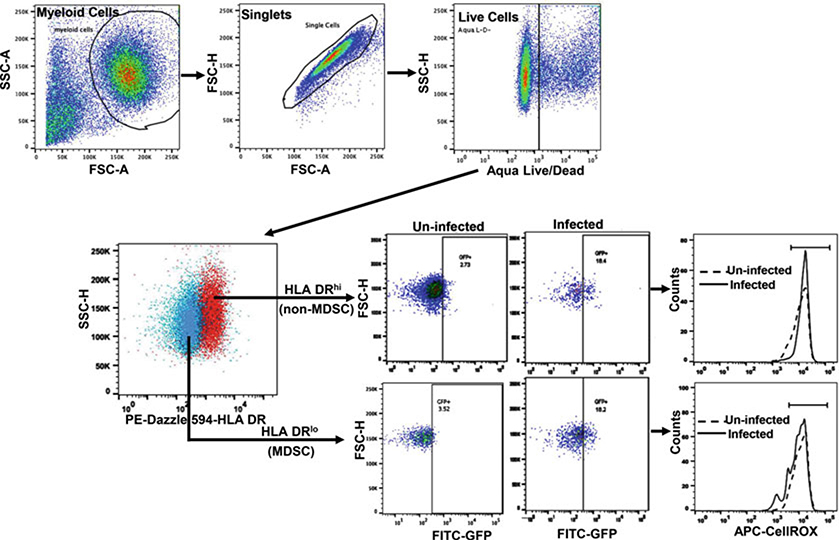
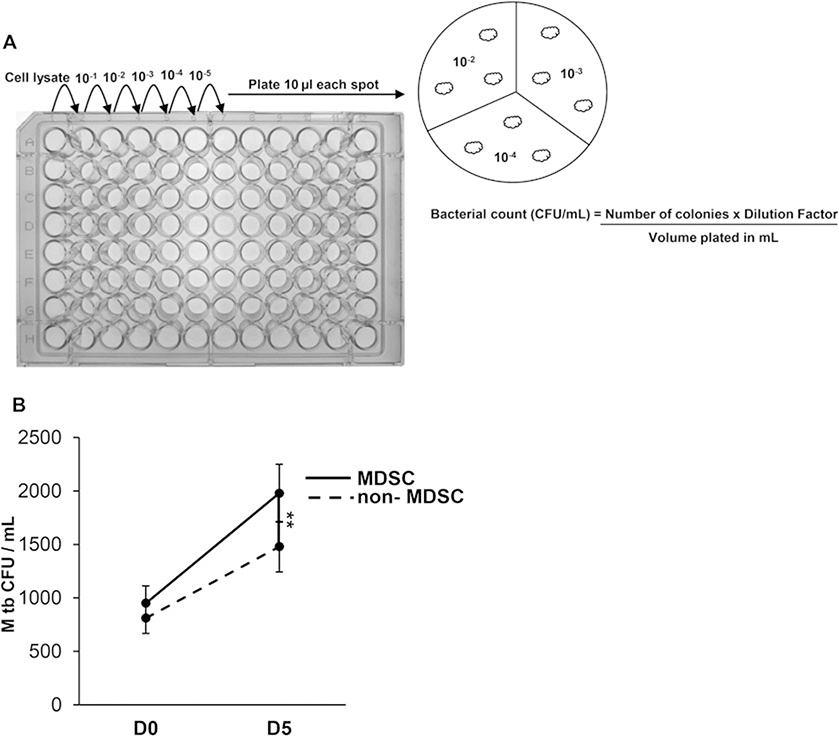
Myeloid-derived suppressor cells (MDSC) encompass a subset of myeloid cells, which suppress both innate and adaptive immune functions. Since Mycobacterium tuberculosis (M. tuberculosis) can infect these cells, interest has emerged to study the antimicrobial response of MDSC to mycobacteria causing tuberculosis. Reactive oxygen species (ROS) are critical mediators to control intracellular replication of M. tuberculosis and MDSC express high levels of these effector molecules. Here we describe the flow cytometric assessment of total cellular ROS produced by MDSC in response to infection with M. tuberculosis and compare it with the ROS activity of non-MDSC myeloid cells. To further understand the dynamics of host-pathogen interactions, we provide details on methods for measurement of the intracellular replication of M. tuberculosis within MDSC. Of note, these procedures were adopted for primary MDSC and non-MDSC subsets isolated from human immunodeficiency virus (HIV)-uninfected or HIV-infected individuals, in vitro infected with M. tuberculosis to mimic M. tuberculosis mono- or HIV-M. tuberculosis coinfection, respectively.
髓系来源的抑制细胞 (MDSC) 是髓系细胞的一个子集,可抑制固有和适应性免疫功能。由于结核分枝杆菌 (M. tuberculosis) 可以感染这些细胞,因此人们对研究 MDSC 对引起结核病的分枝杆菌的抗菌反应产生了兴趣。活性氧 (ROS) 是控制结核分枝杆菌细胞内复制的关键介质,MDSC 表达高水平的这些效应分子。在这里,我们描述了用结核分枝杆菌感染后 MDSC 产生的总细胞 ROS 的流式细胞术评估,并将其与非 MDSC 髓系细胞的 ROS 活性进行了比较。为了进一步了解宿主-病原体相互作用的动态,我们提供了关于测量 MDSC 内结核分枝杆菌细胞内复制的详细信息。值得注意的是,这些程序是针对从人类免疫缺陷病毒 (HIV) 未感染或 HIV 感染个体中分离的原代 MDSC 和非 MDSC 亚群采用的,体外感染结核分枝杆菌分别模拟结核分枝杆菌单感染或 HIV-结核分枝杆菌共感染。