MMWR Morb Mortal Wkly Rep. 2020 Nov 27;69(47):1777-1781. doi: 10.15585/mmwr.mm6947e2.
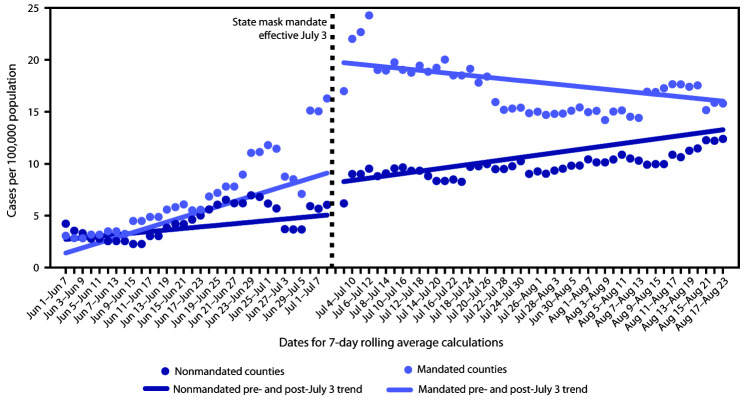
Wearing masks is a CDC-recommended* approach to reduce the spread of SARS-CoV-2, the virus that causes coronavirus disease 2019 (COVID-19), by reducing the spread of respiratory droplets into the air when a person coughs, sneezes, or talks and by reducing the inhalation of these droplets by the wearer. On July 2, 2020, the governor of Kansas issued an executive order (state mandate), effective July 3, requiring masks or other face coverings in public spaces. CDC and the Kansas Department of Health and Environment analyzed trends in county-level COVID-19 incidence before (June 1-July 2) and after (July 3-August 23) the governor's executive order among counties that ultimately had a mask mandate in place and those that did not. As of August 11, 24 of Kansas's 105 counties did not opt out of the state mandate or adopted their own mask mandate shortly before or after the state mandate was issued; 81 counties opted out of the state mandate, as permitted by state law, and did not adopt their own mask mandate. After the governor's executive order, COVID-19 incidence (calculated as the 7-day rolling average number of new daily cases per 100,000 population) decreased (mean decrease of 0.08 cases per 100,000 per day; net decrease of 6%) among counties with a mask mandate (mandated counties) but continued to increase (mean increase of 0.11 cases per 100,000 per day; net increase of 100%) among counties without a mask mandate (nonmandated counties). The decrease in cases among mandated counties and the continued increase in cases in nonmandated counties adds to the evidence supporting the importance of wearing masks and implementing policies requiring their use to mitigate the spread of SARS-CoV-2 (1-6). Community-level mitigation strategies emphasizing wearing masks, maintaining physical distance, staying at home when ill, and enhancing hygiene practices can help reduce transmission of SARS-CoV-2.
戴口罩是减少 2019 冠状病毒病(COVID-19)传播的一种美国疾病控制与预防中心(CDC)推荐的方法,这种方法通过减少当一个人咳嗽、打喷嚏或说话时呼吸道飞沫向空气中的传播,以及减少佩戴者吸入这些飞沫,从而降低 SARS-CoV-2 病毒的传播。2020 年 7 月 2 日,堪萨斯州州长发布了一项行政命令(州政府强制令),自 7 月 3 日起生效,要求在公共场所佩戴口罩或其他面部遮罩。CDC 和堪萨斯州卫生与环境部分析了在州长行政命令发布之前(6 月 1 日至 7 月 2 日)和之后(7 月 3 日至 8 月 23 日)县一级 COVID-19 发病率的趋势,这些县最终实施了口罩强制令,以及那些没有实施口罩强制令的县。截至 8 月 11 日,堪萨斯州 105 个县中有 24 个没有选择退出州政府强制令,或在州政府强制令发布之前或之后不久通过了自己的口罩强制令;81 个县选择退出了州政府强制令,这是州法律允许的,并且没有通过自己的口罩强制令。在州长的行政命令发布后,有口罩强制令的县(实施强制令的县)COVID-19 发病率(计算方法为每 10 万人中 7 天滚动平均每日新增病例数)下降(每日每 10 万人减少 0.08 例;减少 6%),但没有口罩强制令的县(无强制令的县)发病率继续上升(每日每 10 万人增加 0.11 例;增加 100%)。实施强制令的县病例减少,无强制令的县病例继续增加,这进一步证明了戴口罩和实施相关政策的重要性,这些政策要求使用口罩来减轻 SARS-CoV-2 的传播(1-6)。强调戴口罩、保持身体距离、生病时待在家里以及加强卫生习惯的社区层面缓解策略可以帮助减少 SARS-CoV-2 的传播。