Department of Infectious Diseases, Taizhou Hospital of Zhejiang Province, Wenzhou Medical University, Linhai, Zhejiang, 317000, China.
Biological Resource Center, Taizhou Hospital of Zhejiang Province, Wenzhou Medical University, Linhai, Zhejiang, 317000, China; Enze Institute of Health Medicine, Taizhou Hospital of Zhejiang Province, Wenzhou Medical University, Linhai, Zhejiang, 317000, China.
Travel Med Infect Dis. 2020 Jul-Aug;36:101803. doi: 10.1016/j.tmaid.2020.101803. Epub 2020 Jun 24.
Pandemic COVID-19 has become a seriously public health priority worldwide. Comprehensive strategies including travel restrictions and mask-wearing have been implemented to mitigate the virus circulation. However, detail information on community transmission is unavailable yet.
From January 23 to March 1, 2020, 127 patients (median age: 46 years; range: 11-80) with 71 male and 56 female, were confirmed to be infected with the SARS-CoV-2 in Taizhou, Zhejiang, China. Epidemiological trajectory and clinical features of these COVID-19 cases were retrospectively retrieved from electronic medical records and valid individual questionnaire.
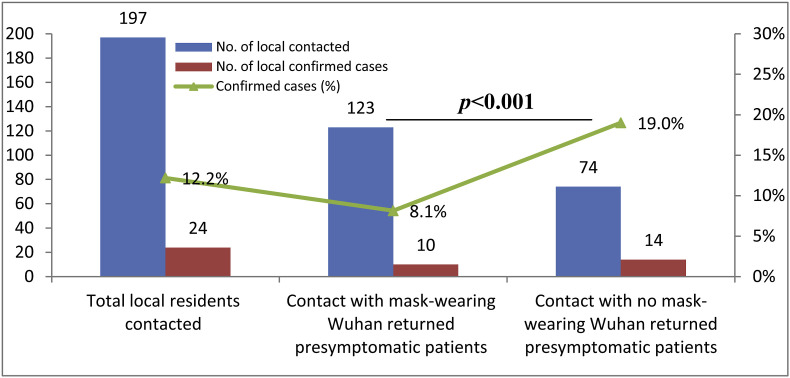
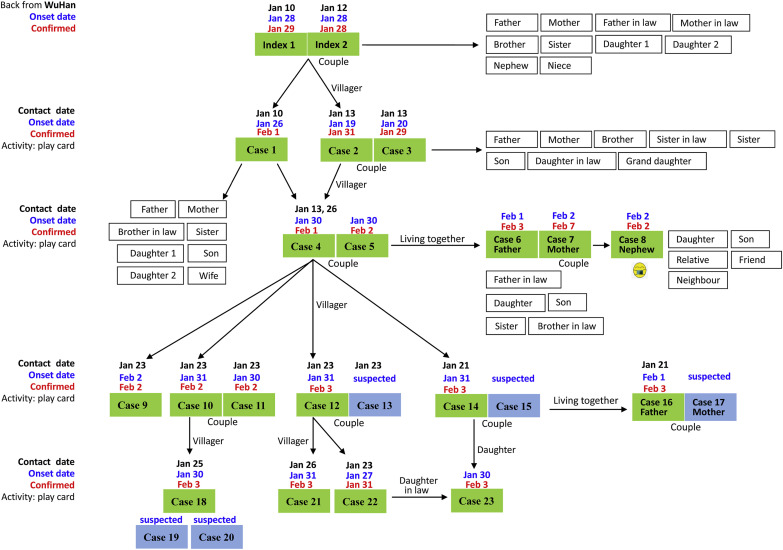
The disease onset was between January 9 to February 14, 2020. Among them, 64 patients are local residents, and 63 patients were back home from Wuhan from January 10 to 24, 2020 before travel restriction. 197 local residents had definite close-contact with 41 pre-symptomatic patients back from Wuhan. 123 and 74 of them contact with mask-wearing or with no mask-wearing pre-symptomatic patients back from Wuhan, respectively. Data showed that incidence of COVID-19 was significantly higher for local residents close-contact with no mask-wearing Wuhan returned pre-symptomatic patients (19.0% vs. 8.1%, p < 0.001). Among 57 close-contact individuals, 21 sequential local COVID-19 patients originated from a pre-symptomatic Wuhan returned couple, indicated dense gathering in congested spaces is a high risk for SARS-CoV-2 transmission.
Our findings provided valuable details of pre-symptomatic patient mask-wearing and restriction of mass gathering in congested spaces particularly, are important interventions to mitigate the SARS-CoV-2 transmission.
大流行 COVID-19 已成为全球严重的公共卫生优先事项。为了减轻病毒传播,已经实施了包括旅行限制和戴口罩在内的综合策略。然而,目前还没有关于社区传播的详细信息。
从 2020 年 1 月 23 日至 3 月 1 日,中国浙江台州共确诊 127 例(中位年龄:46 岁;范围:11-80 岁)感染 SARS-CoV-2 的患者,其中男性 71 例,女性 56 例。从电子病历和有效的个人问卷中回顾性检索这些 COVID-19 病例的流行病学轨迹和临床特征。
发病时间为 2020 年 1 月 9 日至 2 月 14 日。其中,64 例为本地居民,63 例于 2020 年 1 月 10 日至 24 日旅行限制前从武汉返乡。197 名本地居民与 41 名从武汉返回的无症状患者有明确的密切接触。与戴口罩或不戴口罩的无症状武汉返回者分别有 123 人和 74 人接触。数据显示,与不戴口罩的无症状武汉返回者密切接触的本地居民 COVID-19 发病率明显更高(19.0%比 8.1%,p<0.001)。在 57 名密切接触者中,有 21 名连续发生的本地 COVID-19 患者源自一对无症状的武汉返回夫妇,表明在拥挤的空间中密集聚集是 SARS-CoV-2 传播的高风险因素。
我们的研究结果提供了无症状患者戴口罩和限制在拥挤空间聚集的重要细节,特别是这些措施对于减轻 SARS-CoV-2 传播非常重要。