Joint Faculty of Kingston University and St George's University of London, St George's University of London, London, UK.
St George's University Hospitals NHS Foundation Trust, London, UK.
Health Expect. 2021 Feb;24(1):77-86. doi: 10.1111/hex.13149. Epub 2020 Nov 25.
Physician associates (PAs) are one of many new mid-level health practitioner roles being introduced worldwide. They are a recent innovation in English hospitals. Patient confusion with novel mid-level practitioner titles and roles is well documented, alongside evidence of a positive association between patients' ability to identify practitioners and patient satisfaction. No prior research developed an intervention to introduce PAs or any other new practitioner role to hospital patients.
To develop, with patient and public involvement and engagement (PPIE), an intervention for introducing the PA role to hospital patients, and to test feasibility.
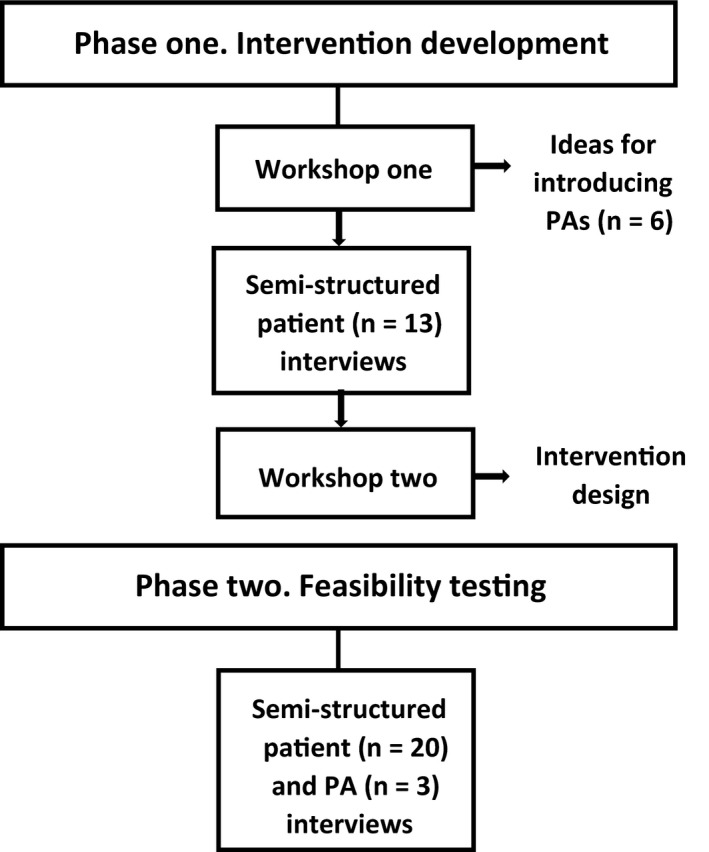
Intervention development was underpinned by an experience-based co-design approach. Workshop participants generated ideas for introducing PAs, subsequently explored in semi-structured interviews with hospital patients (n = 13). Interview findings were used by participants in a second workshop to design the intervention. Feasibility of the intervention was assessed in relation to its acceptability and efficacy using semi-structured interviews with hospital patients (n = 20) and PAs (n = 3).
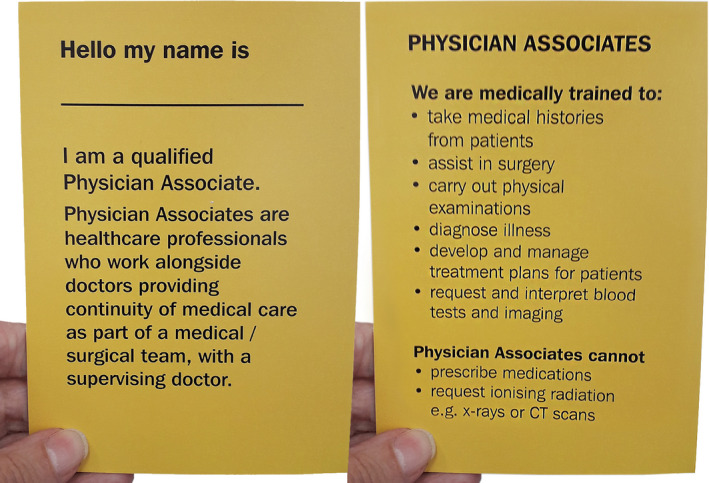
The intervention developed was a patient information leaflet. It was considered feasible to use in the hospital setting, helpful to patients in understanding the PA role and acceptable to both patients and PAs. The intervention was also appreciated by patients for providing reassurance of care and support.
An experience-based co-design approach enabled development of an intervention tailored to patients' experiential preferences. Positive evidence of feasibility and utility is encouraging, supporting future larger-scale testing.
PPIE representatives were involved in the study design, intervention development and data interpretation.
医师助理(PA)是全球范围内引入的众多新的中级医疗从业者角色之一。他们是英国医院的一项新创举。患者对新的中级从业者头衔和角色感到困惑,这一点有充分的记录,同时也有证据表明,患者识别从业者的能力与患者满意度之间存在积极关联。之前没有研究开发过一种干预措施,将 PA 或任何其他新从业者角色引入医院患者。
在患者和公众参与和参与(PPIE)的基础上,开发一种向医院患者介绍 PA 角色的干预措施,并对其可行性进行测试。
干预措施的开发以基于经验的共同设计方法为基础。工作坊参与者提出了介绍 PA 的想法,随后在与医院患者(n=13)的半结构化访谈中探讨了这些想法。访谈结果被参与者用于第二次工作坊,以设计干预措施。通过对医院患者(n=20)和 PA(n=3)进行半结构化访谈,评估了干预措施在可接受性和疗效方面的可行性。
开发的干预措施是一份患者信息传单。它被认为在医院环境中是可行的,有助于患者理解 PA 角色,并且得到患者和 PA 的认可。该干预措施还为患者提供了护理和支持的保证,受到了患者的赞赏。
基于经验的共同设计方法使我们能够开发出一种针对患者体验偏好的干预措施。可行性和实用性的积极证据令人鼓舞,支持未来更大规模的测试。
PPIE 代表参与了研究设计、干预措施的开发和数据解释。