Stott Caroline M, Bobay Louis-Marie
Department of Biology, University of North Carolina Greensboro, 321 McIver Street, PO Box 26170, Greensboro, NC, 27402, USA.
BMC Genomics. 2020 Nov 25;21(1):829. doi: 10.1186/s12864-020-07262-x.
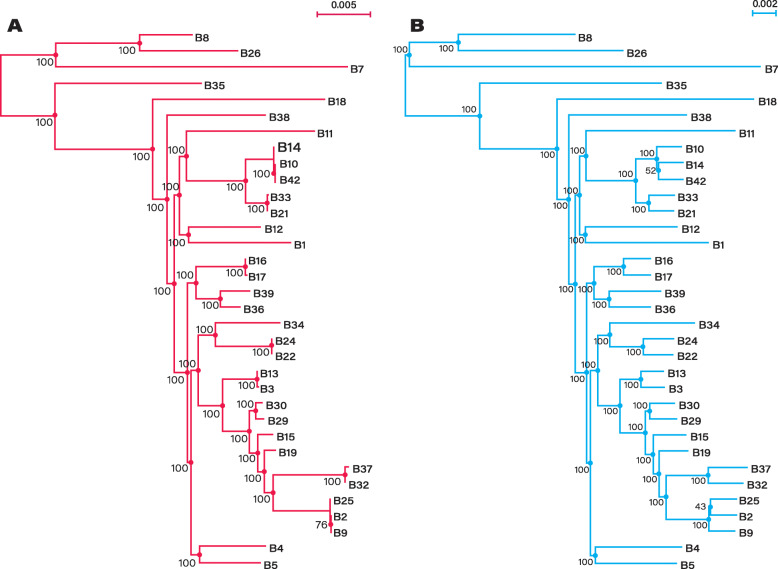
Core genome phylogenies are widely used to build the evolutionary history of individual prokaryote species. By using hundreds or thousands of shared genes, these approaches are the gold standard to reconstruct the relationships of large sets of strains. However, there is growing evidence that bacterial strains exchange DNA through homologous recombination at rates that vary widely across prokaryote species, indicating that core genome phylogenies might not be able to reconstruct true phylogenies when recombination rate is high. Few attempts have been made to evaluate the robustness of core genome phylogenies to recombination, but some analyses suggest that reconstructed trees are not always accurate.
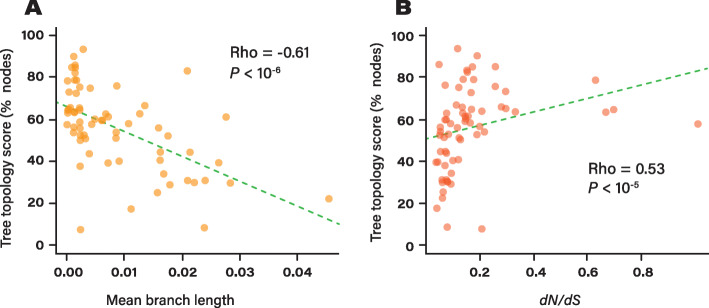
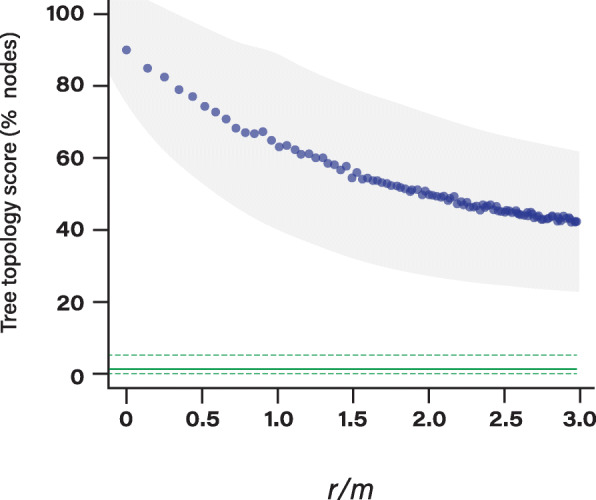
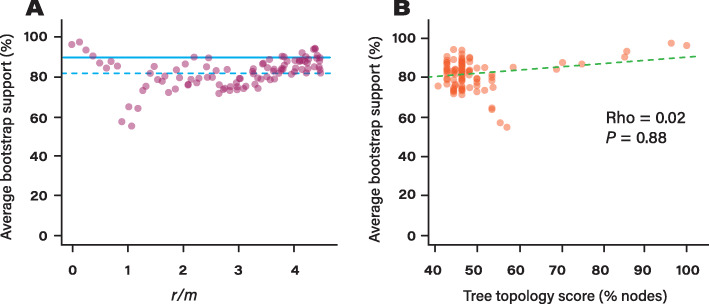
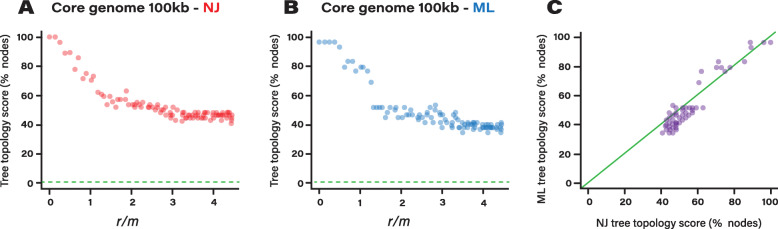
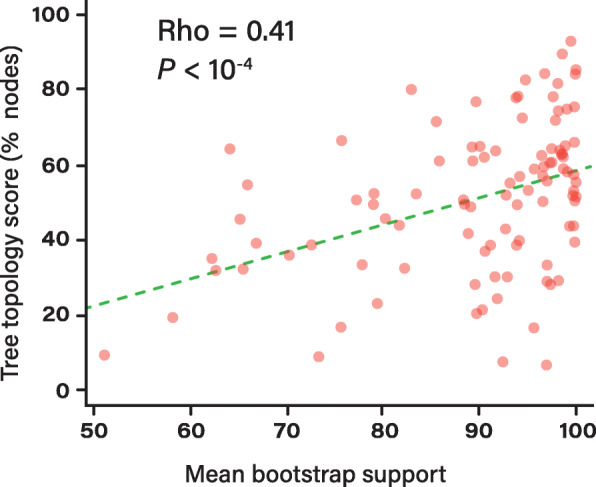
In this study, we tested the robustness of core genome phylogenies to various levels of recombination rates. By analyzing simulated and empirical data, we observed that core genome phylogenies are relatively robust to recombination rates; nevertheless, our results suggest that many reconstructed trees are not completely accurate even when bootstrap supports are high. We found that some core genome phylogenies are highly robust to recombination whereas others are strongly impacted by it, and we identified that the robustness of core genome phylogenies to recombination is highly linked to the levels of selective pressures acting on a species. Stronger selective pressures lead to less accurate tree reconstructions, presumably because selective pressures more strongly bias the routes of DNA transfers, thereby causing phylogenetic artifacts.
Overall, these results have important implications for the application of core genome phylogenies in prokaryotes.
核心基因组系统发育树被广泛用于构建单个原核生物物种的进化史。通过使用数百个或数千个共享基因,这些方法是重建大量菌株之间关系的金标准。然而,越来越多的证据表明,细菌菌株通过同源重组交换DNA的速率在原核生物物种中差异很大,这表明当重组率较高时,核心基因组系统发育树可能无法重建真实的系统发育关系。很少有人尝试评估核心基因组系统发育树对重组的稳健性,但一些分析表明,重建的树并不总是准确的。
在本研究中,我们测试了核心基因组系统发育树对各种重组率水平的稳健性。通过分析模拟数据和实证数据,我们观察到核心基因组系统发育树对重组率相对稳健;然而,我们的结果表明,即使自展支持率很高,许多重建的树也并不完全准确。我们发现,一些核心基因组系统发育树对重组具有高度稳健性,而另一些则受到强烈影响,并且我们确定核心基因组系统发育树对重组的稳健性与作用于一个物种的选择压力水平高度相关。更强的选择压力导致树重建的准确性降低,可能是因为选择压力更强烈地偏向DNA转移的路径,从而导致系统发育假象。
总体而言,这些结果对核心基因组系统发育树在原核生物中的应用具有重要意义。