Centre for Behavioural Research in Cancer, Cancer Council Victoria, 615 St Kilda Road, Melbourne, Victoria, 3004, Australia.
Melbourne School of Psychological Sciences, The University of Melbourne, Parkville, Victoria, 3010, Australia.
BMC Public Health. 2020 Nov 25;20(1):1781. doi: 10.1186/s12889-020-09881-1.
To help address rising rates of obesity in children, evidence is needed concerning impacts of common forms of marketing for unhealthy child-oriented food products and the efficacy of educational interventions in counteracting any detrimental impacts of such marketing. This study aims to explore parents' responses to advertising for unhealthy children's food products that employ different types of persuasive appeals and test whether a counter-advertising intervention exposing industry motives and marketing strategies can bolster parents' resistance to influence by unhealthy product advertising.
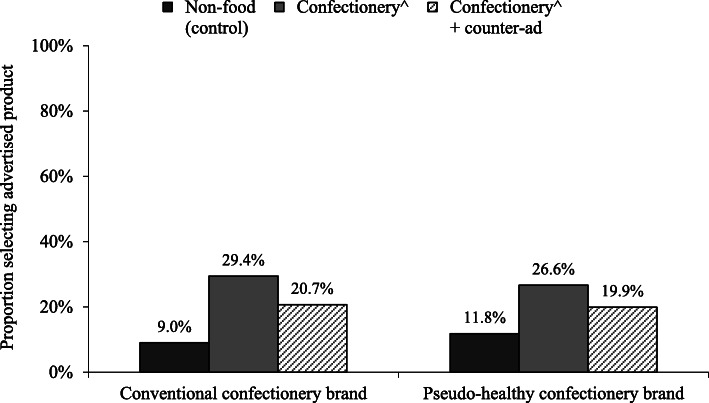
N = 1613 Australian parents were randomly assigned to view online either a: (A) non-food ad (control); (B) conventional confectionery ad (highlighting sensory benefits of the product); (C) pseudo-healthy confectionery ad (promoting sensory benefits and health attributes of the product); (D) conventional confectionery ad + counter-ad (employing inoculation-style messaging and narrative communication elements); (E) pseudo-healthy confectionery ad + counter-ad. Parents then viewed various snacks, including those promoted in the food ads and counter-ad. Parents nominated their preferred product, then rated the products.
Exposure to the conventional confectionery ad increased parents' preference for the advertised product, enhanced perceptions of the product's healthiness and reduced sugar content and boosted brand attitude. Exposure to the pseudo-healthy confectionery ad increased parents' preference for the advertised product, and enhanced perceptions of healthiness, fibre content and lower sugar content. The counter-ad diminished, but did not eliminate, product ad effects on parents' purchasing preference, product perceptions and brand attitudes. The counter-ad also prompted parents to perceive processed foods as less healthy, higher in sugar and lower in fibre and may have increased support for advertising regulation.
Exposure to unhealthy product advertising promoted favourable perceptions of products and increased preferences for advertised products among parents. Counter-advertising interventions may bolster parents' resistance to persuasion by unhealthy product advertising and empower parents to more accurately evaluate advertised food products.
为了帮助应对儿童肥胖率的上升,我们需要了解针对面向儿童的不健康食品产品的常见营销形式的影响,以及教育干预在抵消此类营销的任何不利影响方面的效果。本研究旨在探讨父母对使用不同类型说服诉求的不健康儿童食品广告的反应,并检验揭露行业动机和营销策略的反广告干预是否可以增强父母对不健康产品广告的抵制力。
1613 名澳大利亚父母被随机分配在线观看以下内容:(A)非食品广告(对照);(B)传统糖果广告(突出产品的感官益处);(C)伪健康糖果广告(宣传产品的感官益处和健康属性);(D)传统糖果广告+反广告(采用接种式信息传递和叙事沟通元素);(E)伪健康糖果广告+反广告。然后,父母观看了各种零食,包括广告和反广告中宣传的产品。父母选择他们喜欢的产品,然后对产品进行评价。
观看传统糖果广告增加了父母对广告产品的偏好,增强了他们对产品健康性和含糖量降低的认知,并提升了品牌态度。观看伪健康糖果广告增加了父母对广告产品的偏好,并增强了他们对健康性、纤维含量和较低含糖量的认知。反广告虽然减弱了,但并没有消除广告对父母购买偏好、产品认知和品牌态度的影响。反广告还促使父母认为加工食品的健康程度较低、含糖量较高、纤维含量较低,可能增加了对广告监管的支持。
暴露于不健康产品广告会促进父母对产品的正面看法,并增加他们对广告产品的偏好。反广告干预可能会增强父母对不健康产品广告的抵制力,并使父母更准确地评估广告食品产品。