Versaci Francesco, Sciarretta Sebastiano, Scappaticci Massimiliano, Calcagno Simone, di Pietro Riccardo, Sbandi Francesca, Dei Giudici Angela, Del Prete Armando, de Angelis Stefano, Biondi-Zoccai Giuseppe
Department of Cardiology, Santa Maria Goretti Hospital, Latina, Italy.
Department of Medico-Surgical Sciences and Biotechnologies, "La Sapienza" University of Rome, Latina, Italy.
Eur Heart J Suppl. 2020 Nov 18;22(Suppl L):L160-L165. doi: 10.1093/eurheartj/suaa158. eCollection 2020 Nov.
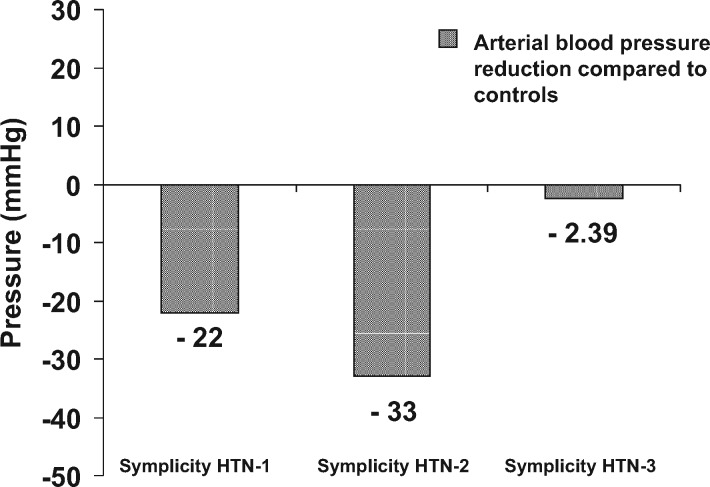
Initial studies on renal denervation (RDN) for the treatment of non-controlled arterial hypertension (HTN) through radiofrequency ablation of renal arteries demonstrated that RDN is an effective therapeutic strategy to reduce arterial blood pressure (BP). Nonetheless, the first randomized study, SYMPLICITY-HTN-3, failed to demonstrate a clear benefit for RND over the control group. Technologic evolution, with the introduction of new second generation multi-electrode devices, allowed deep energy delivery along the full circumference of the vessel. Two recent randomized studies involving patients assuming (SPYRAL HTN-ON MED) or not (SPYRAL HTN-OFF MED) antihypertensive pharmacologic treatment, demonstrated the efficacy and safety of RDN using second generation systems for radiofrequency ablation. Another recent randomized study demonstrated that RDN with ultrasounds (RADIANCE-HTN SOLO) of the main renal arteries led to a significant BP reduction compared to the control group. These studies have once again raised the interest of the scientific community towards attempting to define the appropriate role of RDN in the treatment of hypertension. Nonetheless, larger and longer clinical trials will be necessary to draw further conclusions.
最初关于通过肾动脉射频消融治疗难治性动脉高血压(HTN)的肾去神经支配(RDN)研究表明,RDN是降低动脉血压(BP)的有效治疗策略。尽管如此,第一项随机研究SYMPLICITY-HTN-3未能证明RDN相对于对照组有明显益处。随着新一代多电极设备的引入,技术不断发展,使得能量能够沿血管全周进行深度传递。最近两项随机研究,一项涉及正在接受(SPYRAL HTN-ON MED)或未接受(SPYRAL HTN-OFF MED)抗高血压药物治疗的患者,证明了使用第二代射频消融系统进行RDN的有效性和安全性。另一项最近的随机研究表明,与对照组相比,对主要肾动脉进行超声引导下的RDN(RADIANCE-HTN SOLO)可显著降低血压。这些研究再次引起了科学界对试图确定RDN在高血压治疗中适当作用的兴趣。尽管如此,仍需要进行更大规模、更长时间的临床试验才能得出进一步结论。