Schudy Anna, Żurek Karolina, Wiśniewska Marcelina, Piejka Aleksandra, Gawȩda Łukasz, Okruszek Łukasz
Department of Cognitive Psychology and Neurocognition, Faculty of Psychology, University of Warsaw, Warsaw, Poland.
Social Neuroscience Laboratory, Institute of Psychology, Polish Academy of Sciences, Warsaw, Poland.
Front Psychiatry. 2020 Nov 5;11:589973. doi: 10.3389/fpsyt.2020.589973. eCollection 2020.
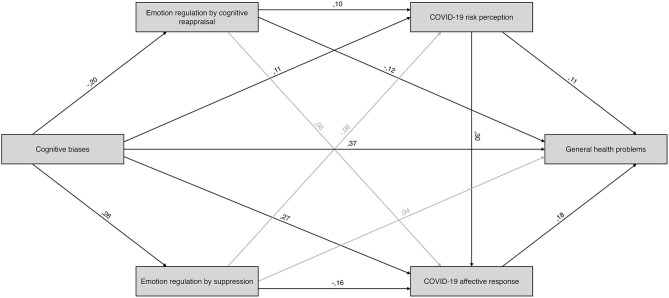
Both cognitive appraisals of risks associated with the specific disease and affective response to crisis situations have been shown to shape an individual response to pandemics. COVID-19 pandemic and measures introduced to contain it present an unparalleled challenge to mental well-being worldwide. Here, we examine the relationship between self-reported cognitive biases (CB) and emotion regulation skills (ER), COVID-19 risk perception and affective response, and mental well-being (MWB). Five Hundred and Eleven individuals completed General Health Questionnaire, Emotion Regulation Questionnaire, Davos Assessment of Cognitive Biases Scale (DACOBS) as well as scales measuring COVID-19 risk perception and affective response during the initial days of the epidemic in Poland. We used path and bootstrapping analyses to examine the hypothesis that CB may shape MWB during COVID-19 pandemic both directly and indirectly by (i) decreasing ER capacity and (ii) by increasing COVID-19 risk perception and affective response. Negative effect of CB and positive effect of ER via cognitive reappraisal on MWB were observed in participants. Furthermore, in line with our hypothesis, we observed indirect effects of CB via increased COVID-19 risk perception and affective response and decreased use of reappraisal strategy, which all, in turn, were related to MWB. Finally, we found an indirect effect of CB on MWB through double mediation of suppression strategies and COVID-19 affective response. Results of the current study suggest that CB, which have been shown to be linked to a variety of mental health symptoms in non-clinical populations, may exacerbate the impact of the COVID-19 pandemic on mental health outcomes.
与特定疾病相关的风险认知评估以及对危机情况的情感反应,都已被证明会塑造个体对大流行的反应。新冠疫情及其防控措施给全球心理健康带来了前所未有的挑战。在此,我们研究了自我报告的认知偏差(CB)与情绪调节技能(ER)、新冠风险认知与情感反应以及心理健康(MWB)之间的关系。511名个体在波兰疫情初期完成了一般健康问卷、情绪调节问卷、达沃斯认知偏差评估量表(DACOBS)以及测量新冠风险认知和情感反应的量表。我们使用路径分析和自抽样分析来检验这一假设:在新冠疫情期间,CB可能通过(i)降低ER能力以及(ii)增加新冠风险认知和情感反应,直接和间接地影响MWB。在参与者中观察到了CB的负面影响以及ER通过认知重评对MWB的积极影响。此外,与我们的假设一致,我们观察到CB通过增加新冠风险认知和情感反应以及减少重评策略的使用而产生的间接影响,而这些又都与MWB相关。最后,我们发现CB通过抑制策略和新冠情感反应的双重中介对MWB产生间接影响。本研究结果表明,在非临床人群中已被证明与多种心理健康症状相关的CB,可能会加剧新冠疫情对心理健康结果的影响。