Zhu Tianwen, Gong Xiaohui, Bei Fei, Ma Li, Chen Yan, Zhang Yonghong, Wang Xia, Sun Jingjing, Wang Jian, Qiu Gang, Sun Jianhua, Sun Yu, Zhang Yongjun
Department of Neonatology, Xinhua Hospital, Shanghai Jiao Tong University School of Medicine, Shanghai, China.
Department of Neonatology, Shanghai Children's Hospital, Shanghai Jiao Tong University School of Medicine, Shanghai, China.
Front Genet. 2020 Nov 6;11:565078. doi: 10.3389/fgene.2020.565078. eCollection 2020.
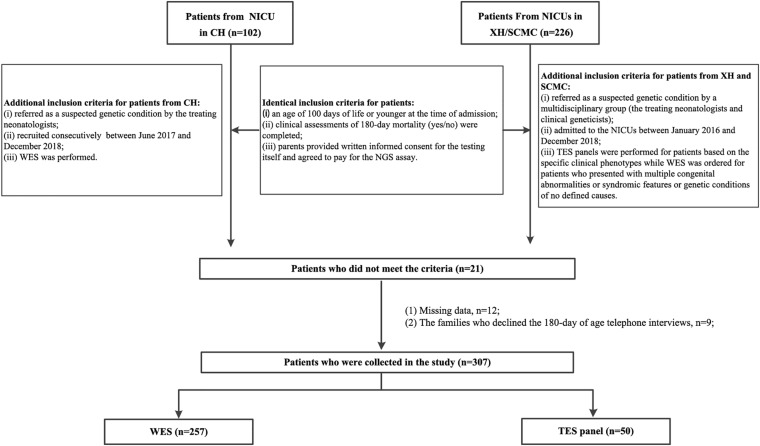
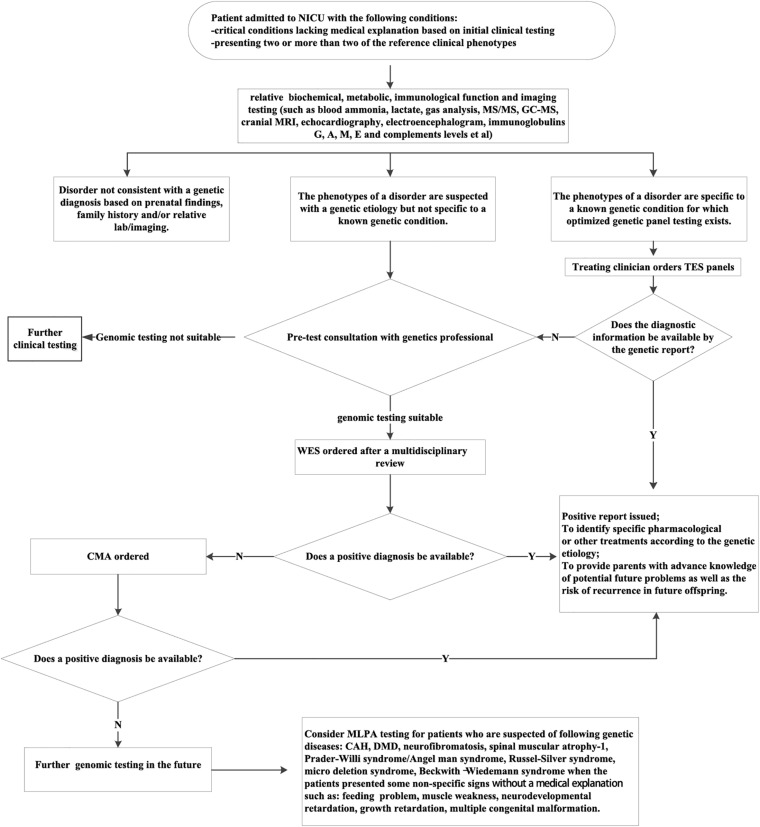
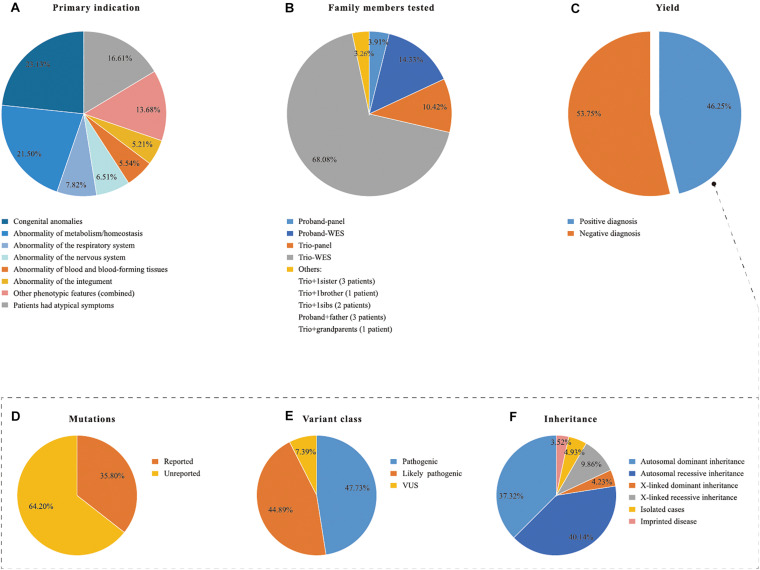
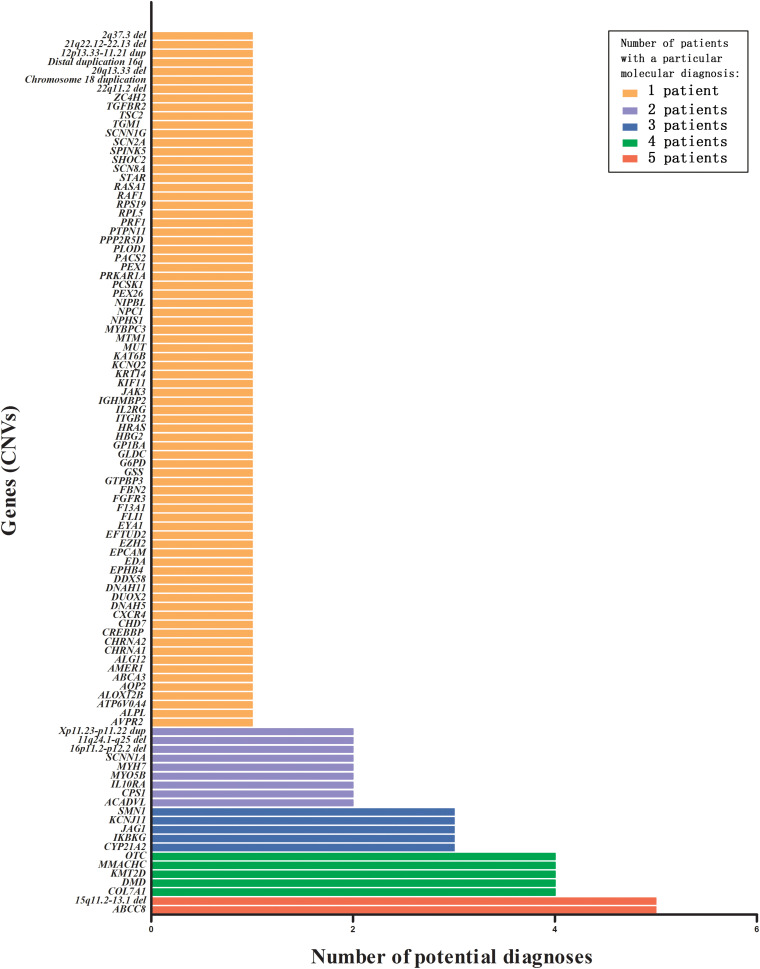
To identify next-generation-sequencing (NGS) clinical usability and to propose a standard diagnostic routine for critically ill infants, aged less than 100 days and suspected of having a genetically heterogeneous condition, a retrospective study was conducted between January 2016 and December 2018 at neonatal intensive care units (NICUs) of three tertiary hospitals in Shanghai, China. Whole-exome sequencing (WES) or panel sequencing was performed on 307 patients. Trio-WES, trio-panel, proband-WES, and proband-panel diagnostic yields were 39.71% (83/209), 68.75% (22/32), 59.09% (26/44), and 33.33% (4/12), respectively. Definitive molecular diagnoses of 142 infants (46.25%) uncovered 99 disorders; 21 disorders displayed on 44.37% of the diagnosed patients. Genetic etiologies were identified for 61.73% (50/81) of the deceased infants. One in three (29.58%) diagnosed infants exhibited one of the following four clinical traits which had a higher odds of diagnostic rate: integument abnormality (adjusted odds ratio [aOR], 19.7; 95% confidence interval [CI], 2.5-156.3), complex immune-related phenotypes (aOR, 9.2; 95% CI, 1.4-83.5), mixed nervous system phenotypes and congenital anomalies (aOR, 5.0; 95% CI, 1.3-19.1), or mixed metabolism and nervous system phenotypes (aOR, 4.5; 95% CI, 1.0-21.5). Our results demonstrated that NGS was an effective diagnostic tool. Infants exhibiting integument, complex immune-related conditions, metabolism, and nervous signs have higher chances of carrying variants in known disease-causing genes. The number of specific phenotypes could be used as an independent predictor of a positive molecular diagnosis, rather than an isolated abnormality. We developed a molecular diagnostic procedure for the use of NGS for diagnosis in Chinese NICU population based on individual characteristics.
为了确定下一代测序(NGS)的临床实用性,并为年龄小于100天且疑似患有基因异质性疾病的危重症婴儿提出标准诊断流程,于2016年1月至2018年12月在中国上海的三家三级医院的新生儿重症监护病房(NICU)进行了一项回顾性研究。对307例患者进行了全外显子组测序(WES)或基因panel测序。三联体-WES、三联体-panel、先证者-WES和先证者-panel的诊断率分别为39.71%(83/209)、68.75%(22/32)、59.09%(26/44)和33.33%(4/12)。142例婴儿(46.25%)得到明确的分子诊断,发现了99种疾病;44.37%的确诊患者表现出21种疾病。在死亡婴儿中,61.73%(50/81)确定了遗传病因。三分之一(29.58%)的确诊婴儿表现出以下四种临床特征之一,其诊断率较高:皮肤异常(调整优势比[aOR],19.7;95%置信区间[CI],2.5-156.3)、复杂的免疫相关表型(aOR,9.2;95%CI,1.4-83.5)、混合的神经系统表型和先天性异常(aOR,5.0;95%CI,1.3-19.1)或混合的代谢和神经系统表型(aOR,4.5;95%CI,1.0-21.5)。我们的结果表明,NGS是一种有效的诊断工具。表现出皮肤、复杂免疫相关疾病、代谢和神经体征的婴儿携带已知致病基因变异的机会更高。特定表型的数量可作为分子诊断阳性的独立预测指标,而不是孤立的异常情况。我们基于个体特征开发了一种分子诊断程序,用于在中国NICU人群中使用NGS进行诊断。