Heredia-Soto V, López-Guerrero J A, Redondo A, Mendiola M
Translational Oncology Research Laboratory, La Paz University Hospital Biomedical Research Institute, IdiPAZ, Paseo de La Castellana 261, 28046, Madrid, Spain.
Centro de Investigación Biomédica en Red de Cáncer, CIBERONC, Instituto de Salud Carlos III, Monforte de Lemos 5, Madrid, 28029, Spain.
EJC Suppl. 2020 Aug 22;15:49-55. doi: 10.1016/j.ejcsup.2019.11.003. eCollection 2020 Aug.
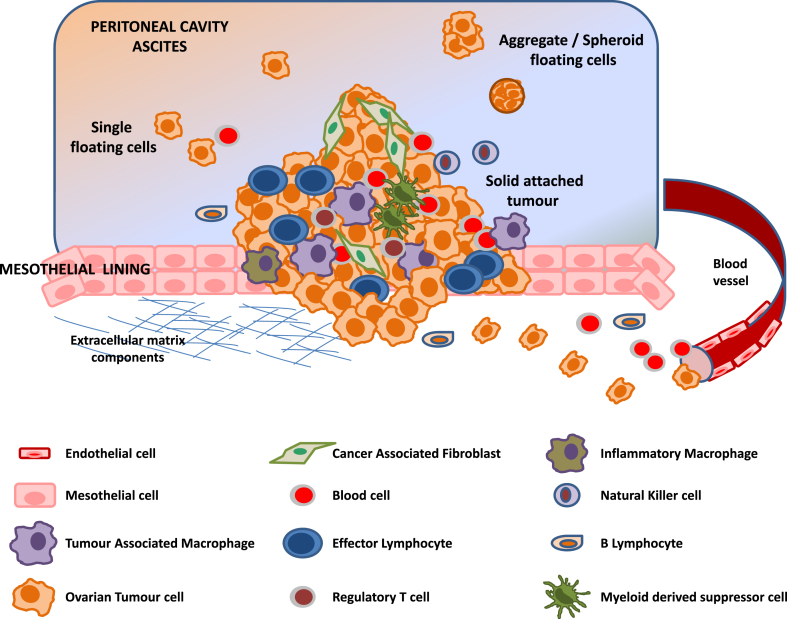
Cancers develop by sustained growth, migration and invasion properties of tumour cells, supported by complex interactions with stromal cells within the tumour micro-environment. This review is focused on the latest discoveries regarding the highlighted role of angiogenesis and tumour micro-environment in ovarian cancer. This cancer milieu encompasses non-cancerous cells present in the tumour or nearby, including vessel-forming cells, fibroblasts and immune cells amongst others that work in a cooperative way with cancer cells, impacting tumour behaviour. Angiogenesis, migration and invasion, and more recently immune evasion, are cancer hallmarks clearly dependent on these supporting cells. Moreover, these stromal cells are more genetically stable than tumour cells and thus represent an attractive therapeutic target. A better understanding of the stromal cells function, and their complex interplay with cancer cells, will open additional areas to target, as the tumour-host interface.
癌症是由肿瘤细胞持续的生长、迁移和侵袭特性发展而来的,肿瘤微环境中的基质细胞与之发生复杂相互作用,对其起到支持作用。本综述聚焦于血管生成和肿瘤微环境在卵巢癌中所起突出作用的最新发现。这种癌症环境包括肿瘤内或附近存在的非癌细胞,其中血管生成细胞、成纤维细胞和免疫细胞等与癌细胞协同作用,影响肿瘤行为。血管生成、迁移和侵袭,以及最近发现的免疫逃逸,都是明显依赖于这些支持细胞的癌症标志。此外,这些基质细胞比肿瘤细胞具有更高的遗传稳定性,因此是一个有吸引力的治疗靶点。更好地理解基质细胞的功能及其与癌细胞的复杂相互作用,将开辟更多作为肿瘤-宿主界面的靶向治疗领域。