McConnell John W, Tsang Yuen, Pruett Janis, Iii William Drake
Kentuckiana Pulmonary Research Center, Kentuckiana Pulmonary Associates, Louisville, KY, USA.
Medical Managed Markets and Health Economics & Outcomes Research, Actelion Pharmaceuticals US, Inc., a Janssen Pharmaceutical Company of Johnson & Johnson, South San Francisco, CA, USA.
Pulm Circ. 2020 Nov 10;10(4):2045894020911831. doi: 10.1177/2045894020911831. eCollection 2020 Oct-Dec.
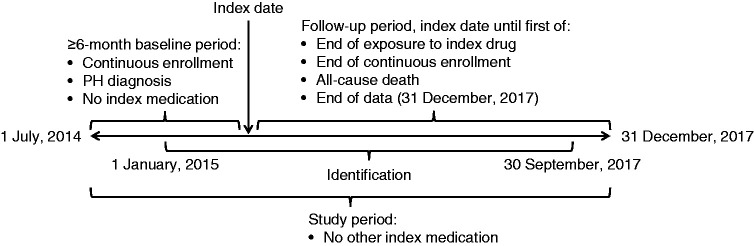
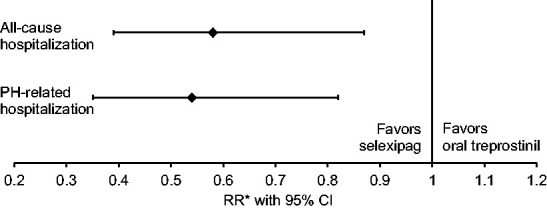
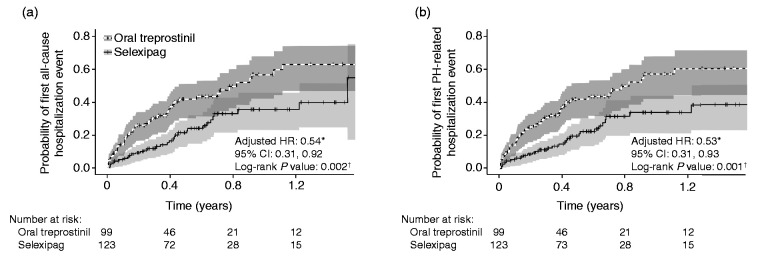
Two oral medications targeting the prostacyclin pathway are available to treat pulmonary arterial hypertension in the United States: oral treprostinil and selexipag. We compared real-world hospitalization in patients receiving these medications. A retrospective administrative claims study was conducted using the Optum® Clinformatics® Data Mart database. Patients with pulmonary hypertension were identified using diagnostic codes. Cohort inclusion required age ≥ 18 years, first oral treprostinil or selexipag prescription between 1 January 2015 and 30 September 2017 (index date), and continuous enrollment in the prior ≥6 months. Patients who switched index drug were excluded. Follow-up was from index date until the first of end of index drug exposure, end of continuous enrollment, death, or 31 December 2017. Multivariable Cox proportional hazard and Poisson regression were used to compare risk and rate, respectively, of hospitalization associated with oral treprostinil vs. selexipag, adjusting for potential confounders. The study cohort included 99 patients receiving oral treprostinil and 123 receiving selexipag. Mean age was 61 years, and most patients were females (71%). Compared with oral treprostinil, selexipag was associated with a 46% lower risk of all-cause hospitalization (hazard ratio 0.54, 95% confidence interval 0.31, 0.92; = 0.02), a 47% lower risk of pulmonary hypertension-related hospitalization (hazard ratio 0.53, 95% confidence interval 0.31, 0.93; = 0.03), a 42% lower all-cause hospitalization rate (rate ratio 0.58, 95% confidence interval 0.39, 0.87; = 0.01), and a 46% lower pulmonary hypertension-related hospitalization rate (rate ratio 0.54, 95% confidence interval 0.35, 0.82; = 0.004). This study suggests that selexipag is associated with lower hospitalization risk and rate than oral treprostinil.
在美国,有两种针对前列环素途径的口服药物可用于治疗肺动脉高压:口服曲前列尼尔和司来帕格。我们比较了接受这些药物治疗的患者的实际住院情况。利用Optum® Clinformatics® Data Mart数据库进行了一项回顾性管理索赔研究。使用诊断编码识别肺动脉高压患者。队列纳入标准要求年龄≥18岁,在2015年1月1日至2017年9月30日之间首次开具口服曲前列尼尔或司来帕格处方(索引日期),并且在之前连续登记≥6个月。更换索引药物的患者被排除。随访从索引日期开始,直至索引药物暴露结束、连续登记结束、死亡或2017年12月31日。分别使用多变量Cox比例风险模型和泊松回归来比较与口服曲前列尼尔和司来帕格相关的住院风险和发生率,并对潜在混杂因素进行调整。研究队列包括99例接受口服曲前列尼尔的患者和123例接受司来帕格的患者。平均年龄为61岁,大多数患者为女性(71%)。与口服曲前列尼尔相比,司来帕格与全因住院风险降低46%相关(风险比0.54,95%置信区间0.31,0.92;P = 0.02),与肺动脉高压相关住院风险降低47%相关(风险比0.53,95%置信区间0.31,0.93;P = 0.03),全因住院率降低42%(率比0.58,95%置信区间0.39,0.87;P = 0.01),以及肺动脉高压相关住院率降低46%(率比0.54,95%置信区间0.35,0.82;P = 0.004)。这项研究表明,司来帕格与比口服曲前列尼尔更低的住院风险和发生率相关。