Santana André Marcos, da Silva Daniela Gomes, Maluta Renato Pariz, Pizauro Lucas José Luduverio, Simplício Kalina Maria de Medeiros Gomes, Santana Clarissa Helena, Rodrigues Sarah de Andrade Dias, Rodrigues Dália Dos Prazeres, Fagliari José Jurandir
Department of Veterinary Medicine, Maringá State University (UEM), Maringá, Brazil.
Department of Veterinary Clinic and Surgery, School of Agricultural and Veterinary Sciences, São Paulo State University (FCAV/UNESP), São Paulo, Brazil.
Front Vet Sci. 2020 Nov 10;7:552413. doi: 10.3389/fvets.2020.552413. eCollection 2020.
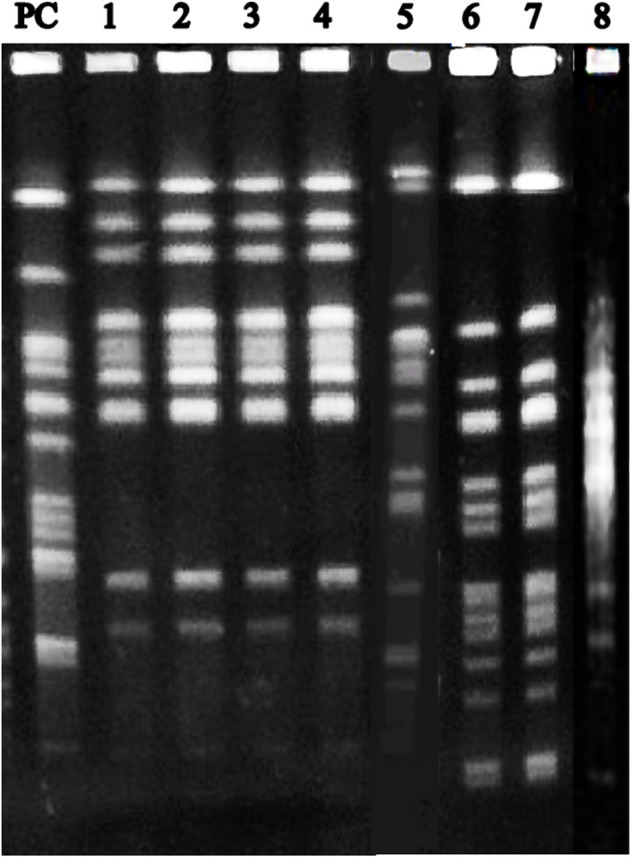
Buffaloes and pigs play an important epidemiological roll in the infection cycle, and asymptomatic animals can act as key component in the dissemination of the disease by horizontal, vertical, and cross-species transmission. Our study aimed and was able to confirm evidences of a cross-species transmission of Agona between asymptomatic buffaloes and pigs. Also, we described infection within the pig production phases, involving serotypes Agona, Senftenberg and Schwarzengrund. Rectal samples were collected from Jafarabadi buffaloes ( = 25) and Piau pigs ( = 32), located on a single farm. Agona was isolated from lactating buffaloes, gilts, pregnant sows, and weaned pigs, Schwarzengrund from lactating sows and Senftenberg from gilts, pregnant sows, lactating sows, and weaned pigs. Pulsed-field Gel Electrophoresis protocol (PFGE) was performed and revealed four different profiles. Profile 1 ( Agona), isolated from a pregnant sow, a gilt and two lactating buffaloes, revealed a indistinguishable PFGE pattern, confirming evidences of potential cross-species transmission. Profile 2 ( Agona), 3 ( Senftenberg), and 4 ( Schwarzengrund), isolated from pigs, revealed important indistinguishable PFGE patterns, evidencing infection within the pig production phases. Considering the epidemiological relevance of buffaloes and pigs in the cycle of infection, confirmation of a potential cross-species transmission of Agona and potential infection within the pig production phases highlights the importance of the correct establishment of preventive health strategies in farms, in special the importance of avoiding contact between buffaloes and pigs, since cross-species transmission can occur, increasing the risk of spreading the disease.
水牛和猪在感染循环中起着重要的流行病学作用,无症状动物可通过水平、垂直和跨物种传播成为疾病传播的关键因素。我们的研究旨在并能够证实无症状水牛和猪之间存在阿哥纳菌的跨物种传播证据。此外,我们描述了猪生产阶段内的感染情况,涉及阿哥纳、森夫滕贝格和施瓦岑格鲁德血清型。从位于单个农场的贾法拉巴迪水牛(n = 25)和皮奥猪(n = 32)中采集直肠样本。从泌乳水牛、后备母猪、怀孕母猪和断奶仔猪中分离出阿哥纳菌,从泌乳母猪中分离出施瓦岑格鲁德菌,从后备母猪、怀孕母猪、泌乳母猪和断奶仔猪中分离出森夫滕贝格菌。进行了脉冲场凝胶电泳分析(PFGE),结果显示有四种不同的图谱。图谱1(阿哥纳菌)分离自一头怀孕母猪、一头后备母猪和两头泌乳水牛,显示出难以区分的PFGE模式,证实了潜在跨物种传播的证据。图谱2(阿哥纳菌)、3(森夫滕贝格菌)和4(施瓦岑格鲁德菌)分离自猪,显示出重要的难以区分的PFGE模式,证明了猪生产阶段内的感染情况。考虑到水牛和猪在感染循环中的流行病学相关性,阿哥纳菌潜在跨物种传播以及猪生产阶段内潜在感染的证实凸显了在农场正确制定预防保健策略的重要性,特别是避免水牛和猪接触的重要性,因为可能发生跨物种传播,增加疾病传播风险。