Department of Surgery, Federal University of Minas Gerais, Medical School, and Rede Mater Dei, Belo Horizonte, Brazil.
Hospital Israelita Albert Einstein, São Paulo, Brazil.
JPEN J Parenter Enteral Nutr. 2021 Sep;45(7):1542-1550. doi: 10.1002/jpen.2052. Epub 2020 Dec 21.
Malnutrition is highly prevalent in hospitalized patients but seldom recognized and treated. Malnutrition poses several adverse events, such as increased infection rates, length of hospital stay, and mortality, as well as costs. Early nutrition interventions have been shown to decrease the associated malnutrition burdens, leading to relevant savings. Thus, this study aims to evaluate the cost-effectiveness of nutrition therapy, including oral supplements to at-risk or malnourished adult inpatients admitted to the Brazilian Public System (SUS) hospitals.
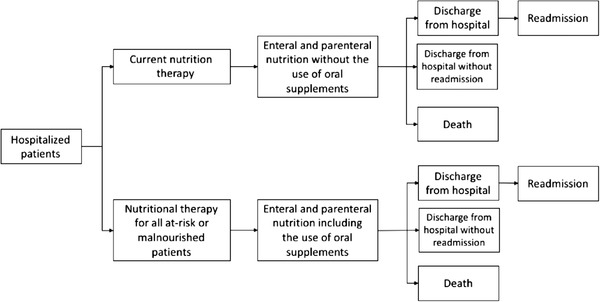
A cost-effectiveness model, encompassing a 1-year period and regarding total costs, length of hospital stay, readmissions, and mortality related to malnutrition, was developed, having the provision of early nutrition therapy as the intervention variable. The number of avoided hospitalization days, prevented hospital readmissions, and prevented deaths defined the effectiveness of the model. All the costs were estimated based on the SUS database.
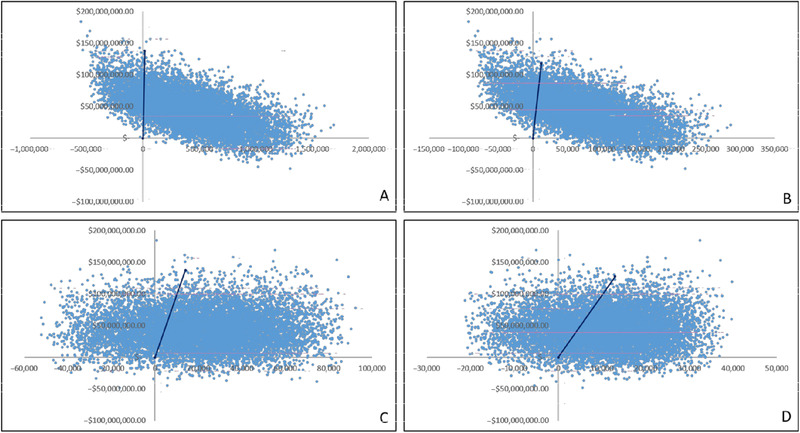
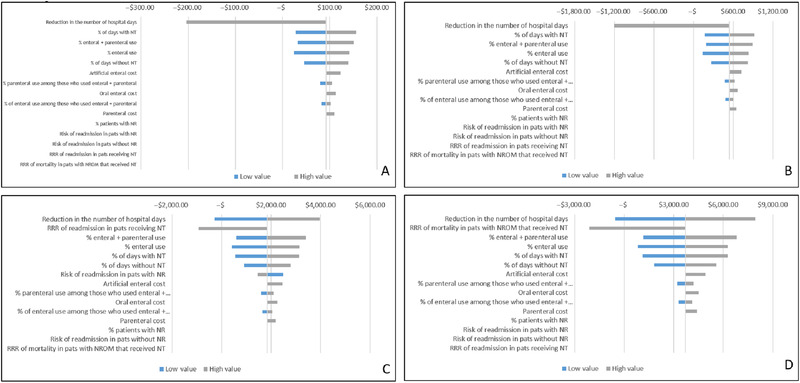
Early nutrition therapy provided to all at-risk or malnourished patients would represent cost-effectiveness of US $92.24, US $544.59, US $1848.12, and US $3698.92, for each day of hospitalization avoided, for additional patients having access to hospitalization, for preventing readmission, and for prevented death, respectively. The highest impact on savings was represented by the mean reduction in the length of hospital stay.
Early oral nutrition intervention for patients malnourished or at risk of malnutrition resulted in overall reduced hospital costs. These findings provide a rationale to tackle the implementation of educational programs focusing on the care of inpatients with malnutrition or its risk.
营养不良在住院患者中非常普遍,但很少被识别和治疗。营养不良会导致多种不良事件,如感染率增加、住院时间延长、死亡率增加以及医疗费用增加。早期营养干预已被证明可以减轻相关的营养不良负担,从而节省相关费用。因此,本研究旨在评估营养治疗的成本效益,包括对有风险或营养不良的成年住院患者(巴西公共系统[SUS]医院)提供口服补充剂。
开发了一个成本效益模型,涵盖了 1 年的时间,考虑了总费用、住院时间、再入院和与营养不良相关的死亡率,将早期营养治疗的提供作为干预变量。避免住院天数、预防医院再入院和预防死亡的数量定义了该模型的有效性。所有成本均根据 SUS 数据库进行估算。
对所有有风险或营养不良的患者进行早期营养治疗,将分别使住院日的成本效益达到 92.24 美元、544.59 美元、1848.12 美元和 3698.92 美元,每避免一天住院、每增加一名可获得住院治疗的患者、每预防一次再入院和每预防一次死亡。对节省成本的影响最大的是平均住院时间的缩短。
对营养不良或有营养不良风险的患者进行早期口服营养干预可降低总体住院费用。这些发现为实施以营养不良或其风险患者护理为重点的教育计划提供了依据。