Department of Physiology and Biophysics, Weill Cornell Medicine, New York, NY 10021, USA; Interdisciplinary Program in Neuroscience, George Mason University, Fairfax, VA 22030, USA.
Department of Physiology and Biophysics, Weill Cornell Medicine, New York, NY 10021, USA.
Cell Rep. 2020 Dec 8;33(10):108429. doi: 10.1016/j.celrep.2020.108429. Epub 2020 Nov 25.
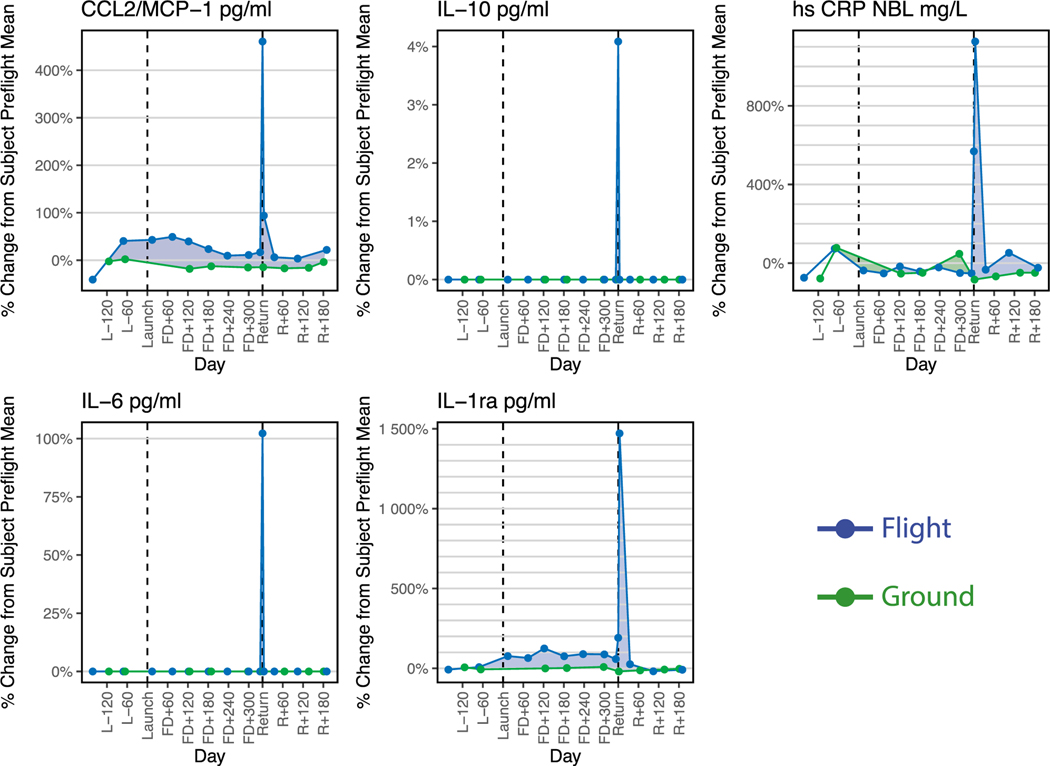
The National Aeronautics and Space Administration (NASA) Twins Study created an integrative molecular profile of an astronaut during NASA's first 1-year mission on the International Space Station (ISS) and included comparisons to an identical Earth-bound twin. The unique biochemical profiles observed when landing on Earth after such a long mission (e.g., spikes in interleukin-1 [IL-1]/6/10, c-reactive protein [CRP], C-C motif chemokine ligand 2 [CCL2], IL-1 receptor antagonist [IL-1ra], and tumor necrosis factor alpha [TNF-α]) opened new questions about the human body's response to gravity and how to plan for future astronauts, particularly around initiation or resolution of inflammation. Here, single-cell, multi-omic (100-plex epitope profile and gene expression) profiling of peripheral blood mononuclear cells (PBMCs) showed changes to blood cell composition and gene expression post-flight, specifically for monocytes and dendritic cell precursors. These were consistent with flight-induced cytokine and immune system stress, followed by skeletal muscle regeneration in response to gravity. Finally, we examined these profiles relative to 6-month missions in 28 other astronauts and detail potential pharmacological interventions for returning to gravity in future missions.
美国国家航空航天局(NASA)双胞胎研究在国际空间站(ISS)上进行了为期 1 年的首次任务期间,对宇航员进行了综合分子分析,并与地球上的同卵双胞胎进行了比较。在执行如此长时间的任务后返回地球时观察到的独特生化特征(例如白细胞介素 1[IL-1]/6/10、C 反应蛋白[CRP]、C 型趋化因子配体 2[CCL2]、白细胞介素 1 受体拮抗剂[IL-1ra]和肿瘤坏死因子α [TNF-α])出现了一些新问题,这些问题涉及到人体对重力的反应以及如何为未来的宇航员做好准备,特别是在炎症的开始或解决方面。在这里,对外周血单核细胞(PBMC)进行的单细胞、多组学(100 个表位图谱和基因表达)分析显示,飞行后血液细胞成分和基因表达发生了变化,特别是单核细胞和树突状细胞前体。这些变化与飞行引起的细胞因子和免疫系统应激有关,随后是为适应重力而进行的骨骼肌再生。最后,我们根据其他 28 名宇航员进行的为期 6 个月的任务检查了这些特征,并详细介绍了未来任务中重返重力状态的潜在药物干预措施。