Institute of Nursing Science and Practice, Paracelsus Medical University, Salzburg, Austria.
Institute of General Practice, Family Medicine and Preventive Medicine, Paracelsus Medical University, Salzburg, Austria.
BMC Geriatr. 2020 Nov 26;20(1):506. doi: 10.1186/s12877-020-01895-z.
In nursing home residents (NHRs), polypharmacy is widespread, accompanied by elevated risks of medication related complications. Managing medication in NHRs is a priority, but prone to several challenges, including interprofessional cooperation. Against this background, we implemented and tested an interprofessional intervention aimed to improve medication appropriateness for NHRs.
A non-randomized controlled study (SiMbA; "Sicherheit der Medikamentherapie bei AltenheimbewohnerInnen", Safety of medication therapy in NHRs) was conducted in six nursing homes in Austria (2016-2018). Educational training, introduction of tailored health information technology (HIT) and a therapy check process were combined in an intervention aimed at healthcare professionals. Medication appropriateness was assessed using the Medication Appropriateness Index (MAI). Data was collected before (t0), during (t1, month 12) and after (t2, month 18) intervention via self-administered assessments and electronic health records.
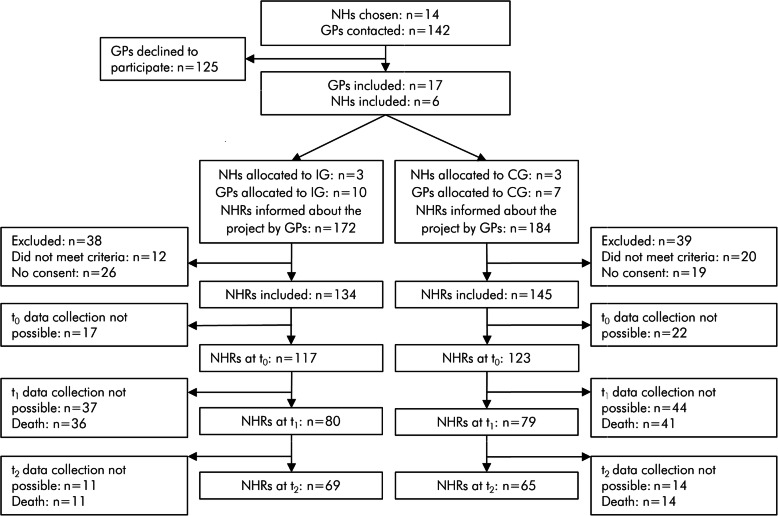
We included 6 NHs, 17 GPs (52.94% female) and 240 NHRs (68.75% female; mean age 85.0). Data of 159 NHRs could be included in the analysis. Mean MAI-change was - 3.35 (IG) vs. - 1.45 (CG). In the subgroup of NHRs with mean MAI ≥23, MAI-change was - 10.31 (IG) vs. -3.52 (CG). The intervention was a significant predictor of improvement in MAI when controlled for in a multivariable regression model.
Improvement of medication appropriateness was clearest in residents with inappropriate baseline MAI-scores. This improvement was independent of variances in certain covariates between the intervention and the control group. We conclude that our intervention is a feasible approach to improve NHRs' medication appropriateness.
DRKS Data Management, ID: DRKS00012246 . Registered 16.05.2017 - Retrospectively registered.
在养老院居民(NHR)中,多种药物治疗很普遍,伴随着药物相关并发症的风险增加。管理 NHR 的药物治疗是当务之急,但容易出现多个挑战,包括跨专业合作。在此背景下,我们实施并测试了一种旨在提高 NHR 药物治疗适当性的跨专业干预措施。
一项非随机对照研究(SiMbA;“Sicherheit der Medikamentherapie bei AltenheimbewohnerInnen”,养老院居民药物治疗的安全性)在奥地利的六家养老院进行(2016-2018 年)。教育培训、引入定制的健康信息技术(HIT)和治疗检查过程结合在一起,针对医疗保健专业人员进行干预。使用药物适宜性指数(MAI)评估药物适宜性。在干预前(t0)、期间(t1,第 12 个月)和干预后(t2,第 18 个月)通过自我评估和电子健康记录收集数据。
我们纳入了 6 家养老院、17 名全科医生(52.94%为女性)和 240 名 NHR(68.75%为女性;平均年龄 85.0 岁)。159 名 NHR 的数据可纳入分析。平均 MAI 变化为-3.35(IG)与-1.45(CG)。在平均 MAI≥23 的 NHR 亚组中,MAI 变化为-10.31(IG)与-3.52(CG)。在多变量回归模型中,控制干预组和对照组之间某些协变量的方差后,干预是 MAI 改善的显著预测因子。
在基线 MAI 评分不适当的居民中,药物适宜性的改善最为明显。这种改善独立于干预组和对照组之间某些协变量的差异。我们得出结论,我们的干预措施是改善 NHR 药物治疗适当性的可行方法。
DRKS 数据管理,ID:DRKS00012246。注册日期:2017 年 5 月 16 日。