Patten Christi A, Juhn Young J, Ryu Euijung, Wi Chung-Il, King Katherine S, Bublitz Josh T, Pignolo Robert J
Department of Psychiatry and Psychology, Mayo Clinic, Rochester, MN, USA.
Department of Pediatric and Adolescent Medicine, Mayo Clinic, Rochester, MN, USA.
J Clin Transl Sci. 2020 Mar 24;4(5):408-415. doi: 10.1017/cts.2020.27.
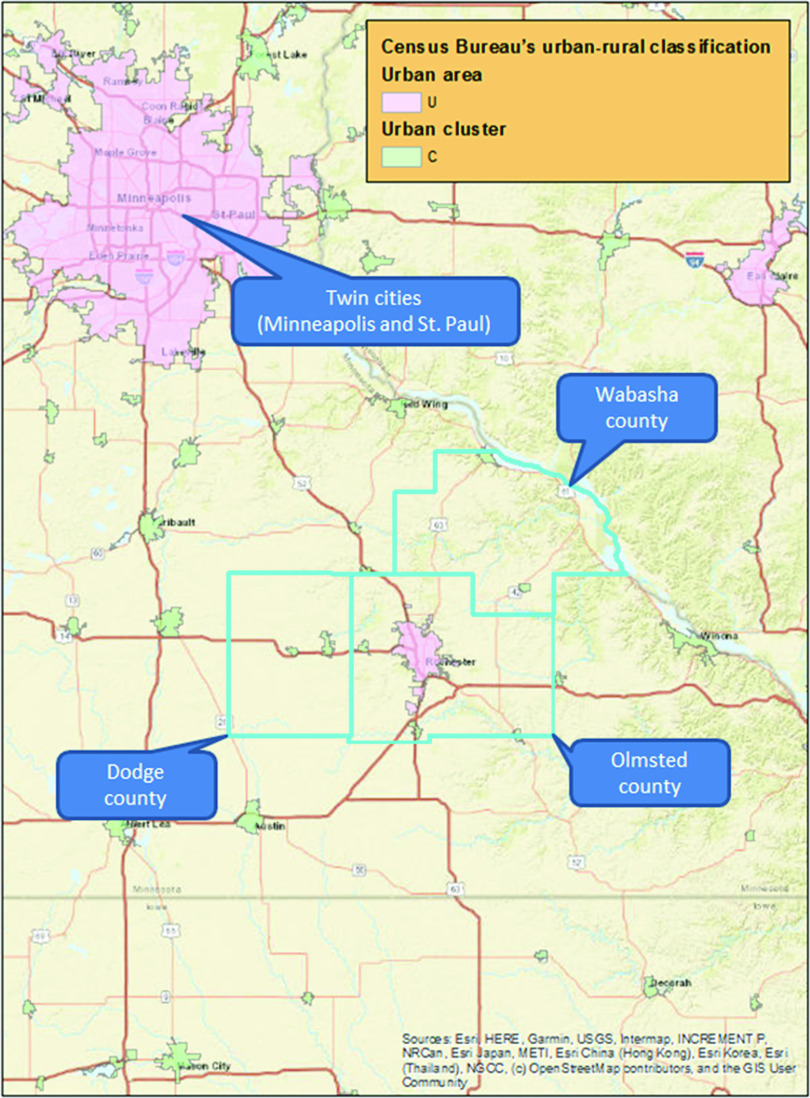
Prior studies indicate greater disease burden for obesity among rural compared with urban residents but no differences for mood disorder based on geographic location. Recent attention has focused on the need to examine regional rural-urban disparities in disease burden. We focused on mood disorders and obesity prevalence within three southeastern Minnesota counties served by the Mayo Clinic Center for Translational Science Award, in Rochester, Minnesota, as these were top priorities identified in community health needs assessments.
Cross-sectional study to assess the association of rural-urban locality on 5-year (2009-2014) prevalence of mood disorder and obesity obtained using the Rochester Epidemiological Project medical records linkage system, among subjects residing in three mixed rural-urban counties on April 1, 2014. Multivariable analyses adjusted for demographics, socioeconomic status using an individual housing-based measure, and counties.
The study cohort (percent rural location) included 91,202 (15%) for Olmsted, 10,197 (51%) in Dodge, and 10,184 (57%) in Wabasha counties. On multivariate analysis, 5-year prevalence of mood disorders and obesity was significantly greater for urban compared with rural residents, after adjusting for confounders; odds ratios (95% confidence intervals): 1.21 (1.17-1.26), < 0.001, and 1.05 (1.01-1.10), = 0.016, respectively. Observed effects were not modified in additional models adjusted for health care utilization (HCU; ≥1 general medical examination visit and flu vaccination).
Rural-urban health disparities for burden of mood disorders and obesity are independent of socioeconomic status and HCU in a Midwestern community. It is important to assess potential regional heterogeneity of rural-urban disparities on health outcomes.
先前的研究表明,与城市居民相比,农村居民肥胖的疾病负担更重,但基于地理位置的情绪障碍并无差异。最近的关注焦点集中在研究疾病负担方面的区域城乡差异的必要性上。我们聚焦于明尼苏达州罗切斯特市梅奥诊所转化科学奖中心所服务的明尼苏达州东南部三个县内的情绪障碍和肥胖患病率,因为这些是社区健康需求评估中确定的首要优先事项。
一项横断面研究,旨在评估城乡居住地与2009 - 2014年5年间情绪障碍和肥胖患病率之间的关联,数据通过罗切斯特流行病学项目医疗记录链接系统获取,研究对象为2014年4月1日居住在三个城乡混合县的居民。多变量分析对人口统计学、使用基于个人住房的指标衡量的社会经济地位以及各县进行了调整。
研究队列(农村地区所占百分比)包括奥尔姆斯特德县的91,202人(15%)、道奇县的10,197人(51%)和瓦巴沙县的10,184人(57%)。在多变量分析中,在对混杂因素进行调整后,城市居民的情绪障碍和肥胖5年患病率显著高于农村居民;比值比(95%置信区间)分别为:1.21(1.17 - 1.26),< 0.001,以及1.05(1.01 - 1.10),= 0.016。在针对医疗保健利用情况(≥1次普通体检就诊和流感疫苗接种)进行调整的其他模型中,观察到的效应未发生改变。
在中西部社区,情绪障碍和肥胖负担方面的城乡健康差异独立于社会经济地位和医疗保健利用情况。评估城乡差异对健康结果的潜在区域异质性非常重要。